MOVED !!! The 2017 Huddleston Cup Regatta

ALERTA !!! MOVED TO JUNE 17th and JUNE 18th !!

huddleston


MOVED !!! NOTE: NEW DATE
Come one, come all to our first race of the season! The Huddleston Cup will be held on SaturdayJUNE 17th and Sunday JUNE 18th. Please contact Bill Miller – Vice Commodore, if you want to serve on the Committee boat. Skippers Meeting at 10am Saturday and Sunday, with racing starting soon after. Saturday morning will include breakfast. Saturday night we will have a meal for $10. Racing will be $25/boat includes both days.

Heading Up by Lee Huddleston

In last month’s Good Old Boat magazine the editors did a review of the O’Day 25. And, yes, they really did contact me to get my opinions. Most of the comments in the article were fair and accurate. They rated the O’Day pretty highly except for one deficiency according to their experience. They found that the boat they were testing had trouble pointing up into the wind as much as they would have liked. That was definitely contrary to what I told them. I explained that I had been racing my O’Day for over 37 years and winning numerous club races and a few Club Championships and regattas (including my class in the Kentucky 100). One of the factors that enabled me to win those races was the ability to point my O’Day higher than most other cruisers against whom I was sailing. So, it is time to share my secrets with you.

One of the “go fast” items that I added to Orion was an adjustable backstay. Orion is a “mast-head rig,” that is, both the forestay and the backstay go straight to the head of the mast. (Many other designs are fractional rigs, where the forestay only goes about 3/5 of the way up the mast.) With Orion’s mast-head rig, if I tighten the backstay, it tightens the forestay. When you look at Orion you will notice a block and tackle system between the stay and the stern. That allows me to put a lot of pressure on the backstay, which, in turn tightens the forestay “piano wire tight.” Without pressure on the backstay, the forestay will sag and curve to leeward. Sometimes you will want it to be tight and sometimes curved.

When the forestay is tight, the luff of the foresail is like a knife. It makes it possible to point up much closer than you ever have before. There is one warning, however, the “knife blade” is not forgiving. You have to pay attention to the luff at all times. One second you will be doing fine, and the next second you will be headed. But for those with a good attention span, a “knife blade” can put you way ahead.

Why would you ever want a more rounded luff? Sometimes watching the luff like a hawk can wear you out and require more effort than you want to dedicate to beating to windward. Another reason is that a slightly more rounded luff can still point without being so sensitive. There is a wider window where the boat is still sailing. Third, remember that curves equal power. If you are beating to windward against waves or a chop, a slightly rounder luff will help you power through the resistance. And finally, when you round the weather mark and head back down wind you will want the luff as loose as you can get it.

Couldn’t you just tighten the halyard? First of all, the halyard should already be tight enough to eliminate any horizontal wrinkles in the luff but not so tight as to produce vertical wrinkles. Yes, it would help, but most sailors don’t think to tighten and loosen their halyard on different points of sail. And you usually cannot tighten the halyard nearly as much as a backstay adjuster without producing a lot of wrinkles.

What if you have a fractional rig such as a San Juan 21? You are in luck, the rig us designed to tighten the forestay automatically when you beat to windward. The rig is initially set up with the forestay being slightly loose. When the boat heads up to beat to windward, you will naturally bring the boom to the centerline and haul in on the mainsheet. As you pull down on the sail with the sheet, it pulls the top of the mast aft which helps tighten up the forestay (or so they tell me)

What other things can you do to help yourself point higher? Adjust the athwart ship location of the fairlead (I dealt with the fore and aft adjustment in my last article). Also pull the foresail in tighter. Ideally, the foot of the foresail should run along the top of the gunwale. I often see sailors racing with their foresail way out from the boat. When I race Orion and use my working jib, I run the sheets between the shrouds so that when I have it pulled in tight, the sail is much closer to the main. When I use the genoa, the fairlead is all the way aft of the cockpit. I tighten it until the sail “kisses up against” the spreader arm. Just don’t go too far and punch a hole in your sail. I admit that it takes a lot of cranking on my big winches to bring the sail in this far if I haven’t brought it in before getting fully on the new tact.

As with all of my advice, this is just a way to do things; not the way. See you on the Lake. Lee


Shifting Gears with Your Foresail by Lee Huddleston

The only thing on Barren River Lake that is consistent is change. Wind speed and wind direction fluctuate throughout most days of sailing. If you hoist a foresail that is perfect for 5 knots of wind, you probably will not be too surprised it the wind increases to 7 knots and then drops off to 3 knots. And the foresail you have chosen may be completely inappropriate for both 7 knots and 3 knots. If you have a large inventory of sails, you might stop and change sails and then stop again and change to another sail. Of course, most of us do not have the luxury of such an inventory. And if you are just day-sailing, who wants to keep fooling with sails.

If you are racing, you almost certainly do not want to stop and change sails. Even on a long course, stopping to change sails is usually fatal. So what do you do if you are beating to windward and the wind is too strong for your foresail and your boat is having a hard time staying upright? Even if you could instantly switch to a smaller sail, as soon as you round the weather mark and start running or reaching, you are going to wish you still had that larger sail up. The answer to your dilemma is to “shift a gears” with your foresail.

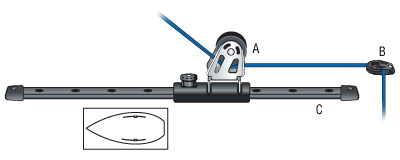
The key is the fairlead, the block or pad-eye through which the sheet goes before it is cleated or turned around the winch.  Normally, you set the fore and aft position of the fairlead by sighting along the seam in the middle of the foresail. The seam will run from approximately midway along the luff to the clew. If your fairlead is located along the line as though the seam extended aft pass the clew, your foresail should be set properly. When the sail breaks it should bread along the entire luff at the same time. If the sail breaks at the top first, the fairlead may be too far aft. If it breaks at the bottom first, the fairlead may be too far forward. (I hope that I have that correct; if I have gotten them mixed up, you have permission to laugh at me.) Unless you are intentionally “shifting gears” (as I will explain below), you need to move the fairlead to correct this problem. Otherwise, it will prevent you from pointing as high and will depower your sail unintentionally.

So, assuming for now that your telltales normally break at the same time all along your luff, here is how you “shift gears.” If the sail is too large for the amount of wind, move the fairlead aft. This will tighten up the foot of the sail and, more importantly, open up the leach. When a puff hits the sail, it will open up and let that heavy air escape out the back of the sail. It will depower the sail some, but you already have too much power.

What if the wind is too light? To some extent you can increase the sail’s power by moving the fairlead forward. Then when you bring in the sheet, you will be tightening the leach and loosening the foot. In other words, you will be making the sail more like a cup. And as you will recall, curves are power.

I can sense some of you thinking, “But I do not have tracks or movable fairleads.” If that is your situation, you can devise a system sometimes referred to as “barber haulers.” The sheet is run through a loose block (or even just the loop of a line). Then the block or the loop is tied down forward or aft of where the fairlead normally is. In other words, you change the angle of the sheet by making your own temporary fairlead. If you find that this works to make your sailing safer and more fun, there are probably tracks and moveable blocks in your future.

See you on the water,

Lee

2016 Recap Championship and Board for 2017

Results of the 2016 Club Championship were Winner Kevin Klarer, for the Cruiser category and Joe Brownfield for the Dinghy category.

kevincruisers

Congrats to Kevin Klarer – Winner Cruisers

joedinghy

Congrats to Joe Brownfield – Winner Dinghies – (Joe Brownfield simulated cause he wasnt at the Xmas party)


Also Steve Stahl won Yachtsman of the Year (Photobomb courtesy of Troy) and Tom Cripps took the Pirate of the Year Award. Congratulations to you both.

yachtsman-of-the-year

crips

Tom Cripps – Pirate of the Year

We also installed our Board for 2017 –  From left to right – Gary Reimer Purser, Gary Guss  Scribe, Bill Miller Vice Commodore, Rob Hatcher Commodore, Troy Monroe Yardmaster, Leah McMurtrey Social, and Steve Stahl Purser.  Our special thanks to Alan Cannon, who is leaving the board after several years as Purser.

2016board.png

The Christmas party was a fun event as usual, wish more mates could have attended.


POYC Christmas Party & POYC Merch. Pre Order Form!

poycxmas16

POYC Christmas Party
Saturday, Dec. 3rd at Cambridge Market
$30.00/person, includes dinner and beverages and a fun-filled night with sailing friends…

For Christmas stocking stuffers and for those hard to buy for, order POYC merchandise. Print the form, fill it out and send along with a check to Frank Kersting. Pick up the merchandise at the party. Simple as that!! Click on the link below for the Form.

POYC Merchandise PreOrder Form (PDF)