Commodore’s Corner – February 2010

Ah yes although its plenty cold outside the days are indeed getting longer and the season is almost upon us. Things are shaping up nicely for the 2010 campaign and I’m here to provide the details. First things first – the schedule of events as slated; notice the date for the Blessing of the Fleet has changed thanks to Capt. Connie Polk reminding me that I had it slated for Derby Day! Here we go:

MARCH

  • 12 – POYC Meeting at the lake. Potluck at 6 pm/Meeting at 7. Come on out and bring a side, I’ve put in the word for good weather.
  • 20 – POYC Spring Work Party – 10 am – Hardmaster Reimer has an aggressive agenda for us to accomplish so all hands on deck!

APRIL

  • 9 – POYC Meeting at the lake as above.
  • 22 – Sailing School – Classroom location to be announced. Capt. Lee Huddleston in charge.
  • 24 – Sailing School on the water – Captains and boats needed to take students out.
  • 29 – Sailing School – Classroom Session.

MAY

  • 1 – Sailing School on the water – again Boats needed.
  • 6 – Sailing School – Classroom Session.
  • 8 – Sailing School on the water.
  • 13 – Sailing School – Last Classroom Session.
  • 14 – POYC Meeting at the lake as above.
  • 15 – Blessing of the Fleet / Final Sailing School on the water.
  • 29 – Huddleston Cup Spring Regatta – Skippers Mtg. 10 am. 29/30th. Sponsored by Commodore Miller.

JUNE

  • 11 – POYC Meeting at the lake as above.
  • 19 – Roberts Long Distance Race – Details forthcoming on this first ever event.

JULY

  • 4 – Yankee Doodle Regatta. Sponsored by the venerable Capt. Herb Siewert.
  • 9 – POYC Meeting at the lake.

AUGUST

  • 7 – Karl Millen Regatta.
  • 13 – POYC Meeting at the lake.

SEPTEMBER

  • 4 – Dixie Cup Regatta – Sponsors Barry Sanders and Rob Wyatt. OREC present from WKU.
  • 10 – POYC meeting at the lake.

OCTOBER

  • 2 – Great Minnow Regatta – note this is a ONE day event this year.
  • 8 – POYC Meeting at the lake.

NOVEMBER

  • 12 – POYC Meeting at the lake – the last hurrah!

DECEMBER

  • 11 – POYC Christmas Party.

Setting the schedule was not the only order of business at the Executive Board meeting in February. Pursuant to an ongoing discussion relating to raising dues, the  board revisited this subject. Purser Sanders had prepared a long list of yearly expenses; all of which have risen over the last three years. Did you know that over the last three years racing expenses have been $15,593 while bringing in $8,872? We did have the lowest expenses in ‘09 but were still in the hole. Corps charges rise each time we renew as does utilities/repairs and upkeep. This is all old news and without explaining further I am pleased to announce that dues are to be raised $25 in 2011 and another $25 in 2012 for both Associate as well as Sustaining members.

Those of you who are reading and objecting please remember that keeping the POYC up and running is a break even situation each year. To keep up with rising costs, much less plan any improvements, requires a dues increase. The club is a fantastic bargain even if dues were raised $100 (which I would be in favor of) just checkout the dues at any other yacht club in the country. I am also pleased to announce that revenue raised from this increase will be placed in a Contingency/Capital Improvement Fund. So that’s where the dues increase will be placed; a good idea I think as there are needed improvements looming on the horizon. (Witness termite eaten poles and a scabbed on roof at the pavilion.)

After discussing the debt incurred by racing we also decided to have one tee shirt with all races listed on the back this year. This would help control one aspect of the cost of racing. I am responsible for the Huddleston Regatta and plan to cook myself for Saturday night’s party as another means of controlling race costs. All suggestions are welcome regarding cost control and believe me BYOB is one item up for discussion. Come on out to the March meeting and put your two cents in. In other news, whether we will be hosting the 2010 Bluegrass Games is still up in the air and we await a decision. Race Chair Doug Roberts announced a new Long Distance Race as well as his belief that one day events are better attended than two day regattas. Thus the Great Minnow is now slated for Saturday only racing this year. In closing, I can barely wait to cast off and get the sailing season started. Much progress was made at our Executive Board Meeting and I hope no one is put off by the dues   increase. It was the only realistic solution to keeping the POYC moving forward and this increase is paltry in the face of the fun we have sailing at a club we all love. Hope to see you at the March meeting on Friday the 12th.

Over and out!

Commodore Bill Miller

The Racing Corner – Part Two

Racing Corner Month 2 by Doug Roberts – POYC Racing Chair

Why we race sailboats.

It’s about being with people who share our interests. It’s about being with friends and making new friends. It’s about adding meaningful memories that will last a lifetime. Our sport is about respect for the rules, respect for fellow competitors and respect for traditions. Sailboat racing is a shared experience. The bonds created on the course outlast the day of competition. Make a commitment to yourself to join this great sport this year.

Rounding Marks

Room at the Mark!!!! You will hear this on the race course. Giving room is one of the areas where it seems sailors have little room for forgiveness. Room is the space needed by a boat in the existing conditions to perform a particular maneuver promptly and in a seaman-like way.

Of all the racing maneuvers you should practice, rounding the marks is where you should definitely sharpen your skills, because many gains and losses are made at mark roundings. Often a pack of boats will approach the mark, basically tied with each other. Because of the nature of the rounding, someone will come out on top, and depending on the number of boats and the skill of the skippers, the last boat could end up 20 boat lengths behind.

There are three “maneuvers” for which room may be required:

(1) keeping clear of a right-of-way boat,
(2) passing a mark or obstruction or
(3) tacking to avoid an obstruction.

There are several important elements within the definition of “room.”

· One element is “existing conditions,” so that the space required for a particular maneuver will vary depending on what conditions (wind and sea) exist at the time (and may also vary depending on the size and type of boats involved).

· A second element to “room” is “seaman-like way”. A boat will only be entitled to enough room to complete a particular maneuver properly (and will not be entitled to the room necessary to “mess up” the maneuver).

· A third element is “promptly,” so a boat is only entitled to the space to make a particular maneuver “promptly” and may not delay in making a particular maneuver if that causes her to take more room than she would have needed if she had acted promptly.

Definitions

· Three-length zone – The three-length zone is an area that extends from a mark or obstruction on the race course that is equal to three boat lengths. The radius of the Zone is equal to three boat lengths.

· Mark – A mark is any object that according to the sailing instructions must be passed on a particular side, including the marks which indicate the ends of the starting and finishing lines. The anchor line of a buoy that is a mark (similarly, the underwater area around an island that is a mark) is not considered part of the mark. So if the island is a mark and you run aground, you do not need to serve the penalty for hitting a mark (unless of course you run aground so hard you hit dry land).

Three More Rules

* When you’re tacking, you must keep clear of all other boats from the time your boat passes head to wind until it is on a close-hauled course (Racing Rule 13). Look around before you tack to make sure you don’t tack in the way of another boat.

* Whenever you are the right-of-way boat and want to turn, you must give the other boat a chance to keep clear (Racing Rule 16). You cannot make an abrupt turn that allows no opportunity for the other boat to stay out of your way.

* When a boat reaches the three-length zone from a mark or obstruction, it has to give boats overlapped inside it room to round or pass the obstruction (Racing Rule 18). The outer edge of this zone is three boat lengths from the mark. This Rule is switched off at starting marks, and between boats on opposite tacks at the windward mark.

In the newsletter next month we will cover finishing the race, avoiding obstructions, and sailing a proper course. See you at the March meeting and work party.

Doug Roberts – Racing Chairman

Commodore’s Corner

Happy New Year and greetings to all mates of the POYC. If you were in attendance for the Commodore’s Reception you know a good time was had by all; and if not I hope to see you next year. Around forty sailors gathered at our house for the festivities that served as the January meeting.
We were glad to see Carol and Frank Kersting back among the ranks as they took a respite from their work in the Ukraine, and they vowed to return late next fall. Kudos to these two who have begun their retirement in an effort to help others rather than thinking of themselves. I admire them and look forward to getting them back on the water with us.
Yes the winter is long but before you know it we will be back at the yard and out on the lake. The 2010 schedule is in the bag and here are the upcoming events coming your way.
Due to the lack of attendance and interest I have witnessed the last three years we will forego a club meeting in February and instead the Executive Board will meet in a planning session.
On the social front Past Commodore Herb Siewert has graciously invited all mates to a Super Bowl party at his home. The address is 2011 Barberry Ct which is just off 31-w just south of WKU in Bowling Green.
We will return to the lake for the March meeting on Friday 3/12. As usual we will gather for a potluck dinner at 6 pm with the meeting to follow around 7. Bring a side dish, bread or dessert and come on out to get our year at the club started off right. Our first work party at the yard is slated for Saturday 3/20 and will begin at 10 am. These parties are always as much fun as they are work and I hope to see as many mates out as possible.
The full schedule will be published soon but I will announce that the Blessing of the Fleet will take place Saturday May 1, and that we will take to the water for the Huddleston Cup on May 29/30th.
So as you can see although the season may seem distant we are actually ready to roll.
Any and all mates with info or questions fell free to contact me at 270-792-3728 or at our web address millersonmeng@aol.com. Since I am still trying to catch up with the nineties a phone call my be a quicker medium. Hope to see you at the super Bowl Party and I look forward to a successful campaign in 2010!
Commodore Bill Miller

Alternative Sailing

As a contrary sort I’ve been interested in this topic for a long time. People have been sailing for thousands of years and have invented myriads of ways to build boats, sails, and equipment.
When Magellan sailed his square rigged vessel to Guam, he was greeted by natives who were rapidly sailing circles around him with their proas. Watch this video of a sailing canoe in the Marshall Islands : Marshall Canoe, its a real eye-opener. No fiberglass, expensive sails, fancy boat shoes, autofurlers, etc. and I’ll bet few of our boats could match the speed at which they are traveling. Look closely, they brought some crabs along for lunch.
All over the rivers of China, old women and kids propel sampans using a Yuloh, this simple device for sculling is a lot greener than outboard motors and requires a notch on the transom for the oar and a simple rope attached to the oar with a knot. Plus you don’t have to lug gasoline around.
Junk rigs sail all over the world and sail like witches, even when they have holes in them to let some of the wind through. While I’m not ready to throw in the towel on my sloop yet, I’m always fascinated by these different ways to solve common problems and amazed at the ingenuity of human beings. As a last link, here’s the cheap sailing pages to explain these and other rigs Cheap pages Craig has put together a lot of ideas we can look at for our boats. It’s a great way to wile away some time while waiting for the season to start.

Gary Guss – Scribe

Tattoos

Tattooing has been associated with the seafaring life of the navy for centuries. This tradition began in the 1700s when Captain Cook discovered the tattooed natives of the South Pacific. Cook’s sailors were looking for the perfect memento of their journey into foreign lands, and a tattoo was the most exotic souvenir they could bring home.
A Sailor without a tattoo is like a ship without grog: not seaworthy.
The United States Government issued a recruiting circular in 1909, which stated, “Indecent or obscene tattooing is cause for rejection, the applicant should be given an opportunity to alter the design, in which event he may, if otherwise qualified, be accepted.
In the 1940s this obscure ruling caused one of the biggest booms the tattoo trade had known in years. From far and wide, eligible young men were flocking to their favorite
needlers with demands for lingerie, skirts, brassieres, fans, bubbles, flowers, butterflies, almost anything that would cover up a bare spot.
Some meanings of sailor designs;
HOLD on the knuckles of one hand and FAST, on the other. This is said to help the seaman to better hold the riggings.
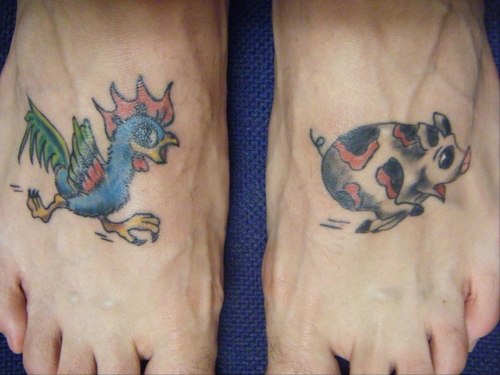
A PIG, on the top of one foot and a ROOSTER, on the other. This is said to protect the seaman from drowning, because both of these barnyard animals cannot swim so they would get the seaman quickly to shore.

An ANCHOR showed the seaman had sailed the Atlantic Ocean.
A FULL-RIGGED SHIP showed the seaman had sailed around Cape Horn.
A DRAGON showed the seaman had served on a China station.
A SHELLBACK TURTLE denotes a seaman who has crossed the equator.
A GOLDEN DRAGON denotes a seaman who has crossed the International Date Line.
ROPE tattooed around the wrist meant the seaman was a deckhand.
Miss Eleanor Barnes of the Seaman’s Institute once remarked,
“Some people pour out their colorful stories to juries. Others relieve the tension by writing for the confession magazines. The sailor enlists the tattooers needle upon
his own body in dull blues, vivid reds, greens and yellows to record the story of his loves and hates, his triumphs, his religion, and his patriotism.”

Racing Corner #1 by Doug Roberts

Racing Corner Month 1 by Doug Roberts – POYC Racing Chair

This is a year to commit to having fun with your boat or one of the club boats by racing it. Club racing is meant to be fun and help develop skills and that will be the focus of the race program this year. When a sailor begins to race, many questions come up, such as, “How do the sails work,” “Why do I always get passed rounding the mark,” and “What is rounding the mark?” This section of the newsletter over the next few months should provide some quick answers to basic questions in a relatively painless and comprehensive way. Once you look behind the curtain, you will find that sailboat racing is not all that mysterious and you can have great fun.

Let’s start with some definitions.
· Tack, Starboard or Port – Simply a boat is on a tack which is opposite of the side its main boom is on. If the main boom is on the port (left) side the boat is on a starboard tack. If the main boom is on the starboard (right) side the boat is on a port tack
· Leeward and Windward – A boat’s leeward side is the side that is away from the wind. However, when sailing downwind, her leeward side is the side on which her mainsail lies. The windward side is the side that the wind hits first or when sailing downwind it is the side opposite of the main boom. When two boats on the same tack overlap, the one on the leeward side of the other is the leeward boat. The other is the windward boat
· Keep Clear – One boat keeps clear of another if the other can sail her course with no need to take avoiding action and, when the boats are overlapped on the same tack, if the leeward boat can change course in both directions without immediately making contact with the windward boat

· Overlap, Clear Astern and Clear Ahead – One boat is clear astern of another when her hull and equipment in normal position are behind the aftermost point of the other boat’s hull and equipment in normal position. The other boat is clear ahead. Boats overlap when neither is clear astern.

Rules of Sailboat Racing:

There are three guiding principles that underlie the Racing Rules. All competitors are expected to compete within the framework of sportsmanship, fair sailing and helping those in danger. If you’re new to racing, you only need to know a few basic rules to handle most situations you’ll encounter on the race course. As you gain more experience, you’ll learn more about the subtleties and limitations of these and other rules.

Racing Rule 14 – Avoiding Contact

You must avoid contact with other boats if possible. Even if your boat has right of way you must avoid contact, but you don’t need to act until it becomes obvious that the other boat is not going to keep clear.

Three of the basic rules of the road for sailing also apply to racing.

These rules are:
* When boats approach each other on opposite tacks (one starboard tack and one port tack), the boat on port tack shall keep clear of the boat on starboard tack (Racing Rule 10). The port-tack boat keeps clear, if the starboard-tack boat does not have to change course to avoid a collision. (Just like driving an automobile you yield to the right – yield to the boat whose boom is on its starboard (right) side)

* When boats are on the same tack and overlap each other, the windward boat shall keep clear of the leeward boat (Racing Rule 11). If your boom is on the side toward the other boat, you are the windward boat. Don’t run your boom into another boat.

* When boats are on the same tack and don’t overlap each other, a boat that is overtaking from behind shall keep clear of the boat that is clear ahead (Racing Rule 12). The overtaking boat must change course to avoid running into the back of the other boat. If the boat from behind continues to overtake the other boat and they become overlapped then the windward-leeward rule (Racing Rule 11) applies – the windward boat must keep clear of the leeward boat. If you are overlapped and your boom is pointing toward the side the boat is overtaking you, you must keep clear.

Re: The Commodore’s Reception

Dear POYC Friends,

Bill and I would like to thank everyone for filling our home with laughter and friendship during the Commodore’s Reception.The presence of each of you gave these walls a much needed rattle that rang of times past when the Meng’s used to entertain on a a regular basis. It has been years since the staircase felt the bounding (no, not pounding) of tiny feet. This brick bastion has never felt so warm as it did on the evening of January 1, 2010. We are truly grateful for the occasion.

There is a constant reminder that we do not know what 2010 will hold. Who of us will see the end of 2010 on this earth? Who will not? Let us take comfort in each other during difficult times and rejoice in victories.

We’ll see you on the water and that won’t be soon enough.

Bill and Kaye Miller