Summer Sailstice June 19, 2010

Summer Sailstice is a global holiday celebrating sailing held annually on the Saturday closest to the summer solstice, the longest sailing days of the year.

Its easy to participate in Summer Sailstice and its free! Summer Sailstice participants simply register, go sailing and automatically become eligible to win one of over 400 prizes from our supporters, from a yacht charter with The Moorings to sailing gear your favorite marine suppliers.

Summer Sailstice

Connie Polk and several of our members do this every year.

The Challenge of Racing – by Doug Roberts, Racing Chairman

Racing Corner Month 5
The challenge of sailing is to get your boat to go from point A to point B, even when the wind will not cooperate. Racing helps force you to learn how to get your boat from point A to point B to point C in as short of a period possible. The fastest way to learn new skills is by following a better racer (and it is great way to place in the race). These guys are often better for a reason, and there is much to learn. Follow them, figure out why they went the way they did, or why they didn’t do what you would have done. If you can’t figure it out on your own, ask them after the race. Most of the club members are happy to share tips with more than just a quick answer. Many times, when a person begins to race, they will follow a faster boat and finish second or third. However, for some reason this stops, and they drop back in the fleet. It may be that “beginner’s luck” runs out. But, more than likely, they just stop following faster racers.

More definitions

Finish – A boat finishes when any part of her hull, or crew or equipment in normal position, crosses the finishing line in the direction from the last mark either for the first time or, if she takes a penalty, after complying with rule 31.2 or rule 44.2.

Obstruction – An object that a boat could not pass without changing course substantially, if she were sailing directly toward it and one of her hull lengths from it. An object that can be safely passed on only one side and an area so designated by the sailing instructions are also obstructions. However, a boat racing is not an obstruction to other boats unless they are required to keep clear of her or give her room.

Proper Course – A “proper course” is one the boat would sail to finish as quickly as possible. Since different sailors often have different ideas of the quickest route to get to the finish line there can be more than one proper course for a boat at any particular point in time. Thus, two boats sailing side by side may have different proper courses because of differing views on how best to get to the finish line as quickly as possible.

A boat has right of way when another boat is required to keep clear. The following rules cover some special situations where a boat must keep clear.

  • If you cross the starting line too soon before the start, you have to go back behind the line and start again. While going back, you have to keep clear of all boats that have started (Racing Rule 20).
  • If you hit a mark while racing, you must take a penalty as soon as possible by doing one 360-degree circle (Racing Rule 31). While doing your penalty circle, you must stay clear of all other boats.
  • If you foul another boat while racing, you must take a penalty as soon as possible by doing two 360-degree circles, or turning 720 degrees (Racing Rule 44). While doing your two penalty circles, you must stay clear of all other boats.

Racing Rule 14 – Avoiding Contact You must avoid contact with other boats if possible. Even if your boat has right of way you must avoid contact, but you don’t need to act until it becomes obvious that the other boat is not going to keep clear.

POYC Racing Rule 2010 – Have fun and learn while racing. This is the year to commit to having fun with your boat or one of the club boats and race. Club racing is meant to be fun and help develop skills and that will be the focus of the race program this year. If you don’t feel comfortable racing your own boat, come on out to the club on race day. Many racers are always glad to have crew aboard on race day. Come out to the club on race morning and it is guaranteed you will be asked to either crew on a boat or work the committee boat.

Now you are ready to start racing. But if you want that extra little boost of confidence, come out for the introduction to sailboat racing class May 13.  We will talk about the rules, the marks, as well as racing strategies and tactics with some of the best racers in the club. In the mean time here is a great link to learn more about racing http://www.racing.sailingcourse.com/index.html

Racing Corner – Month 4 Taxonomy of the Race Course by Doug Roberts

Taxonomy of a Race Course

Here are some of the terms you may hear when people talk about race courses.
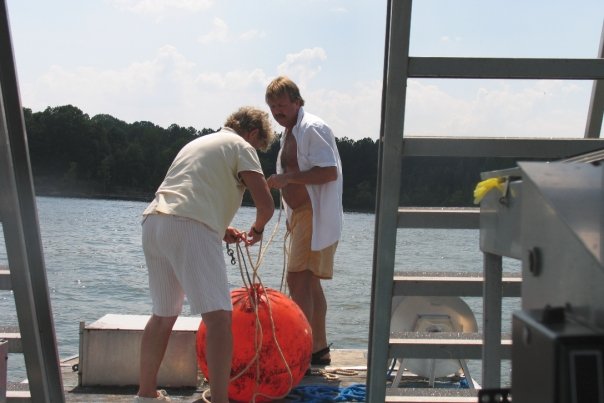
Committee Boat: The end of the starting line marked by the Race Committee boat.
Usually the starboard end of the line when facing upwind. The Committee Boat flies the flags and sounds the horns to signal the racers and records start and finish times.
Pin: The end of the starting line marked by a buoy. Usually the port end of the line when facing upwind.
Open Line: Racers are allowed to cross the start/finish line during the race. This is the case unless the Sailing Instructions say otherwise.
Closed Line: Racers are not allowed to cross the start/finish line while racing except while starting or finishing their race. This is sometimes called a Closed Gate.
Weather Mark (or Windward Mark): The mark buoy that is the most upwind.
Lee Mark: The mark buoy that is the most downwind.
Gybe Mark: The second mark on a triangle course, where you have to gybe to stay on the course.
Windward Leg: A leg of the race where you must sail closehauled and tack to reach the next mark.
Reaching Leg: A leg where you can sail on a reach and do not need to tack or gybe to reach the next mark.
Downwind Leg: A leg where you must sail more or less straight downwind to reach the next mark and you may need to gybe one or more times.
Marks Left to Port: When you round a mark, you pass it so that the mark stays on the left side of your boat. Most fleet racing courses are designed this way, particularly for the first windward mark.
Marks to Starboard: When you round a mark, you pass it so that the mark stays on your right side. Match race courses are designed this way, particularly the America’s Cup.

Race Course Diagrams

Race Course Diagrams

2010 Port Oliver Yacht Club Race Instructions
These instructions are intended to provide information necessary to coordinate and participate in the POYC racing program. A good understanding of these instructions will help prevent some conflicts during the season.

A. A race should be fair and sporting for all competitors. Good sportsmanship is expected from all participants.
B. All boats entered into a race shall be subject to the direction of the Race Committee (RC). However, it shall be the sole responsibility of each skipper to decide whether or not to START or CONTINUE a race.
C. All races will be conducted under The Racing Rules of Sailing (RRS), the class rules, and rules modifications as determined by the POYC Race Committee.
D. All required safety equipment shall be carried aboard all boats participating in a race. Each skipper is responsible for the safety of his/her crew and boat. If the Race Committee determines that conditions require the use of life preservers, it shall hoist the Y flag or a life preserver/vest.
E. Races shall be sailed back-to-back each racing day.
F. A minimum of four boats are required to form an official race class.
G. P.O.Y.C. Race Courses are typically windward/ leeward or triangle courses. If other course configurations are used, the configurations must be explained in the skippers meeting before the race.
H. Starting signals shall be covered in the skippers meeting. The starting signals usually consist of a combination of Class flags, a Preparatory (P) flag, and sounds. The sounds are optional.
The class flags are as follows:
a. Red flag – Cruiser
b. Blue flag – Dinghy
c. Yellow flag – Multi-hulls

The starting process is as follows:

d. 5 minutes before the start, the class flag is raised and a warning signal may be sounded.

e. 4 minutes before the start, the P flag (blue with a white square in the middle) is raised and a warning signal may be sounded.

f. 1 minute before the start, the P flag is lowered and a long warning signal may be sounded.

g. The class flag is lowered to signal the start the race. A warning signal may be sounded.

I. The RC will hail early starters, but the burden of a proper start is the responsibility of the skipper.

J. The RC may score all boats remaining on the course 20 minutes after the first boat of the class crosses the finish line as DNF (Did Not Finish) and recall the boats to prepare for the start of the next race.

K. The handicap factors used will be the Portsmouth Yardstick, D-PN factors. No penalty for under-crewed boats. If your boat has modification factors, please indicate on the registration form.

L. Awards will be given for individual races as well as a season champion for both Cruiser and Dinghy class racers. Multi Hulls awards will be available for individual races, when a class exists.

M. The top scores for each skipper for 50% of the races in the 2010 season will count toward the calculation for the season championship in each class. Season points shall be awarded for each race of the day as follows:

a. 1st place = 1 point
b. 2nd place = 2 points
c. 3rd place = 3 points
d. So on through all boats placing.
e. DNF shall be awarded the number of boats finishing + 1

If there is a tie between two or more boats, each boat’s race scores shall be listed in order of best to worst, and at the first point(s) where there is a difference the tie shall be broken in favor of the boat(s) with the best score(s). No excluded scores shall be used. If a tie remains between two or more boats, they shall be ranked in order of their scores in the last race. Any remaining ties shall be broken by using the tied boats’ scores in the next-to-last race and so on until all ties are broken. These scores shall be used even if some of them are excluded scores.

N. Protests may be filed with the RC at the conclusion of each race. Hearing of protests will be held at the end of the race day. Please keep in mind rule 14 “You must avoid contact with other boats if possible.” Intentional violation of this rule will disqualify you from filing a protest.

Need more help with the rules? Introduction to racing class Thursday evening May 13, details to follow.

Racer’s Corner #3 – by Doug Roberts

Committee boat

The challenge of sailing is to get your boat to go from point A to point B, even when the wind will not cooperate. Racing helps force you to learn how to get your boat from point A to point B to point C in as short of a period possible. The fastest way to learn new skills is by following a better racer (and it is great way to place in the race). These guys are often better for a reason, and there is much to learn. Follow them, figure out why they went the way they did, or why they didn’t do what you would have done. If you can’t figure it out on your own, ask them after the race. Most of the club members are happy to share tips with more than just a quick answer. Many times, when a person begins to race, they will follow a faster boat and finish second or third. However, for some reason this stops, and they drop back in the fleet. It may be that “beginner’s luck” runs out. But, more than likely, they just stop following faster racers.

More definitions:
Finish – A boat finishes when any part of her hull, or crew or equipment in normal position, crosses the finishing line in the direction from the last mark either for the first time or, if she takes a penalty, after complying with rule 31.2 or rule 44.2.

Obstruction – An object that a boat could not pass without changing course substantially, if she were sailing directly toward it and one of her hull lengths from it. An object that can be safely passed on only one side and an area so designated by the sailing instructions are also obstructions. However, a boat racing is not an obstruction to other boats unless they are required to keep clear of her or give her room.

Proper Course – A “proper course” is one the boat would sail to finish as quickly as possible. Since different sailors often have different ideas of the quickest route to get to the finish line there can be more than one proper course for a boat at any particular point in time. Thus, two boats sailing side by side may have different proper courses because of differing views on how best to get to the finish line as quickly as possible.

A boat has right of way when another boat is required to keep clear. The following rules cover some special situations where a boat must keep clear.

  • If you hit a mark while racing, you must take a penalty as soon as possible by doing one 360-degree circle (Racing Rule 31). While doing your penalty circle, you must stay clear of all other boats.
  • If you foul another boat while racing, you must take a penalty as soon as possible by doing two 360-degree circles, or turning 720 degrees (Racing Rule 44). While doing your two penalty circles, you must stay clear of all other boats.
  • Racing Rule 14 – Avoiding Contact You must avoid contact with other boats if possible. Even if your boat has right of way you must avoid contact, but you don’t need to act until it becomes obvious that the other boat is not going to keep clear.
  • POYC Racing Rule 2010 – Have fun and learn while racing. This is a year to commit to having fun with your boat or one of the club boats and race. Club racing is meant to be fun and help develop skills and that will be the focus of the race program this year. If you don’t feel comfortable racing your own boat come on out to the club on race day. Many racers are always glad to have crew aboard on race day. Come out to the club on race morning and it is guaranteed you will be asked to either crew on a boat or work the committee boat.

Now you are ready to start racing. But if you want that extra little boost of confidence, come out for the introduction to sailboat racing class in April. We will talk about the rules, the marks, as well as racing strategies and tactics with some of the best racers in the club. Look for more information in the next newsletter.

Doug Roberts – Racing Chairman

Lets be careful out there .. Sailor’s Superstitions


It is unlucky to start a cruise on Friday.
This is the day Christ was crucified.

Never start a voyage on the first Monday in April.
This is the day that Cain slew Abel.

Don’t start a voyage on the second Monday in August.
This is the day Sodom & Gomorrah was destroyed.

Starting a cruise on Dec. 31 is bad.
This is the day Judas Iscariot hanged himself.

Black traveling bags are bad luck for a seaman.

Avoid people with red hair when going to the ship to begin a journey.
Red heads bring bad luck to a ship, which can be averted if you speak to the red-head before they speak to you.

Avoid Flat-footed people when beginning a trip.
They, like red heads, are bad luck. The danger can be avoided by speaking to them before they speak to you.

A stolen piece of wood mortised into the keel will make a ship sail faster.

A silver coin placed under the masthead ensures a successful voyage.

Disaster will follow if you step onto a boat with your Left Foot first.

Pouring wine on the deck will bring good luck on a long voyage.
A libation to the gods.

Throwing stones into the sea will cause great waves and storms.

A stone thrown over a vessel that is putting out to sea ensures she will never return.

Flowers are unlucky on board a ship.
They could later be used to make a funeral wreath for the dead.

Priests are not lucky to have on a ship.
They dress in black and perform funeral services.

Women on board a ship make the sea angry.

A naked woman on board will calm the sea.
This is the reason for naked figureheads.

Don’t look back once your ship has left port as this can bring bad luck.

A dog seen near fishing tackle is bad luck.

Black cats are considered good luck and will bring a sailor home from the sea.

Swallows seen at sea are a good sign.

Sighting a curlew at sea is considered bad luck.

A cormorant sighted at sea is bad luck.

Dolphin swimming with the ship are a sign of good luck.
Killing one will bring bad luck.

It is unlucky to kill an albatross.

It is unlucky to kill a gull.
They contain the souls of sailors lost at sea.

Handing a flag through the rungs of a ladder is bad luck.

Losing a mop or bucket overboard is a sign of bad luck.

Repairing a flag on the quarterdeck will bring bad luck.

Turning over a hatch will cause the hold to fill with seawater.

Cutting your hair or nails at sea is bad luck.
These were used as offerings to Proserpina, and Neptune will become jealous if these offerings are made while in his kingdom.

Church Bells heard at sea mean someone on the ship will die.

St. Elmo’s Fire around a sailors head means he will die within a day.

When the clothes of a dead sailor are worn by another sailor during the same voyage, misfortune will befall the entire ship.

If the rim of a glass rings stop it quickly  or there will be a shipwreck.

Never say the word Drowned at sea.

The caul of the head of a new-born child is protection against drowning and will bring the owner good luck.

The feather of a wren slain on New Years Day, will protect a sailor from dying by shipwreck.

A ships bell will always ring when it is wrecked.

A shark following the ship is a sign of inevitable death.
Sharks were believed to be able to sense those near death.

A sailor with over 50 years of service was said to go to “Fiddler’s Green” when he died.

Commodore’s Corner – February 2010

Ah yes although its plenty cold outside the days are indeed getting longer and the season is almost upon us. Things are shaping up nicely for the 2010 campaign and I’m here to provide the details. First things first – the schedule of events as slated; notice the date for the Blessing of the Fleet has changed thanks to Capt. Connie Polk reminding me that I had it slated for Derby Day! Here we go:

MARCH

  • 12 – POYC Meeting at the lake. Potluck at 6 pm/Meeting at 7. Come on out and bring a side, I’ve put in the word for good weather.
  • 20 – POYC Spring Work Party – 10 am – Hardmaster Reimer has an aggressive agenda for us to accomplish so all hands on deck!

APRIL

  • 9 – POYC Meeting at the lake as above.
  • 22 – Sailing School – Classroom location to be announced. Capt. Lee Huddleston in charge.
  • 24 – Sailing School on the water – Captains and boats needed to take students out.
  • 29 – Sailing School – Classroom Session.

MAY

  • 1 – Sailing School on the water – again Boats needed.
  • 6 – Sailing School – Classroom Session.
  • 8 – Sailing School on the water.
  • 13 – Sailing School – Last Classroom Session.
  • 14 – POYC Meeting at the lake as above.
  • 15 – Blessing of the Fleet / Final Sailing School on the water.
  • 29 – Huddleston Cup Spring Regatta – Skippers Mtg. 10 am. 29/30th. Sponsored by Commodore Miller.

JUNE

  • 11 – POYC Meeting at the lake as above.
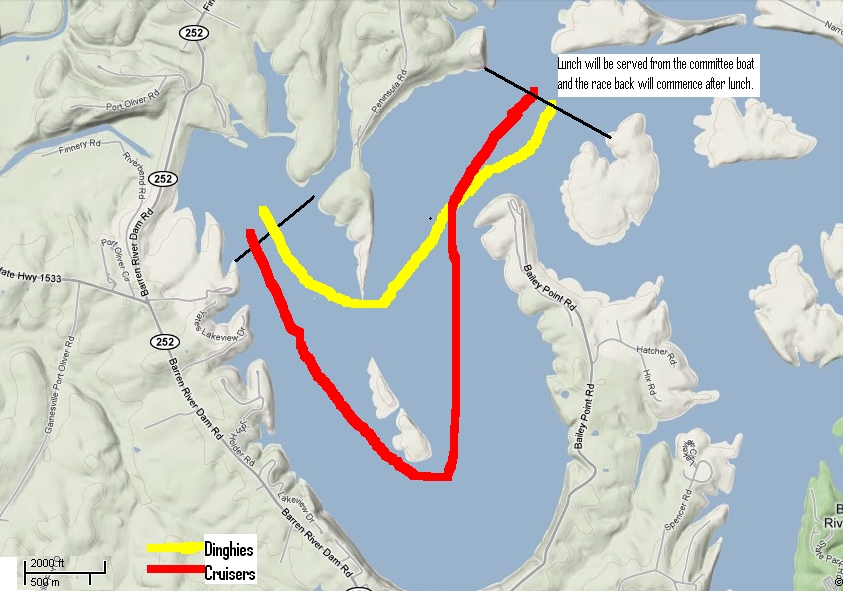
  • 19 – Roberts Long Distance Race – Details forthcoming on this first ever event.

JULY

  • 4 – Yankee Doodle Regatta. Sponsored by the venerable Capt. Herb Siewert.
  • 9 – POYC Meeting at the lake.

AUGUST

  • 7 – Karl Millen Regatta.
  • 13 – POYC Meeting at the lake.

SEPTEMBER

  • 4 – Dixie Cup Regatta – Sponsors Barry Sanders and Rob Wyatt. OREC present from WKU.
  • 10 – POYC meeting at the lake.

OCTOBER

  • 2 – Great Minnow Regatta – note this is a ONE day event this year.
  • 8 – POYC Meeting at the lake.

NOVEMBER

  • 12 – POYC Meeting at the lake – the last hurrah!

DECEMBER

  • 11 – POYC Christmas Party.

Setting the schedule was not the only order of business at the Executive Board meeting in February. Pursuant to an ongoing discussion relating to raising dues, the  board revisited this subject. Purser Sanders had prepared a long list of yearly expenses; all of which have risen over the last three years. Did you know that over the last three years racing expenses have been $15,593 while bringing in $8,872? We did have the lowest expenses in ‘09 but were still in the hole. Corps charges rise each time we renew as does utilities/repairs and upkeep. This is all old news and without explaining further I am pleased to announce that dues are to be raised $25 in 2011 and another $25 in 2012 for both Associate as well as Sustaining members.

Those of you who are reading and objecting please remember that keeping the POYC up and running is a break even situation each year. To keep up with rising costs, much less plan any improvements, requires a dues increase. The club is a fantastic bargain even if dues were raised $100 (which I would be in favor of) just checkout the dues at any other yacht club in the country. I am also pleased to announce that revenue raised from this increase will be placed in a Contingency/Capital Improvement Fund. So that’s where the dues increase will be placed; a good idea I think as there are needed improvements looming on the horizon. (Witness termite eaten poles and a scabbed on roof at the pavilion.)

After discussing the debt incurred by racing we also decided to have one tee shirt with all races listed on the back this year. This would help control one aspect of the cost of racing. I am responsible for the Huddleston Regatta and plan to cook myself for Saturday night’s party as another means of controlling race costs. All suggestions are welcome regarding cost control and believe me BYOB is one item up for discussion. Come on out to the March meeting and put your two cents in. In other news, whether we will be hosting the 2010 Bluegrass Games is still up in the air and we await a decision. Race Chair Doug Roberts announced a new Long Distance Race as well as his belief that one day events are better attended than two day regattas. Thus the Great Minnow is now slated for Saturday only racing this year. In closing, I can barely wait to cast off and get the sailing season started. Much progress was made at our Executive Board Meeting and I hope no one is put off by the dues   increase. It was the only realistic solution to keeping the POYC moving forward and this increase is paltry in the face of the fun we have sailing at a club we all love. Hope to see you at the March meeting on Friday the 12th.

Over and out!

Commodore Bill Miller