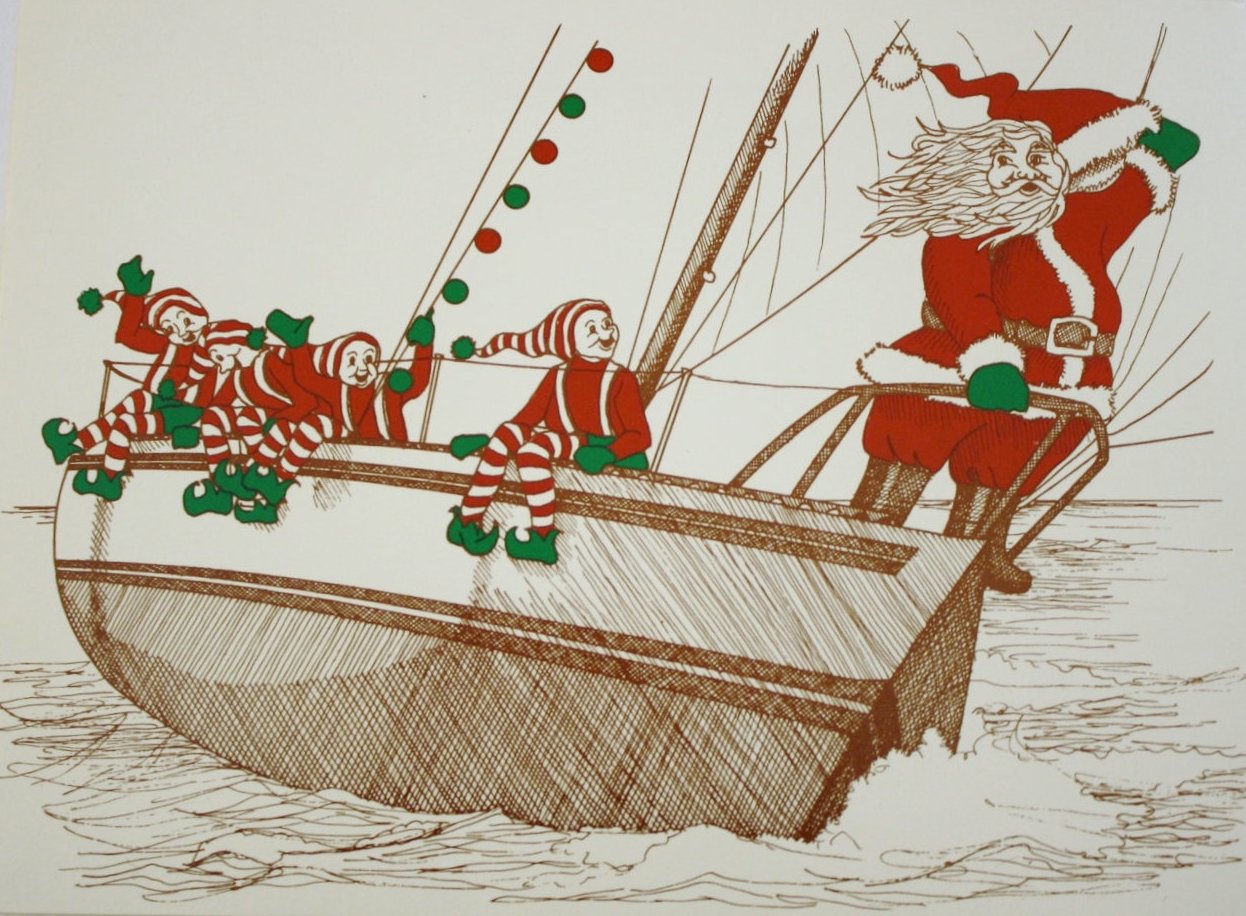
The Christmas Party! December 16th : Port Oliver Yacht Club
Reply

Fall work day is this Saturday morning. Lunch is our annual chili cookoff. There is a new world’s hottest chili pepper to be employed. Meeting will follow lunch.

PERIODIC NEWSLETTER OF THE PORT OLIVER YACHT CLUB
CORRECTION OF THE CORRECTION
In the October Telltale I wrote the correction that in the Karl Million Regatta that Terry Williams, “was the skipper of his own Catalina 22, S/V Resurgam which he skippered amazingly well to come in second.” Actually Terry’s boat is an O’Day 23. How could I, of all people, forget.
THE GREAT MINNOW
The Club actually did have an Oktoberfest, in October, with brats, kraut, und beer! Prepared by our own Herr Brandon Cook. Terry and Annabelle Williams actually came dressed in ledderhosen for Terry and a drinnel dresses for Annabelle. I understand that the food and beer were Wunderbar!
The Great Minnow Regatta was also run. Due to poor weather on Sunday, it was only a one-day regatta. The lederhosen clearly inspired Terry because he won first place in his O’Day 23. Kevin Klarer in his Hunter came in second. Dado Basic in his Catalina 22 came in third, and Bob Sharlow in this Catalina 22 came in fourth.
After the day of racing and the Oktoberfest, I understand that we had our October meeting. No one took any notes, so we can assume that nothing radical or earth-shaking occurred.
COMING ATTRACTIONS
On the second Saturday of November, that is November 11, we will start the day with the Fall Clean-Up starting around 9:00 a.m. Please pitch in to clean up the Club property. Remember that Club dues were increased by $100 per year, BUT with the provision that you can work off that increase simply by participating in Club activities such as the Fall Clean-Up. Come out and help and earn yourself some credit. If you have tools that might be useful, please bring them with you. Blowers, trimmers, power saws, rakes, leaf bags, and such tools would probably be helpful.
After we work up an appetite cleaning up, we will be treated to another gourmet meal by our esteemed resident Chef, Brandon Cook. Please also bring some extra food, because we will have worked up an appetite.
After our repass, we will have our November Meeting. You may recall (but probably not) that the November Meeting is when we nominate and vote for members for positions as officers for the coming season. Originally, the only officers we elected were the Commodore, Vice Commodore, Purser, Scribe, and two Board Members At Large. Sometime along the way we stopped electing Board Members At Large and started electing people who agreed to carry out specific tasks, Race Committee Chair, Yard Master, Dock Master, and Editor of the Telltale. Of course, there is nothing to keep us from adding to or subtracting from this list. Think about whether you might be willing to serve or who else might serve.
SURVIVING THE SUCCUBUS
PROLOGUE – THE CPR THEORY
© Lee Huddleston 2023
I was taking a class in Cardiopulmonary Resuscitation (CPR) given by our Yacht Club’s own Super Nurse, Carol Kersting, through the Public Health Department. The class was going well when I realized that I didn’t need to take a class in CPR, I needed to get my friends to take a class in CPR. Well, ok, maybe cute, but that really isn’t so. The very idea of just standing by while a person died in my presence is awful beyond words. But the principle actually is relevant when the subject is blue-water sailboats. I don’t need to own a blue-water sailboat, I need to get my friends to own blue-water sailboats. Let them deal with the initial cost, the taxes, and the eternal upkeep.
How would that be of any benefit to me? Visit any marina where ocean-capable boats hang out. There may be hundreds of beautiful, seaworthy boats just begging to go sailing. But their land-bound owners cannot take them out because they lack one very important ingredient. That ingredient is a crew. Even for the many boats capable of being single-handed and skippers who are capable of doing it, single-handing for longer than a day or two is boring and rather dangerous except for the dedicated introvert. By being willing and able to crew, you are doing the skipper a favor. And they usually realize it.
Don’t you need to be trained and certified? No. It doesn’t hurt to have training and experience, but the people with formal training and certification are often expecting to be paid. I’m focused on the enthusiastic person who simply wants to go sailing in exciting places, and often for free. A good personality is the primary requirement. And that holds true for the skipper as well as the crew. There are enough good skippers who need crew that a bully or primidone can find himself or herself sailing alone. Or not at all.
An eagerness and willingness to learn can go a long way to make up for a lack of sailing experience. Besides, the skipper usually has his or her own special way of doing about everything. If you have had formal training, you sometimes have to unlearn the official way and learn the skipper’s “better” way. And ironically, many skippers enjoy training their crew. Just be open to being told what to do and how to do it. That is part of the fun of being skipper. And, of course, avoid telling the skipper that his or her way is not the correct way, even if you think so yourself that it is.
The financial arrangements are as varied as there are different boats. I have never paid for the privilege of sailing, nor have I ever been paid. Do check what is expected. My experience has been usually meals purchased off of the boat are paid for by the individual. Meals on the boat are often covered, at least in part, by the crew and sometimes covered by the skipper. Often, the crew will go shopping for basic food at local stores before the trip begins. And in some places, getting local ingredient or food is a special, enjoyable benefit. Considering that you would have to buy food if you were home and that you are eating your meals in paradise, the food costs are usually reasonable. Talk with the skipper before signing on. Don’t wait for a surprise halfway through a cruise. Sailors need boats, and boats need sailors. It doesn’t hurt to ask.
I have been able to sail in the Bahamas, the Virgin Islands, the Turks and Caicos Islands, the Dominican Republic, Porto Rico, Antiqua, Dominica, Guadeloupe, Saint Lucia, Martinique, Venezuela, Greece, Turkey, the Chesapeake Bay, and along the Eastern Coast of the United States, all for free except for a share of the food. You can too.
More chapters of Surviving The Succubus are coming.
OFFICIOUS INTERMEDDLER
Yes, that really is a genuine legal term. It is the label for a person who interjects himself into someone else’s business, without being invited, often with disastrous, unintended results. One such instance comes to my mind. Our esteemed members, Carol and Frank Kersting purchase themselves a brand-new Flying Scott with the prettiest apple-red gelcoat we had ever seen. Carol and Frank were about to launch their new toy when along came a well-meaning officious intermeddler, who shall remain unnamed. As Carol and Frank were stowing equipment on their boat which was sitting about ten feet from the water, the intermeddler decided to help them launch the boat. He untied the bow line. Unfortunately, the intermeddler hadn’t noticed that the Kersting’s trailer was equipped with rollers instead of bunk boards. The instant that the bow line was released, the boat began its journey to the sea. Before it even registered on anyone, gravity was pulling the boat aft at a rapid clip. The three participants were paralyzed by the shock as the boat gained momentum. Gravity succeeded in launching the fiberglass missile into the air before crashing it down onto the concrete ramp, and scrapping it down to the water’s edge.
The intermeddler looked at Frank, who at the time was young, tall, and quite strong. The intermeddler’s life passed before his eyes. He just knew that he was a dead man walking.
At the same time, Frank was trying to decide whether to kill the intermeddler immediately or latter. Fortunately for the intermeddler, Frank was genuinely serious about his religion and the intermeddler’s life was spared, with just a very stern admonition, “Don’t you ever help me with my boat again!”
Lee Huddleston, Editor of the Telltale
TELLTALE
October 2023
PERIODIC NEWSLETTER OF THE
Port Oliver Yacht Club
THE LAKE CLEAN-UP
The Lake Clean-up was a success in that Allan Janes, Kevin Klarer, and I showed up. We used the Committee Boat to transport a lot of children and several adults around our end of the Lake picking up all manner of trash that had blown up on the shore around where we normally sail. We were also able to get rid of the large orange highway barriers that had floated into our cove. The Corps had lost them and were especially glad to get them back. We all wore our POYC shirts and made sure that the Corps knew we were there to support them and our lake. Our passenger children and their parents had a really good time. On the inbound trip we let the older children ride on the upper deck sitting down. I took the occasion to tell them what we did with the Committee Boat and tout sailing to them. We then went to the food and prizes festival down at the swimming beach. Terry Williams did show for the food and drink. But, importantly, he and the rest of the Crew were wearing our most flamboyant POYC shirts. The food was pizza from Page’s Pizzas. All you could eat and all the soft drinks you could drink. The pizza was unusually good tasting. After a group photo in which the POYC was in the front row, they handed out prizes. Two little boys each won very fancy kayaks. Their excitement was fun to watch. We made sure that the Corps knew that the POYC was there doing our part, and the Corps appreciated that.
CORRECTION
In the September Telltale I wrote regarding the Karl Million Regatta that, “Dado Basic with the help of Leeloo Basic and Willa Basic and just a little help from Terry Williams, on Dado’s Catalina 22 took second place.” WRONG! The TRUTH was that Terry was the skipper of his own Catalina 22, S/V Resurgam which he skippered amazingly well to come in second. After all, Terry has only been sailing since this summer. Dado, Leelou, and Walla were crew. Sorry, Terry, I was fighting to right a sunfish while you zoomed past.
COMING EVENTS
Ach Du Liebe!! We are going to have an Oktoberfest, in October. Yep, the second weekend of the month (10/14 and 15) will be a genuine Oktoberfest with brats, kraut, und beer! Prepared by our own Herr Brandon Cook. Yummy! Those dressed in Ledderhosen for men and Drinnel Dresses for ladies will get extra brats and beer.
Also that weekend, 10/14 and 15 will be the Great Minnow Regatta. Yes, two days of racing. I have to go to a family reunion that weekend, so other racers will have a prime opportunity to win. Bragging? Of course, but you will see one of these days.
[Repeat] How did we get a regatta called, of all things, the Great Minnow Regatta? Cecil Etheredge was a prominent Thistle racer and was eager that the Club start having races. But other Members questioned whether the Club could actually pull off a full two-day regatta. So it was decided to start with a single-day regatta, a Minnie regatta. Cecil also had connections with the Glasgow newspaper and used those connections to get some publicity for the Club and the race. The copyeditor of the newspaper thought that Minnie was just a misprint so he “corrected” in to Minnow. Since we were so hungry for any publicity, we just adopted the name, the Great Minnow Regatta, and have used the unusual name ever since.
Keep in mind that the Great Minnow is a two-day race. One day of blind luck will not get the job done. You have to exhibit some consistency to win this regatta. If you have any interest in racing or learning to race, this the one to join. I urge you, don’t miss this regatta.
After the first day of racing and the Oktoberfest, we will have our October meeting. Somebody please take notes. If you have something radical you want to get adopted by the Club, with the Members full on brats and beer and tired from the first day of racing, this might be the best meeting to bring it up. Otherwise just come and enjoy.
NAUTY CAL LANGUAGE
UNDER WAY and MAKING WAY: It seems like nit-picking, but the Coast Guard and the Admiralty Courts take it very seriously. If you are made fast to a permanent dock, you are not underway. Our docks probably do qualify. But if you are anchored you are underway. This doesn’t make sense unless you realize that an anchored vessel can move around. If you are not anchored and just drifting in the current, if course, you are underway. If you are using any means, oars, paddles, poles, motors, or sails to move your vessel you are making way. So if your vessel is not under way, e.g., tied up at a dock, your liability is pretty light. If you are under way, you do have some liability but not much, depending on the circumstances. But, on the other hand, if you are making way, you have full responsibility for whatever your vessel does. It is somewhat similar to owning a dog. Caged or locked up, very slight liability; on a leash, depends on how you manage the dog; running free, you are responsible for any damage.
LAST CLEAR CHANCE: This a concept that is used in the common law. If another person runs a stop light, can I go ahead and hit his car? No. I have to make every effort to avoid the collision even when the other party has violated a law. Regarding vessels, the concept is even more strictly applied. If your boat is hit by another boat, you need to be prepared to tell the Coast Guard why you could not have taken any action to avoid the collision. Even though the other vessel should not have put you in a bind, you are essentially assumed to be guilty until you can prove that there was no way for you to “dodge the bullet.” Unfair, perhaps, but that is the approach used by the Coast Guard.
NOBLE A. “BUD” BURFORD
Often members who have joined the Yacht Club in the last few years are not aware of those major characters who formed and shaped the Club as long ago as fifty-seven years. That is doubly unfortunate. Those who worked hard to make it possible for us to enjoy such a great sailing club are not given the credit they deserve. Equally as bad, the newer members do not get to know the fascinating men and women who lived our history. This is a deficiency that ought to be corrected by the “plank owners” and other gray-beards who can still remember the past, or at least spin tales that are marginally believable. A “plank owner” is the name given to sailors who serve in the first crew of a newly launched Navy vessel. That is why the little park over near our “work station” is referred to as the Plank Park (technically incorrect other than the original organizers, but with all of the past commodores and in need of updating.)
In 1966 Bud Burford, Paul Huddleston (Bud’s attorney), Joe Mayfield (Bud’s neighbor), Joe Huddleston (Bud’s attorney),), and Don Mayfield (Bud’s neighbor) got together to officially form the Port Oliver Yacht Club. The federal government had just announced that it was going to create a flood-control lake on the Barren River. Since the dam would be located near the tiny community of Port Oliver, so named because it was the jumping-off point for boats carrying produce down the River, the lake was initially to be called Port Oliver Lake. The Founders took the name of the Club from the proposed name of the Lake, but that name was also intended to be a joke. The Port Oliver community was even smaller than it is today, and the largest “yacht” in the Club was Bud’s Y-Flyer at 18 feet. Compare that to the New York or Chicago Yacht Clubs.
It is fair to say that Bud was the instigator. He had infected his neighbors on Highland Drive, Joe Mayfield and his son, Don, with the sailing bug early on. Then he drew Paul Huddleston in by selling him Bud’s old, wooden Star, a two-person Olympic keelboat (kind of like learning to drive in a racecar). Paul’s son, Joe, was soon captivated, followed shortly by Philip and Lee when they got home from college.
Bud had been sailing for a long time. We need to call on his son, John Burford, and daughter, Alice Burford, both current members of the Club, to fill us in on how Bud got started in sailing. It would be a living example of the “butterfly effect” of chaos theory where a small event has long-range consequences well beyond what might be expected. Whoever got Bud sailing got hundreds, if not thousands, of others into our great sport through a ripple effect. Bud’s quiet enthusiasm and enjoyment were perfect for attracting people to sailing. He was so good at it, he made it seem like the easiest thing in the world.
My first introduction to Bud was on Old Hickory Lake in Tennessee. I was crewing for my father, Paul, along with my mother, on “Mica,” the Star (“mica” is Latin for “twinkle;” isn’t that cute?). Barren River Lake had not been impounded yet so Old Hickory was the closest lake to Bowling Green. Bud came sailing by on his Y-Flyer. At his invitation I stepped over onto his boat to watch how he sailed his boat. Bud started sharing his enormous wealth of experience and knowledge of sailing. That was the beginning of a long, steep learning curve for me.
One of the factors that contributed to Bud’s exceptional experience and sailing expertise was his work situation. His family owned large tobacco warehouses in Bowling Green and North Carolina. From September until after January he worked long and hard buying, selling, and brokering the major cash crop in Kentucky and North Carolina. From February to August, while the tobacco was being grown, there was not as much for Bud to do. This made it possible for him to devote serious time and energy to racing sailboats all over the country. He sailed the Star “Mica” out of KenLake Sailing Club on Kentucky Lake. They had a large and very competitive Star class that raced almost every week.
Fortunately for the Huddleston family, the Star fleet got disbanded at KenLake when a hoist used to launch these keelboats collapsed, seriously injuring a sailor. Bud sold his Star to Paul Huddleston and then moved on to his Y-Flyer. As an easily trailerable boat, the Y-Flyer made it possible for Bud to range even farther in racing sailboats. On several occasions Bud raced in the Y-Flyer nationals.
Bud told me a story of racing his Y-Flyer on the Mississippi River near Saint Louis. Bud realized that the wind had dropped so that the boats were sailing, but not fast enough to overcome the swift current. He quietly slipped a small anchor over the side of his boat and held it with his hand. This is legal as long as you don’t use the anchor to move forward. With Bud stationary in the current, he began to “pass” boats left and right. Fortunately, no one was directly up-stream from him. When the wind finally picked back up, Bud was able to retrieve the anchor and sail across the finish line, skunking the entire fleet.
Another “trick” that Bud taught me came from an experience on Lake Carlyle in Illinois. The Lake is relatively round and the racecourse was set in the middle of the Lake. It was an extremely hot day with hardly a breath of wind. After the start Bud veered away from the racecourse and headed for the shore. The air temperature was so hot that there was a slight land-effect right at the shore. Due to the difference in the heating of water and ground, a very light breeze sometimes blows from the water toward the shore. This is very common at the ocean but much less noticeable on a lake. Bud was able to use the land-effect breeze and slowly sail all the way around the Lake then head back out to the finish line before any other boat even rounded the first mark.
Many years later I was able to use Bud’s “trick” in the Kentucky 100 Mile Race. It was another very hot day and what little breeze there was blew straight out of the North. This was making everyone have to beat and beat for many hours on end to get to the finish line at the dam. I sailed Orion over to the very edge of the Lake and heeled her over to leeward. As Bud had predicted, the land-effect was just barely enough to bend the north wind slightly toward the shore. This made it possible for us to ghost along going in and out with the shoreline, but essentially due north toward our objective. The other boats were sailing much faster but covering many times our distance. To our utter amazement after 31 hours of racing we were able to cross the finish line and win first place in our cruiser class, thanks to Bud. Some of you may have seen my huge trophy with brass sea serpents holding up a large bell.
Under Bud’s influence I bought a Y-Flyer. Bud’s Y-Flyer was wooden and ugly as a mud fence (turquoise and black because that just happened to be the color of paint he had handy when it came time to paint her). My new Y-Flyer was fiberglass and quite pretty. It had adjustable barberhaulers. Yes, that was my reaction, too, “adjustable whats?” Barberhaulers are essentially jib sheet fairleads that move athwartship to change the angle the sheet pulls on the jib. (Aren’t you glad you know now?) I asked Bud to tell me the secrets of how to adjust them. His advice was, “Put them in the middle and leave them alone. When you get to the nationals and can’t break into the top ten, then learn what to do. Otherwise it will be like Nero. You will be fiddling while I sail past you.” And sail past me Bud did, time after time. But every time he did I learned a little bit more.
Another “trick” that I learned from Bud was how to sail downwind in a Y-Flyer. Bud’s advice was to get as far forward in the boat I could. A Y-Flyer is a scow shaped boat, with a blunt bow and a shallow dish-like hull. We used to have a whole fleet in the Club with a sister-fleet in Owensboro that occasionally came down to race us. Now we only have one Y-Flyer offered for sale by Joe Brownfield. By getting forward in the boat, the stern lifted out of the water (allowing the water to leave the hull with a gentle slope, and the bow tilted down to just above the on-coming water in front of the boat. With the sail straight out to the side and the tiny jib drawing what wind it could, the Y-Flyer could ghost across the water very rapidly. The only caveat was to keep your eye constantly on the bow. If the bow dipped into the water, the bow would scoop up a ton of water within seconds converting your boat into a submarine before you could blink. The normal reaction would be to rush to the stern. But your movement aft would drive the boat forward, compounding the dilemma. I have seen several Y-Flyers barreling along downwind suddenly disappearing under water. Funny to watch but not to experience. The trick that Bud showed me was in this situation to immediately throw the tiller to the side. This would cause the boat to heal over, dumping the tons of water off of the bow, and then recommence sailing down wind.
Bud, thanks for getting me and so many other people into sailing. With joy we have all tried to pass along your enthusiasm, joy, and good sportsmanship. And especially, thanks for sparking the creation and growth of the Port Oliver Yacht Club, a fitting memorial to you.
Lee Huddleston, Editor of the Telltale
Just after you receive this Telltale, on Saturday, September 8th, we will have the PORCAY Race. What it will consist of will be decided by the Race Committee at the time. The weather is predicted to be very nice. The skippers’ meeting will probably be conducted on or around 10:00 a.m.
The following weekend on Saturday, September 15th, the Corps of Engineers will conduct the Annual Lake Clean-up. We have participated every year and, in doing so, have earned considerable goodwill from the Corps. It is very important that we demonstrate our genuine appreciation of our beautiful Lake. The Corps has been especially good to us over the many years. Please come out and help pick up trash, and occasionally something really weird. The Club normally uses the Committee Boat to move participants around our end of the Lake as well as supplying actual trash pickers. We usually move the Committee Boat over to the Port Oliver Ramp between 6:30 a.m. and 7:00 a.m. you can join us at the Club or at the Port Oliver Ramp. The Corps gives out tickets for prizes given after the Clean-up at a hamburger/hotdog fest held at the swimming area. Please wear your POYC t-shirts to show the Corps and others that we are good citizens and not “snooty yachties.” Please also bring a wearable PFD (life jacket).
KARL MILLEN REGATTA
Surprise! Barry Sanders won the Sunfish Class, again. Patrick Stewart came in second, and Rob Hatcher came in third. Lee Huddleston scratched for a fourth, by capsizing his Sunfish and then being unable to get the boat back upright. Lee swears that the mast filled with water, making it impossible to get the Sunfish back upright.
Greg Glass, in his O’Day 24, captured first place in the Cruiser Class. Dado Basic with the help of Leeloo Basic and Willa Basic and just a little help from Terry Williams, on Dado’s Catalina 22 took second place. John Burford in his Catalina 22 came in third.
The wind changed 180 ° after the first race but Keven Klarer, the Race Committee, very innovatively just used the former “C” mark for a new “A” mark.
DOCKS
First, let me say, without any chance of challenge, that our Dock Master, Greg Glass, has done an exceptional job. There haven’t been any fussing because his instructions and enforcement have been clear and even-handed. At the time this Telltale is being written, there are only two vacant slips. But that kicks in the time limit for boats on the docks for longer than three weeks.
Only one “groan,” when I called Greg to check on another matter, he informed me that he and his family were vacationing in Myrtle Beach, S.C. Now who is watching out for our KET TV towers while he is gone?
NAUTY CAL LANGUAGE
As you know, I enjoy learning the derivation or source of nautical words. Sometimes it explains how we came to call a particular item or activity by an otherwise unrelated or mysterious name. Sometimes it helps us to understand or appreciate a nuance. But, I just ran across a term and still have not understood the connection to sailing. The term is “vogue” as in the well-known fashion magazine. It comes from Old Italian by way of Old French and then Middle French, where it meant sailing or rowing. But, of course, you knew that already, didn’t you? And how could you ever expect to sail successfully without knowing this critical term? At least now you know that you are in fashion.
During the Labor Day Holiday, I was at the Club by myself almost the entire weekend. I grant that there was no sailable wind the entire three days. The only person who showed up was the newest and probably youngest member talking with the longest active and almost the oldest member. The young man was Cyrus Basil from Glasgow, who has recently acquired Spiritus, the Catalina 22 previously owned by Watson (as best I recall). Cyrus is a delightful young man who could use advice and training from other Catalina 22 sailors. Cyrus is a senior at Glasgow High School. Home of the “Scotties.” That was a source of some embarrassment for Cyrus at first. I admonished him that the Scots were a very fierce tribe of folks who kicked the butts of the Brits, Angles, Saxons, Romans, and British for many years. As you may know, the local descendants of the Scots throw a big “to-do” in May of each year. One person who attended was asked about the experience. His observation was, “There were a bunch of men wearing dresses (kilts) but no one was snickering.” One of the athletic events is called “tossing the caber.” The caber is a full sized telephone pole. The contestant picks up the caber, stands it on one end, puts his hands under the end of the caber, runs with it, and then tosses it so that it lands on the other end and falls in a straight line. “Hey, nice kilt, SIR.”
We might want to have a display of sailboats designed by Sandy Douglas, such as the Thistle (national flower of Scotland) and the Flying Scott, at their next to do. Perhaps some good publicity for the Club.
Interesting story, but how does this tie into Nauty Cal Language? After graduating Cyrus is hoping to attend college in the Netherlands, from where we get a significant quantity of out nautical words. [Repeat] For example, where do we get the term “Yacht?” As a yacht club, it might be appropriate to know. Back in the day, sailboats were all commercial vessels such as off-shore fishing boats or commerce haulers. Private sailboats were not yet known of since hardly anyone had the free time. Then some folks starting using boats to hunt waterfowl in the many wetlands in the Netherlands. Shallow-draft boats for one or more people with bird guns. You may be familiar with the German word for hunting, jaeger. And from the liquor Jägermeister, you have concluded that the “J” is pronounced like our “Y.” So, bird-hunting boats were “jaeger shift,” hunting ship. So a privately owned and used boats were all “jaeger shifts” shortened to then become “yacht.”
THE ISLES OF SCILLY
The Isles of Scilly are an archipelago (a group of islands) about 28 miles off the Cornish Coast of South-Western England. It has a rather attractive flag. It is red with three golden, running legs connected at the thighs. I want to sail there so that I can get one of their flags as a courtesy flag for visiting yachts. The archipelago consists of five larger islands and about 135 smaller islands. The Isles of Scilly are famous for jokes that make you think – well, a little bit. And yes the name is actually pronounced as though there were no “C” in it. Here are some tidbits direct from the archipelago.
Tom Crips asked his wife what her birthday is. She answered, “March first.” So he got up and walked around the house and then asked her again.
Kevin told Denise that she should embrace her mistakes. So she came over and gave him a hug.
Bob Sharlow watched a documentary on beavers. According to Bob, “Best dam show I have seen.”
Rob’s dog Teddy ate a whole box of Scrabble tiles. Took him to the veterinarian. But no word yet.
Steve Stahl’s wife accused him of taking her thesaurus. He said that he was appalled, aghast, and devastated.
Gary Reimer’s wife told him to put ketchup on the grocery list. He did, but then he couldn’t read it.
Terry used to work in a bank, but a customer ask him to check her balance, so he shoved her.
Did you hear about the man who evaporated? He’ll be mist.
If a child refuses to sleep, is she guilty of resisting arrest?
Someone stole my antidepressants. I hope they’re happy.
Leah’s husband asked her, “Did you know that cows kill more people than sharks?” Leah responded, “I didn’t know that cows killed sharks.”
There was a shark attack that took off a man’s whole left side. I couldn’t believe it when he said that he was all right.
Debbie bought a sweater that kept creating static electricity. She returned it and the store gave her a new one free of charge.
Patrick’s wife asked him he had seen the dog bowl. Patrick answered, “I didn’t know he ever did.
Anyone who did not get this Telltale, please let me know.
NEXT TIME
The next issue will be heavy duty nautical. I have more information than my fingers can type. But it you would like to submit a reasonable sized article, send it to me. If you want me to focus on any aspect of sailing, let me know. If I don’t know the answer (unlikely) I can find the answer. Since we get new members frequently, I think that it makes sense for me to repeat some material. This time for real, help me track down people who are not receiving the Telltale or other information. Ask people, especially older members and new members.
Lee Huddleston, Editor of the Telltale
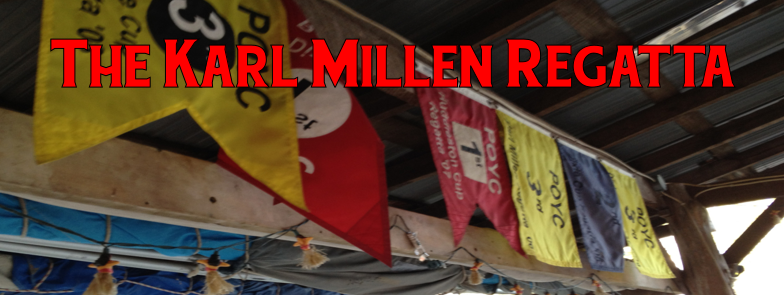
Saturday August 12th – Skippers Meeting at 10am with racing directly after. Sunfish Entry fees are waived, Dinghy’s are $10 and Cruisers $12.50. Fabulous Trophies are being created! – No Charge for members to attend the dinner which should start around 5pm. Dinner by G. Reimer with menu TBA. August Club meeting after dinner with Social activity!
 Port Oliver Yacht Club - The Telltale