Tattoos

Tattooing has been associated with the seafaring life of the navy for centuries. This tradition began in the 1700s when Captain Cook discovered the tattooed natives of the South Pacific. Cook’s sailors were looking for the perfect memento of their journey into foreign lands, and a tattoo was the most exotic souvenir they could bring home.
A Sailor without a tattoo is like a ship without grog: not seaworthy.
The United States Government issued a recruiting circular in 1909, which stated, “Indecent or obscene tattooing is cause for rejection, the applicant should be given an opportunity to alter the design, in which event he may, if otherwise qualified, be accepted.
In the 1940s this obscure ruling caused one of the biggest booms the tattoo trade had known in years. From far and wide, eligible young men were flocking to their favorite
needlers with demands for lingerie, skirts, brassieres, fans, bubbles, flowers, butterflies, almost anything that would cover up a bare spot.
Some meanings of sailor designs;
HOLD on the knuckles of one hand and FAST, on the other. This is said to help the seaman to better hold the riggings.
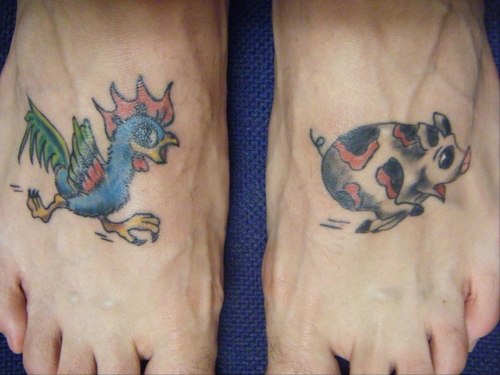
A PIG, on the top of one foot and a ROOSTER, on the other. This is said to protect the seaman from drowning, because both of these barnyard animals cannot swim so they would get the seaman quickly to shore.

An ANCHOR showed the seaman had sailed the Atlantic Ocean.
A FULL-RIGGED SHIP showed the seaman had sailed around Cape Horn.
A DRAGON showed the seaman had served on a China station.
A SHELLBACK TURTLE denotes a seaman who has crossed the equator.
A GOLDEN DRAGON denotes a seaman who has crossed the International Date Line.
ROPE tattooed around the wrist meant the seaman was a deckhand.
Miss Eleanor Barnes of the Seaman’s Institute once remarked,
“Some people pour out their colorful stories to juries. Others relieve the tension by writing for the confession magazines. The sailor enlists the tattooers needle upon
his own body in dull blues, vivid reds, greens and yellows to record the story of his loves and hates, his triumphs, his religion, and his patriotism.”
Racing Corner #1 by Doug Roberts

Racing Corner Month 1 by Doug Roberts – POYC Racing Chair

This is a year to commit to having fun with your boat or one of the club boats by racing it. Club racing is meant to be fun and help develop skills and that will be the focus of the race program this year. When a sailor begins to race, many questions come up, such as, “How do the sails work,” “Why do I always get passed rounding the mark,” and “What is rounding the mark?” This section of the newsletter over the next few months should provide some quick answers to basic questions in a relatively painless and comprehensive way. Once you look behind the curtain, you will find that sailboat racing is not all that mysterious and you can have great fun.

Let’s start with some definitions.
· Tack, Starboard or Port – Simply a boat is on a tack which is opposite of the side its main boom is on. If the main boom is on the port (left) side the boat is on a starboard tack. If the main boom is on the starboard (right) side the boat is on a port tack
· Leeward and Windward – A boat’s leeward side is the side that is away from the wind. However, when sailing downwind, her leeward side is the side on which her mainsail lies. The windward side is the side that the wind hits first or when sailing downwind it is the side opposite of the main boom. When two boats on the same tack overlap, the one on the leeward side of the other is the leeward boat. The other is the windward boat
· Keep Clear – One boat keeps clear of another if the other can sail her course with no need to take avoiding action and, when the boats are overlapped on the same tack, if the leeward boat can change course in both directions without immediately making contact with the windward boat

· Overlap, Clear Astern and Clear Ahead – One boat is clear astern of another when her hull and equipment in normal position are behind the aftermost point of the other boat’s hull and equipment in normal position. The other boat is clear ahead. Boats overlap when neither is clear astern.

Rules of Sailboat Racing:

There are three guiding principles that underlie the Racing Rules. All competitors are expected to compete within the framework of sportsmanship, fair sailing and helping those in danger. If you’re new to racing, you only need to know a few basic rules to handle most situations you’ll encounter on the race course. As you gain more experience, you’ll learn more about the subtleties and limitations of these and other rules.

Racing Rule 14 – Avoiding Contact

You must avoid contact with other boats if possible. Even if your boat has right of way you must avoid contact, but you don’t need to act until it becomes obvious that the other boat is not going to keep clear.

Three of the basic rules of the road for sailing also apply to racing.

These rules are:
* When boats approach each other on opposite tacks (one starboard tack and one port tack), the boat on port tack shall keep clear of the boat on starboard tack (Racing Rule 10). The port-tack boat keeps clear, if the starboard-tack boat does not have to change course to avoid a collision. (Just like driving an automobile you yield to the right – yield to the boat whose boom is on its starboard (right) side)

* When boats are on the same tack and overlap each other, the windward boat shall keep clear of the leeward boat (Racing Rule 11). If your boom is on the side toward the other boat, you are the windward boat. Don’t run your boom into another boat.

* When boats are on the same tack and don’t overlap each other, a boat that is overtaking from behind shall keep clear of the boat that is clear ahead (Racing Rule 12). The overtaking boat must change course to avoid running into the back of the other boat. If the boat from behind continues to overtake the other boat and they become overlapped then the windward-leeward rule (Racing Rule 11) applies – the windward boat must keep clear of the leeward boat. If you are overlapped and your boom is pointing toward the side the boat is overtaking you, you must keep clear.

Re: The Commodore’s Reception

Dear POYC Friends,

Bill and I would like to thank everyone for filling our home with laughter and friendship during the Commodore’s Reception.The presence of each of you gave these walls a much needed rattle that rang of times past when the Meng’s used to entertain on a a regular basis. It has been years since the staircase felt the bounding (no, not pounding) of tiny feet. This brick bastion has never felt so warm as it did on the evening of January 1, 2010. We are truly grateful for the occasion.

There is a constant reminder that we do not know what 2010 will hold. Who of us will see the end of 2010 on this earth? Who will not? Let us take comfort in each other during difficult times and rejoice in victories.

We’ll see you on the water and that won’t be soon enough.

Bill and Kaye Miller

Commodore’s Reception and 2009 Recap

Greetings and salutations to all of my mates at the POYC!  This epistle comes as both a recap of the month of December as well as an invitation to the Commodore’s Reception to be held on January 1st.  Almost fifty sailors gathered for the Christmas Party on December 12th at Cambridge Market with all the usual suspects present except for one mate.

It was and is my unpleasant and sad duty to announce the passing of Capt. John O’Connor who died just prior to the party.  He had just brought wife Meg home after a dangerous session in the hospital and was in fine spirits when I spoke to him on Friday the 11h.  Having completed his mission he sailed to the other shore that night.  John was a fine mate and I saw his transom sail away from me in many a race; he will be in our hearts and sorely missed.  All condolences to Meg, and hang in there.

The mates present at the party were quieted by this news, but as John would have wanted he was heartily toasted and the party proceeded.  Guitarist Brett Puckett and singer Tyrone Dunn entertained as we enjoyed each others company and jousted over the past year’s sailing season.  Past Commodore’s Herb Siewert and Lee Huddleston regaled us with some sailing lore and then we sat down to the Christmas feast.

After dinner Brown Bag Awards were presented by social chair Debbie Champion and then I had the privilege to emcee the main event.  I was pleased to present the Dinghy Cup for 2009 to Capt. Dale Sturm who not only sailed well at the club, but represented us well at the Bluegrass Games.

The Cruiser Champion came down to a tie in points initially between Capt. Gary Reimer and Capt. Dale Allison.  After a conference with John O’Connor on Friday morning the tie was broken with the winner having the lowest overall average in all races – Dale Allison.  Congratulations to both skippers – it was the year of the Dale’s.

As Commodore it was my responsibility to select the Yachtsman of the Year and this was a tough one.  Due to her prowess racing as well as her consistent dedication to the POYC Debbie Champion was my choice for this esteemed award.  The final detail of the evening was to announce the officer’s for the 2010 campaign. Race Chair – Doug Roberts  /  Hardmaster – Gary Reimer /  Purser – Barry Sanders /Scribe – Gary Guss /  Vice-Commodore – Debbie Champion

If some of these names sound familiar its because they have once again stepped up to shoulder the responsibilities of serving as officers – and they were the only candidates.

It was a great party and I hope to see all these mates and more at next year’s Christmas Party.

The Commodore’s Reception is traditionally held by the outgoing Commodore for the incoming Commodore.  I am honored to be serving a second season as Commodore so we will commence the festivities at my house at 4 pm on January 1st.

The address is 1824 Meng Road in southern Warren County.  Directions to the house are as follows:  from the North – down I-65 to the Scottsville Road exit then the first left onto Three Springs Road.  Proceed  approx. five miles to the south to the first stop sign at highway 242. Turn left onto 242 and after passing the small white church in the turn Meng Road dives off to the right while 242 continues to the left.  We are about a mile and a half down the road and the third house on the left side of the road.  The Miller mansion is almost a century old, constructed of brick and sporting four white columns across a large front porch.  Highway 242 can also be reached from 31-W from either the north of south, and if you come that way the only large road you cross will be at the above mentioned stop sign on 242 and proceed as above.  It really is easy to find so do not be deterred.

I hope to see my mates from the POYC as this will serve as the January meeting.  The past season went by quickly for me and I didn’t get as much done as I would have liked; but I hope all feel it was a successful campaign.  Thanks for your support – together we can make 2010 even better.  Merry Christmas to all and I hope to see you New Years Day!

Commodore Capt. Bill Miller