Part Dos: Puerto Rico
Since I am calling this travelogue “Gringo Escapade,” it is only right that I begin this section by quoting that great Saturday Night Live philosopher, Roseanne Roseannadanna, who famously said, “It’s always sompting.” We had checked the weather and knew that some rough weather would be rolling into the passage between St. Thomas and Puerto Rico. Ocean swells were predicted to be 20-30 feet. It looked scary on the weather charts, so we dropped our plan to sail to one of our favorite islands, Culebra, and on to Puerto Rico the next day. Instead we decided to sail to the island of Vieques and sail along its south shore to use it as a shelter from the nasty northerly weather. With a good early start we could reach the Palmas del Mar marina on the Puerto Rican mainland and would be under the shelter of Puerto Rico.
Then soon after sunrise the Roseannadanna Principle struck–the engine wouldn’t start. The wind would be on our nose so motoring would be essential. Even to get out of Charlotte Amalie harbor the motor would be needed. One day’s delay would trap us in St. Thomas until all the bad weather blew through. I ran through my repertoire of engine starting tricks in a couple of minutes and knew we needed a mechanic. But where are you going to get one on a Saturday who can come to your boat right away? Amazingly I found a great guy whose shop had been ruined by Irma and Wilma and was operating out of his truck. He found and corrected the problem that had been periodically plaguing us and at 1:30 pm we weighed anchor and began our sunrise dash for Puerto Rico.
Under the circumstances we didn’t feel that it was cheating to motor sail all the way. Minutes and miles were precious. We arrived at Bahia de la Chivas (Goat Bay) on Vieques a few minutes before sundown and got settled into a perfect anchorage protected by a small reef. We were the only boat within miles. After supper we were entertained by sparkles of light from tiny fish swimming in the bioluminescent water, a beautiful starry sky, and a big fat pumpkin moon rising over the horizon. I wonder what Roseanne Rosannadanna would say about that.
Palmas del Mar. We were reluctant to leave our private anchorage in the morning, but Puerto Rico wouldn’t come to us, so we set sail. I mean, we really set sail! The wind was blowing 15 knots from 60 degrees to starboard and we were knocking out 8 knots with one reef in the sails and the traveler down. I had almost forgotten what real sailing was like, but this was good. Escapade heeled to leeward and as I tinkered with the sails and found my sea legs again, she sliced through the sea. Three hours later we were entering Palmas del Mar marina.
Palmas is actually more than a marina. It is a community. It is a multimillion dollar marina in an upscale condominium development. When we entered the harbor we found a long concrete dock completely empty, so we tied up alongside it. Soon two dock hands met us in a golf cart to give us a tour and to recommend a slip they thought we would like better. “You’ll be lonely out here. We have a good place for you where you will have neighbors.” We were barely docked when two precocious kids from the boat behind us came up to introduce themselves. Before I could comprehend my new surroundings, the girl, Arden, was whispering something in Diana’s ear about her brother, Carver. We rode in the golf cart to the office to check in, and then walked over to the tiki bar. A big Irish setter trotted over to sniff our crotches and make friends and let us pet him. The four people at the bar welcomed us in Spanish accented English and talked with us as though we were old friends. It was easy to feel like we were part of this friendly community.
Our second day at Palmas we went for a short land excursion. Bernardo, a dock hand, gave us a ride in the golf cart to a small shopping plaza. After we bought a couple of souvenirs, the owner of the shop offered to let us use her golf cart to explore the area. I was completely overwhelmed that this woman who didn’t know us at all would offer to let us use her cart–no strings attached except to bring it back by 6 pm when she closed. We accepted her gracious offer and puttered off to find La Pescaderia, a highly recommended fish restaurant, and a nail salon. The salon was closed on Mondays, but the restaurant lived up to its reputation. We used the cart to haul heavy groceries to the boat and returned it to Sandra full of gas. I will never forget the gentleness and warmth of everyone we met in Palmas.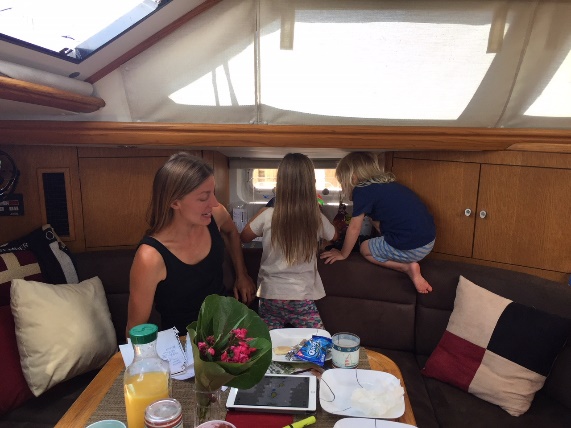
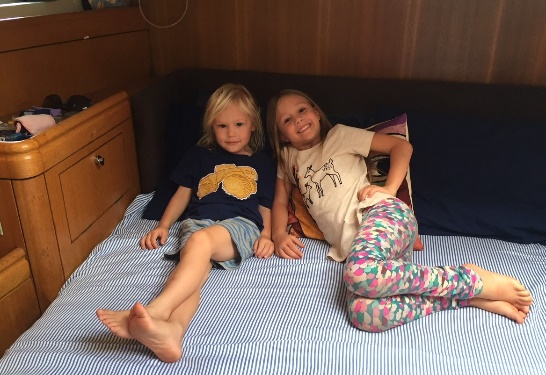
Bahia de Jobos. Before we cast off to sail west the next morning, our neighbor on the dock, Lindsay, came over to share a pitcher of fruit smoothie and to swap east bound and west bound cruising information with us. An hour or so later the junior welcoming committee, Arden and Carver, joined her along with their dad, Bay. The kids were pumped up to see the boat and found our bowl of candy and cookie snacks particularly interesting.
The downwind sail to Jobos was easy and fast, but the approach through two coral reefs at 4:30 pm with the sun in our face was a sphincter clincher. I had marked the waypoints for the entrance on the chart plotter and as long as the chart and the GPS were accurate, there was nothing to worry about. Right? Fortunately they were accurate so we settled into our anchorage behind the mangroves well ahead of sunset and proceeded to cook steaks on the grill. When night fell we discovered that the shore was decorated with blinking red lights on a row of wind generators and the glow of several factories in an industrial center.
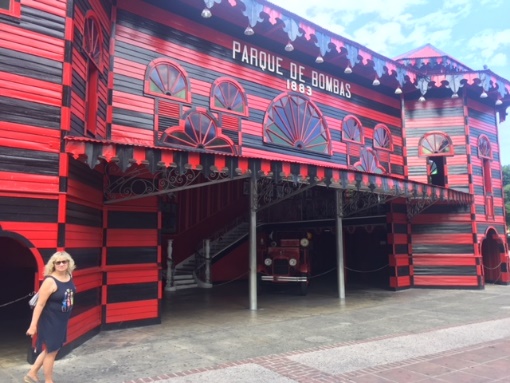
Ponce is the second largest city of Puerto Rico and very old, founded in 1692. The center of the city is a square called Plaza de las Delicias. It is shared by the elegant Cathedral of our Lady of Guadeloupe, a lovely park with a fountain, and the fire station. The fire station? Yes, the gaudiest red and black building you’ve ever seen, built in 1883 and preserved as a landmark in all its splendor. We visited these places and enjoyed walking in the historic district.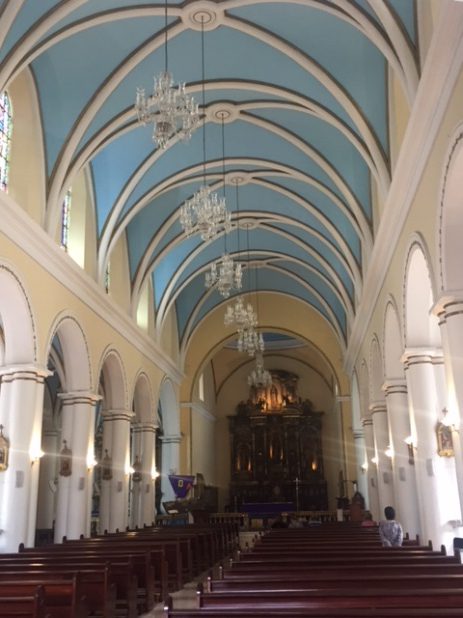
Tourism was not our primary mission in Ponce–it was the Great Ponce Scavenger Hunt. We were there to shop in the places near and dear to our hearts at home–Walmart, Sam’s Club, OfficeMax, and Home Depot. Ponce is replete with American franchise stores, including McDonalds, Wendy’s, Pizza Hut, and KFC. And most of the people are bilingual, so communicating is no problem. We had developed a detailed list of “must have” items in addition to groceries, so with a rented car and the Waze app, we hit the town hard. Prices were comparable to the same items in the US, so we wanted to make every minute count. What a treat it was to shop at USA prices instead of the double price in USVI and the triple price in BVI. Escapade is probably sitting two or three inches lower in the water after we loaded all our new equipment and provisions.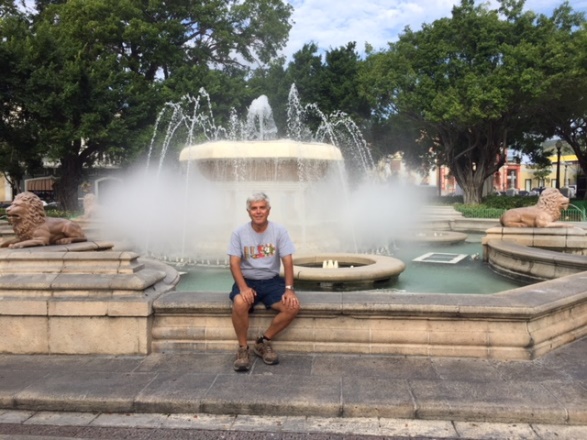
International surveys usually list Puerto Ricans as some of the happiest people in the world. Two days in Ponce showed me why this is. Puerto Ricans are completely relaxed about rules and regulations. Traffic signals are viewed as recommendations. Simple instructions like Walmart’s “Please return shopping carts here” barely rise to the level of a suggestion. If you want to use a cart in the store, just take the one left in the parking space next to your car. And clothing is not a hassle either. The men wear yesterday’s fishing shirt and the women just use spray paint.
The one area besides music where Puerto Ricans really come alive is driving. They are fearless, not a worry in the world. And so are the pedestrians. They cross the street in front of you and don’t even look back over their shoulder. These are very relaxed people.
Cayos de Cana Gorda. After a mad dash to turn the car in and get off the dock of the Ponce Yacht and Fishing Club before our daily rentals turned into another day, we sailed west to Cayos de Cana Gorda. This was another anchorage tucked behind a long mangrove reef. The only other boat in the anchorage was a German boat. Gabrielle and Thorsten came over to greet us and give us the scoop on the island known locally as Gilligan’s Island. It’s a mangrove island with a scruffy beach and doesn’t look much like the Gilligan’s Island I remember from 1960’s television.
We felt compelled to set foot on this misnamed island. It turned out that the real attraction was not the island but the Puerto Ricans who came to the island to party. They were equipped for a picnic expedition with rolling coolers, giant picnic baskets, lounge chairs, and loud music. Diana and I were the only twosome in the crowd. There were no couples or nuclear families. No group had less than about 8 people. Puerto Ricans bring everyone!
Boqueron. With a fresh breeze behind us we left the main furled and sailed on the genoa at over 7 knots. When we rounded the southwest corner of Puerto Rico at Caba Rojo, the wind moved to our beam and kicked up into the low 20’s. We had only a short distance to go so we furled the genoa and motored into the bay. A long palm-lined sandy beach looked quite inviting, but we were tired from the day’s sail and took a nap instead. I think this must be the tempo of “senior cruising.”
After my nap, I had a new surge of ambition, plus I was hot, so I jumped into the water to scrub the green slime off the waterline of the boat. A lot of little barnacles were growing on the hull from the long dockage in BVI, so I took a long handled scraping brush from our cleaning supplies and got busy scraping. It was a great activity. I got some exercise, cooled off, and increased my pride of ownership to have a more presentable boat.
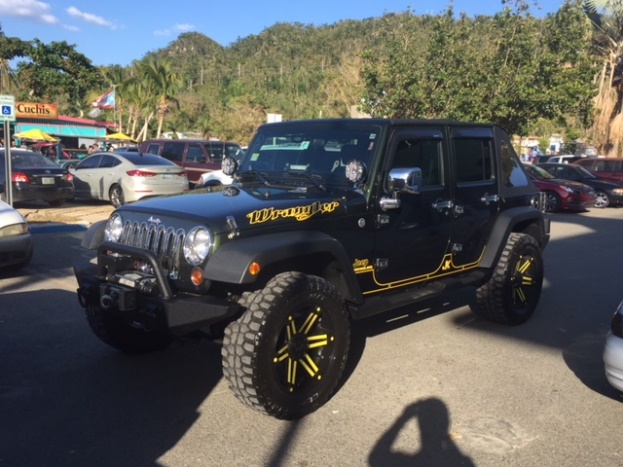
Puerto Real is a quaint fishing village squeezed between a meandering highway and the sea on the west coast of Puerto Rico. It is also where the excellent Marina Pescaderia is located. We docked there and rented a car to explore this end of the island. We drove north to Aguadilla, a town which is clearly secondary to its long ocean front. An endless parade of cars, trucks, motorcycles, dune buggies, and jeeps cruised the road beside the impressive malecon where people strolled or congregated at the many cafes and bars. The scene on this warm Sunday afternoon could only be described as “joyous chaos.” Music blared from every café and every vehicle, so whether you strolled the malecon or just stood still, you experienced a kaleidoscope of sights and sounds assaulting the senses. Puerto Ricans love their music and it comes in three styles: loud, louder, and OMG! Even the motorcycles were blasting music above the throaty staccato sputter of their engines. The royalty among the vehicles was the pimped out and jazzed up 4-door Jeep Wranglers. Whole families cruised the strip in these Road Kings. I wouldn’t have been surprised to see a Jeep stretch limousine!
There were few signs of the wreckage of Hurricane Maria until we got to the end of the malecon. The park there was still littered with debris from the hurricane and the wooden boardwalk was buckled and twisted beyond use. Still people were strolling and having fun there. The big attraction was an amazingly huge tree house built around an amazingly huge tree. Surely this treehouse had been reconstructed after the storm because it had no damage and it stood in the midst of obvious damage.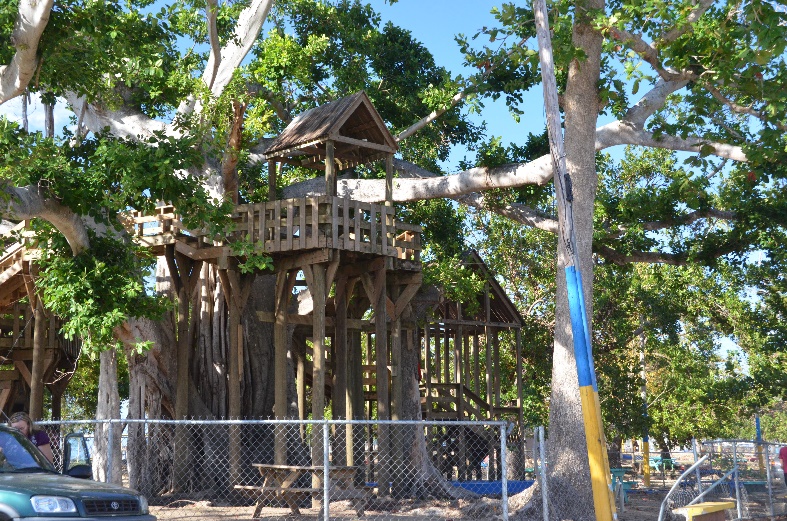
Another day in Puerto Real began with a dinghy excursion into the mangrove lagoon next to the larger harbor. This is where 25 boats hid out from Hurricane Maria without a single loss. In addition to providing a premier habitat for fish hatchlings, mangrove roots cling to the earth tenaciously. Even a category 5 hurricane didn’t tear them or the boats tied to them loose.
This exercise in ecology was followed by an exercise in futility. It was time for me to change the oil in the generator. The concept for this is not hard to comprehend, but the logistics of packing a large generator into a cramped engine room raises the difficulty level considerably. To access the dip stick, the oil and fuel filters, and the fill port I had to remove the starboard side sound shield. To remove that shield requires removing 8 other panels, supports, and pieces of the boat. A contortionist would be the ideal candidate to change the oil on this generator, but since none was available, that left the job for me. I’m sure my dad was watching from heaven and chuckling. He was probably poking my mom and saying “He earned a Ph.D. but failed Learn from Dad.”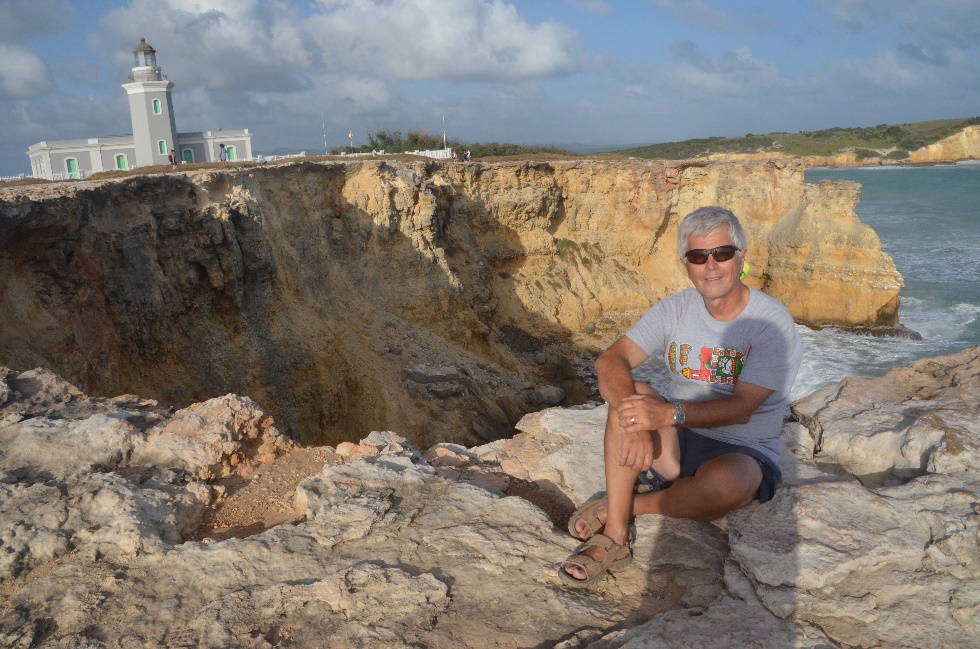
On our last day in Puerto Real we rented a car again and drove to the lighthouse we had seen on Cabo Rojo as we sailed around the southwest corner of the island. It sits on a breathtaking cliff with waves crashing on its shore 200 feet below. To get to the lighthouse we drove a deeply potholed dirt road through a wilderness refuge that presented a bleached landscape of salt flats and thickets of barkless twisted tree trunks that made me think of a Salvador Dali painting. The drive and the hike were worth it.
On the way back to the boat we drove through the town of Boqueron and experienced the Puerto Rican version of Key West. It was only 6 pm but the bars were already full and Latin music filled the streets. This seems to be a town where the party never ends and all are invited.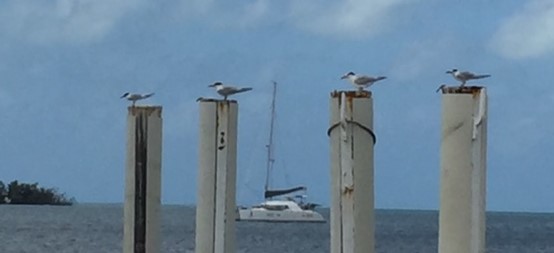
2We fueled up at the marina and dropped the hook out in the harbor in preparation for a first light departure to Bahia Samana in Dominican Republic. We
were working on putting away or tying down lines Birds of a feather
fenders, water hose, power cord and anything loose when we started hearing “Splash! Splash!” all around us. We discovered we were in a bombing range. A squadron of 40 or 50 pelicans were dive bombing for fish. They would glide in a circle until they saw a fish and then would tuck their wings to become more streamlined and hurtle beak first into the water like falling out of the sky. Scanning the water around us we saw water explosions on all sides, including some quite close to the boat. The bombardment was a great show to wrap up our days in Puerto Rico.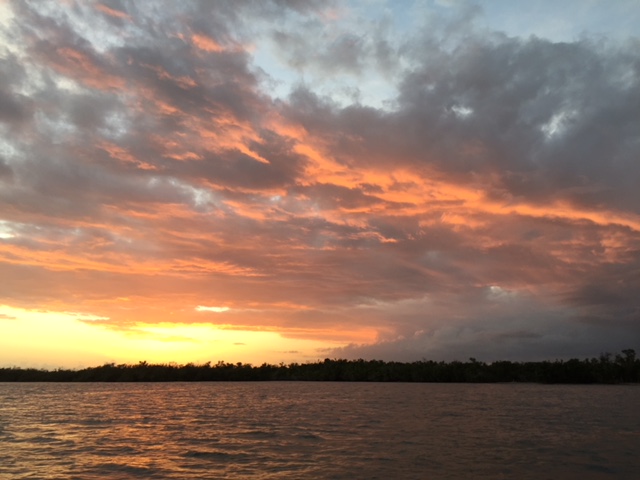
So what have we learned about Puerto Rican culture? Five things are of utmost importance: Fishing, beer, music, family, and friends–not necessarily in that order, but always with maximum exuberance.
~ Larry











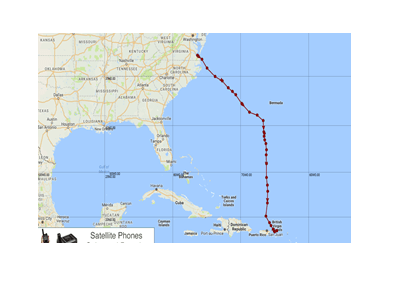
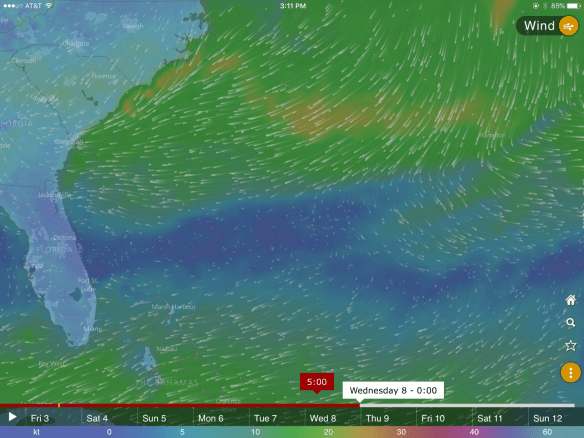 Unfortunately the Windy app showed a giant hole in the wind stretching from the coast of Florida several hundred miles to the east. The rhumb line that we had hoped to sail to BVI would take us through several days without wind. Escapade has an inboard diesel engine and a large fuel tank, but would it be enough to get us through the windless patch? We calculated Escapade’s cruising range to be about 1000 miles on 220 gallons of fuel, but BVI was 1500 miles away. And that doesn’t count fuel usage by the generator to run the refrigeration. So we chose to sail east toward Bermuda after crossing the Gulf Stream near Cape Hatteras. The sailing was slow, and we motorsailed frequently to keep speed from falling below 5 knots. Later on, our standards eroded and we were content to sail if we could keep boat speed above 4 knots.
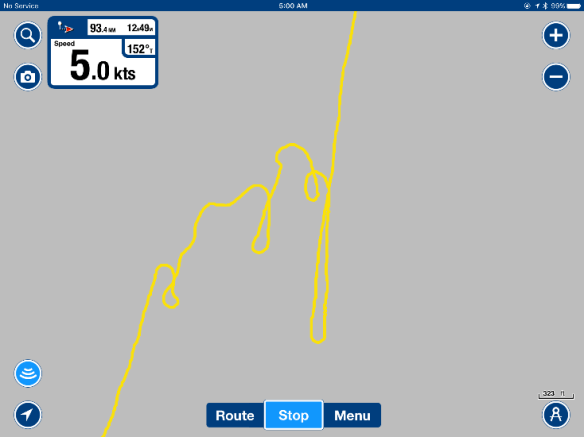 About 200 nm northwest of St. Thomas it had a psychotic event and started sailing us in sharp circles as shown by the track in this chart. I was asleep but sensed something weird going on. I jumped up to help the crew on watch get the helm under control. The autopilot refused to behave so we had to turn it off and hand steer the boat. That’s the normal way we sail on a lake in the daytime, so what’s the big deal? On the ocean there are no easy points of reference to steer by as there are on a lake. All 360 degrees look exactly the same. And night time makes it all the more tedious to steer by watching the compass. So we started the engine, furled the genoa, and left the main up for stability. Since we were motoring, we changed course and headed directly toward St. Thomas.