Caribbean Adventure – by Larry Calliouet

The good ship Vagamonda, a Beneteau 51 like our Mary Jewell, left St. Martin on Monday for a short sail to St. Barts. After spending a day with the beautiful people (no, we didn’t see any glitterati) we motored 30 miles on a windless day to Saba, an island fraught with difficulties due to its extremely deep water, vertical shores with no beaches, and only one small manmade harbor behind a seawall.  The people of Saba live in five villages high on the island. At 800 feet altitude we reached a spotless town of white houses and red tile roofs, ironically named Bottom.  From there we went up another thousand feet to the village of Windwardside, named for an obvious reason. This incredibly steep island was very scenic and the diving was spectacular.
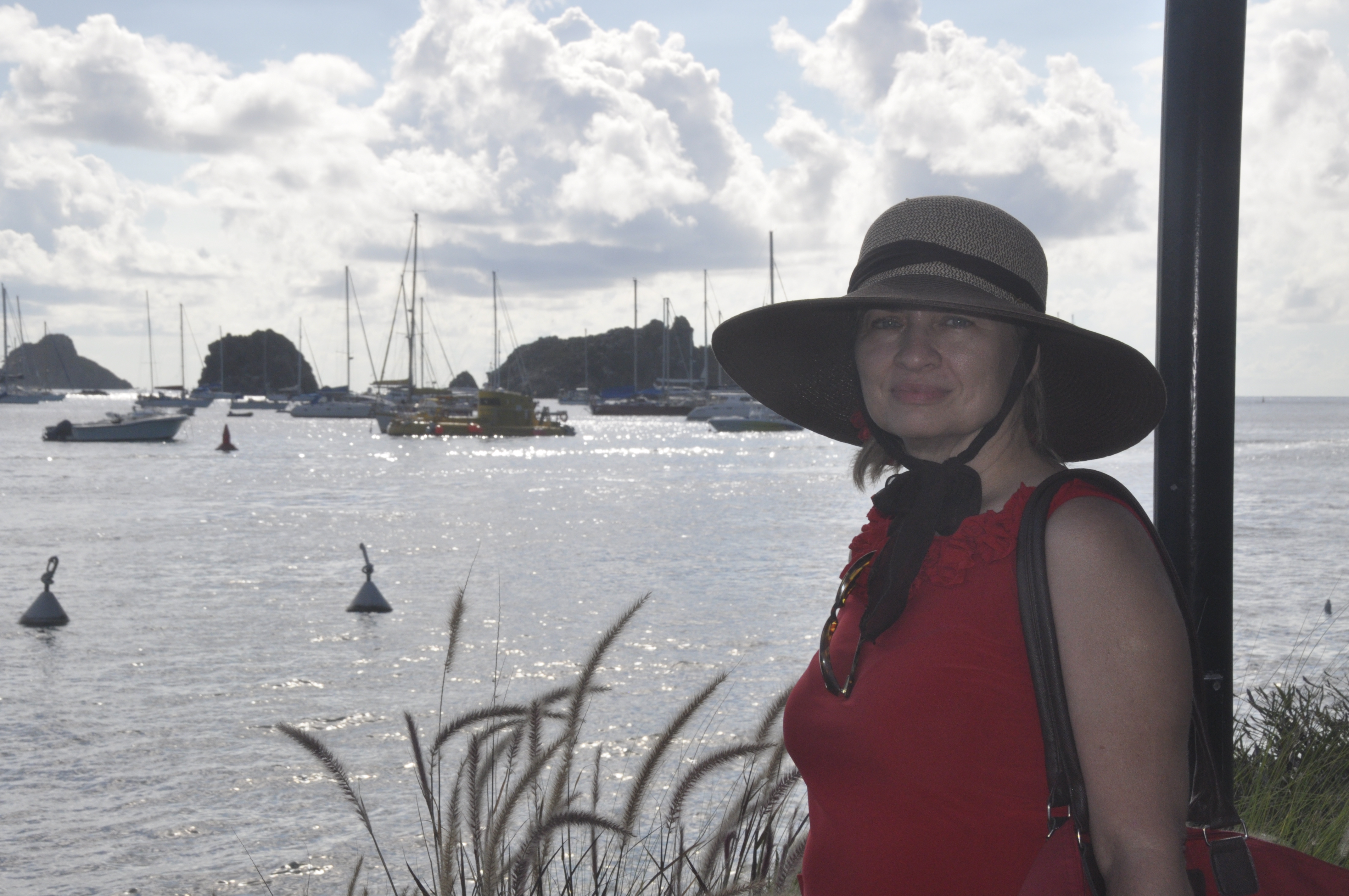
At the Carreenage in St. Barts

Next we went to St. Eustatius where we hiked up an extinct volcano and down into the crater which was covered with rain forest. After stops in St. Kitts and Nevis we arrived in Jolly Harbor, Antigua.  Antigua Race Week was going on, so we spent a day watching the races. From Shirley Heights between English Harbor and Falmouth Harbor we could see boats making mistakes that we would never make if we were racing . Down at Nelson’s Dockyard sailors, vendors, and spectators mingled, partied, and swapped stories, lies, excuses, and exaggerations.

Sailing conditions were exhilarating for the long haul from Antigua to Guadeloupe. Winds were 25 knots on the beam with gusts over 30, seas were mostly 8-10 feet with occasional 15 foot rollers, and skies were clear. With two reefs in the mainsail we covered the first 41 miles at 8-9 knots and occasionally touched 10 knots. If that wasn’t enough to write home about, big things began to happen 5 miles out of Deshaies, Guadeloupe. First the genoa halyard snapped.  The sail fell down the forestay and was whipping in the wind and water, not unlike some spinnaker problems we had witnessed in the Antigua races. We dropped the main and headed to windward.  The genoa on a cruising charter boat is heavy duty and stiff, so getting it down was a struggle, but we managed to stuff it into the forepeak cabin, the first time I ever thought that cabin was worth much except for storing empty luggage.  Then the cleat on the mast that the topping lift was secured to popped its rivets and pulled off. Down came the boom on the bimini.  That bent the frame and popped another rivet, but we used a small line to tie down the bimini frame until we could reorganize the boat and get some repairs made. Arriving in Deshaies was completely anticlimactic after all this, but we were glad to be in the harbor of this picturesque little French village.

After spending the night anchored in Deshaies harbor we motor sailed to Jacques Cousteau’s marine park at Pigeon Island where I scuba dived with a boatload of French people. The dive boat looked pretty rough, but after the first dive, they cleared off all the scuba gear from a platform on the boat and spread a pretty table cloth over it for lunch. The French take dining very seriously.

Today we set sail at 6:30 a.m. so that we could reach the Sunsail base in Marina bas du Fort, Point-a-Pitre, in time for boat repairs. It proved to be a historic occasion as we were this base’s very last customer–they are closing the base tomorrow. Sunsail’s British technician, who was holding the fort until the end, gamely climbed to the top of the mast in a bosun’s chair and installed a new halyard. While he was making this and other repairs, we were unloading garbage and upgrading our electronic capabilities, a local woman was cleaning the boat, and another woman was delivering provisions for the next two weeks. Such a beehive of activity! We will set sail tomorrow for Marie Galante or Ille des Saintes.

Larry
Pinching the Wind by Doug Roberts

Without wind there is no sailing.
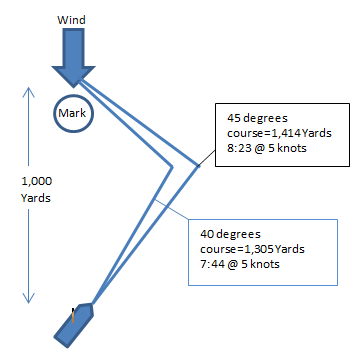
A good sailor knows exactly how high her boat will point into the wind while still maintaining the maximum velocity toward the destination.  This is especially true if you want to get from point A to B as fast as possible and point B is directly upwind.
Achieving maximum velocity toward the destination is a delicate balance between the shortened distance gained by pointing higher and the potential increased speed by falling off.

The chart demonstrates the time you can gain by pointing up 5 degrees, a little over half a minute for a typical leg of a POYC race.  However, if you give up more than 3/10 of a knot, you will have a net loss of time.

Practice, Practice, Practice
The only way to learn how well your boat can pinch the wind is to sail upwind and slowly swing the bow into the wind. When the sails start to luff, fall off until they fill. Work at broad reaching, gybing and running with the wind too.  Take something to measure your speed and see how much speed you give up by pinching the wind.  You should practice in all wind conditions.  During a race is not the time to experiment, so get out and practice sailing to a fixed buoy on the lake.

Knot of the Month for May – The Monkeys Fist

From Wikipedia ~
A monkey’s fist or monkey paw is a type of knot, so named because it looks somewhat like a small bunched fist/paw. It also looks somewhat like a volleyball or an older style football. It is tied at the end of a rope to serve as a weight, making it easier to throw, and also as an ornamental knot. This type of weighted rope can be used as an improvised weapon, called a slungshot by sailors. It was also used in the past as an anchor in rock climbing, by stuffing it into a crack, but this is obsolete and dangerous.

The monkey’s fist knot is most often used as the weight in a heaving line. The line would have the monkey’s fist on one end, an eye splice or bowline on the other, with about 30 feet (~10 meters) of line between. A lightweight feeder line would be tied to the bowline, then the weighted monkey’s fist could be hurled between ship and dock. The other end of the lightweight line would be attached to a heaver-weight line, allowing it to be drawn to the target easily.

The knot is usually tied around a small weight, such as a stone, marble, tight fold of paper, or a piece of wood. A thicker line will require a larger object in the center to hold the shape of the knot. Another variation of the monkey’s fist knot omits the use of an external object as a weight and rather uses the spare end which gets tucked back into the knot. This results in a nicer looking knot of a lesser weight, minimizing the potential danger of hurting someone with the knot when hauling line.
Monkey’s fists were also commonly used as melee weapons by sailors embroiled in street and tavern fights during the 19th century and the use of the monkey’s fist as a slungshot became common in the street gang subcultures of the 19th century. Similarly, when learning or practicing in the use of a Chinese meteor hammer, each end of the practice weapon is often tied off with a monkey’s fist knot.

Monkey’s fist’s are commonly used as a convenient and unobtrusive method of storing and transporting precious gemstones.[citation needed]

A monkey’s fist can be used on two ends of a tow lines of one side a fish net which is then thrown from one trawler to other, allowing the net to be cast and set between two boats so the trawl can be used between the two, in pair trawling[1] where the tow or catch is negotiated between both parties. This makes it easier to catch fish given the greater surface area between both boats to turn around and catch missed fish from the sea much quickly. Once all fish have been hauled up from the sea, tow lines of the fish net is returned by way of thrown both monkey’s fists back to the host trawler. Alternatively, a monkey fist can be used as a weight of a heaving line thrown to over to an opposing ship to bring two ships together.[2]

Click Here Monkey’s Fist Animation

April Meeting Highlights

The April meeting was held at the lake on April 8th at 6:30 pm.

The Commodore opened the meeting with a salute to past commodores, with Barry Sanders, Ronny Hendricks, Herb Siewert and Doug Roberts all present.

A discussion was held regarding getting Plank Park ready for the Blessing of the Fleet on April 30th. Commodore Champion and Capt. Max Vinson will work on the stained glass; Linda Guss will attempt to make some new commodore bricks for the yard,
Capt. Doug Roberts and Teresa will provide finger foods for this event and Capt. Gary Guss will work on the program. We have Father Michael from the Episcopalian church coming to give the blessing.

Purser Sanders reports that the bills are paid and money is in the bank. Three quarters of the dues have been paid so far and the rest are expected to come in soon.

Capt. Roberts is in need of helpers for the Committee boat for the Huddleston Regatta which will be held on May 28th and 29th, we will train you, no experience is necessary, just a keen eye and attention to detail. A strong back to pull up the anchors is helpful.

The Executive Committee will meet in 2-3 weeks to view the plans for the proposed Pavilion rebuild, and discuss dues structures etc. It looks like it will cost about $2500 for the initial build of the pavilion, but we are in the early stages of planning. Ronny Hendricks reported that Phil Sansom donated a large concrete countertop with a sink, this will be nice if we can build an outdoor kitchen as planned. This work is planned to begin in November of 2011.

Purser Sanders will purchase flags for those officers who need them.

The Knot of the Month for May is the Monkey’s Fist, the most elaborate Monkey’s Fist will win the prize and the prize will be determined by the Commodore. This months winner was Capt. Doug Roberts who received a wonderful colorful rubber band ball for his tying prowess on the Jug knot.

Sailing School – We need people to sign up for these classes, we have only one person thus far. If you know of anyone with an interest in Sailing, please make mention of this class. These classes will be held at the Lake each Saturday starting April 30th and through May, from 9:30 – 11:30 am with a sailing portion on the lake at 12:30. Cost is $45 each/ $75 for a couple. Capts. Bill Miller and Rob Wyatt will teach the classes. This is a great opportunity to learn sailing and get acquainted with our club.

Randy Wheeler and Max Vinson were the first club members on the water this year. The lake is at Summer pool and the ramp and docks are ready.

We enjoyed a fine meal of country ham prepared by Capt. Hendricks – Thanks Ronny !

Next months meeting will be May 13th with a potluck at 6pm, Faye Stinnet will be preparing the main course, please bring a side to share.

The meeting was adjourned at 7:19pm.

Gary Guss – Scribe

Race the Course – by Doug Roberts Racing Chairman

Race the Course
One way to ensure your best finish is to get around the course as fast as you can. This seems rather obvious, but as other competitors enter the picture you are tempted to alter your original race plan and soon you find yourself playing follow the leader. One approach is to develop your race plan focused on racing the course and not your competitors; the course is the constant in the equation.

Before the start of the race you will see boats racing along with what seems to be enough speed to win the race. During the pre-race sailors sail their boats at maximum speed without regard to the course or other competitors. During a race, however, some sailors get distracted by competitors on the course, resulting in them adjusting their race plan and sailing less effectively.

This doesn’t mean you ignore the competitors completely, but you should only use them to gain an advantage on the course. Look at the competitors who are windward (upwind) of you to help judge the changes in the wind and on Barren River Reservoir there are plenty of them. The best way to help ensure a win is to sail at your boat around the course as efficiency as possible. This means tacking as soon as a shift occurs to take maximum advantage of a wind shift rather than waiting so that you can have an opportunity to disadvantage another boat. Of course you have to be mindful of the rules so you do not place yourself in a disadvantaged position, but this still allows you to race your plan and not someone else’s race plan. You can quickly lose control of your race plan when you start factoring in the variable of other boats. Remember, you can be fast enough to win as long as you spend more time going fast and sailing a shorter distance. Next month – Pinching the Wind

March Meeting Highlights

The meeting was held at 6:30PM on March 11th at the club grounds.

Commodore Debbie cooked white chicken chili  which was enjoyed by all the mates.

Purser Barry Sanders commented that Board members should fly their flags at club events and meetings, a discussion of who had and needed flags ensued.

We discussed the need to rehab our Plank park and Max Vinson, Debbie Champion and Linda Guss all expressed interest in rehabbing the stained glass. The need to explain who is listed on the bricks in the park and their history was talked about. Captain Lee Huddleston will get a sign made and posted in the clubhouse to accomplish this. Commodore bricks are needed for the past several years. Past commodores can buy these for $25 each.

Our Purser – Barry Sanders reported that we have cash and the bills have been paid ( hope he doesn’t mean Bill Miller and Bill Champion ). Next year our bill from the Corp of Engineers is $1250 /year or $6250 for the next 5 years.

The knot of the month is the Jug Sling Knot. This knot was used on dhows in ancient times and also to provide a handle to enable hauling multiple amphorae at a time. Max Vinson is our go-to person for this knot (and most knots ). Ask Max who has a great knowledge of these matters and can tie this knot three different ways.

Sailing School at the Club – starts on April 30th and runs every Saturday from 9:30-11:30 through Saturday May 21st. The fee is $45 for each person and $75 for two people. Each Saturday at 12 noon there will be a sailing portion of the class, we need skippers and boats to sail with the new students and explain our sport. Classes will be held rain or shine.

Capt. Max Vinson needs to have some crew to help him with his boat. This is an excellent opportunity to learn from the master and will let Max sail more often. If you are interested and would like to sign up for weekends when Max is available, please contact Debbie Champion. If you have any experience in setting up a web based calendar scheduling system please contact your Scribe Gary Guss. We would like to be able to set something like this up on our website and match up skippers and crews. This will give us all a chance to sail more often and learn the differences between boats.

We just had the Spring Work Party on March 18th. Attendance was great and we got a lot accomplished. Thanks to all who attended and worked. Please see Yardmaster Reimer if you can help with some of the items left unfinished.

The Blessing of the Fleet will be held on April 30th at 11:30 am. Father Michael from Christ Episcopal will be presiding at the ceremony.

The next monthly meeting will be April 8th at 6:30pm for potluck at the lake. The Kerstings will be cooking “Shashlik”, the Ukrainian National Summer Entrée’. Here in Kentucky we call it BBQ.

Spring Work Party – Saturday March 19th

The List for Saturday:
Need Tools – Extension Ladder if anybody can bring one – Powerwasher also

WORK PARTY LIST
SATURDAY MARCH 19, 2011
1) DOCK EXTENSIONS
2) INSTALL FLOOD LIGHTS
3) POWER SPRAY INSIDE HEAD
4) PAINT INSIDE HEAD
5) DRINK BEER
6) CLEAN/ORGANIZE SHED
7) REORGANIZE SHELTER LOFT
8) CUT & TRIM GRASS AROUND BOATS
9) RE-ARRANGE DINGY ROW
10) POLICE YARD
11) PAINT GATES
12) CLEAN HEAD AND SHED ROOFS
13) CLEAR RAMP
14) CUT BACK DECORATIVE GRASS
15) CLEAN AND COVER CLUB BOATS
16) REMOVEOLD TIES FROM LAKE PATH
17) REPLACE TIES ON PATH TO UPPER LOT
18) CLEAN MAYFIELD PARK