Bermuda Escapade

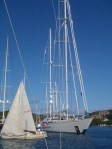
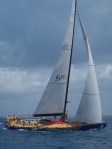
escapade Larry and Diana Caillouet have been invited to race in this year’s Newport to Bermuda Race in their 1996 Oyster 55, Escapade. The race leaves Newport, Rhode Island on June 17. Depending on wind and sea conditions and skills of navigation and sailing, most of the fleet will cover the 635 miles to Bermuda in about 5 days. The biggest wild card in the race is crossing the Gulf Stream, which can significantly affect the weather and make this a race to be won or lost by the navigator. Finding the best way to minimize the northward flow of the stream and capitalize on its southward eddies is often the secret to finishing well. This year’s race has 200 monohulls ranging from some 36-38 footers to the 100-foot speed demon Comanche which holds the monohull speed record of sailing 618 miles in a single 24-hour period.

 escape2Escapade will race with a crew of six men including Richard Collins and Larry from Bowling Green, one from Indiana, one from California, and two from Connecticut. Diana will not be onboard for the race but will meet the crew in Bermuda and cruise back to Annapolis from there.

Larry and Diana are using this race to prepare the boat and themselves for long distance cruising after the race. The Newport Bermuda Race has very strict and specific safety requirements for equipment and crew training. Larry says “Money spent on safety is wasted–until you need it” so he and Diana are hoping that it will all be wasted.

Escapade will be racing in the Cruiser Division which is for cruising boats with amateur helmsmen.

BVI Spring Regatta aboard the Mary Jewell

Larry and Diana Caillouet are now cruising in the Virgin Islands on their Beneteau 50, Mary Jewell, after placing on the podium in all three events of the 2016 BVI Spring Regatta and Sailing Festival. Mary Jewell took second place in the first event, the Nanny Cay Cup Around Tortola Race. The course consisted of a two hour upwind leg up the Drake Channel past Beef Island and Scrub Island, then a jibe onto a downwind leg along the Atlantic coast of Tortola. After rounding Brewer’s Point at Cane Garden Bay, the boats raced through the Thatch Island Cut, rounded Frenchman’s Cay, and sailed upwind in the Drake Channel again to the finish line. Although the course is approximately 28 miles, Mary Jewell traveled almost 39 miles to complete the course in 5 hours 18 minutes and 10 seconds. In addition to the miles added by tacking upwind, Larry and his crew followed a strategy of sailing well offshore on the north coast of Tortola to avoid the wind shadow from the mountains. Winds were fairly steady at 18-23 knots. Mary Jewell averaged over 7 knots with a brief top speed of 11.0 knots. The crew consisted of Larry, Richard Collins, and Dan Chaney, all of Bowling Green, and Bill Linehan of Indianapolis.

The second event was the Scrub Island Race from Nanny Cay on Tortola to the Scrub Island Resort and Marina. Mary Jewell took second place again behind the same team from the Netherlands who won the first race.

The third event was a three-day six-race regatta using a combination of islands and floating marks to create interesting and challenging courses. Except for the second race which was held during a howling rain storm, all the races enjoyed perfect BVI weather. Diana Caillouet and Ron Weiss joined the crew for the regatta races. After the first day of racing, Mary Jewell was in fourth place in the fleet of sixteen boats in the charter boat division. After the second day Mary Jewell was still in fourth place, 4 points behind the third place boat. In the fifth race Mary Jewell pulled a stunning upset and placed second, ahead of all three previous leaders, gaining three points to move onto the heels of the third place boat. However, in a controversial decision, the race committee voided the entire fifth race based on a protest against the course instructions, so Mary Jewell remained four points behind third place. The final race was in light breezes, not unfamiliar to Barren Lake sailors. Mary Jewell trailed her target, the third place boat named Thunder Girl, at the windward mark, but steadily pulled ahead on the downwind run to the finish to beat Thunder Girl by four places, earning a tie for third place. In the tie breaker, Mary Jewell’s first place finish in Race 3 awarded them the third place trophy.

At 7 years old, Mary Jewell was the oldest boat in the race and raced against mostly new boats with crisp new sails. In a champagne celebration onboard Mary Jewell after the regatta, Larry toasted “To Mary Jewell –the old girl can still shake it!”

Dan and Larry waving the Red Towel while celebrating the win onboard Mary Jewell.

Dan and Larry waving the Red Towel while celebrating the win onboard Mary Jewell. Dan, Diana, and Larry are the three Hilltoppers in the race crew. Other crew members (left to right) are Bill Linehan from Indianapolis, Richard Collins from Bowling Green, and Marty and Ron Weiss from Stamford, Connecticut. The wine decanter and 4 crystal glasses are marked with the logo of the 45th BVI Spring Regatta, Third Place. The framed map of the British Virgin Islands is the award for winning Second Place in the Around Tortola Race. The trophy with the Lucite sailboat sitting on the table is the award for winning Second Place in the Scrub Island Race.

DSC_0552

POYC Around the World

The Port Oliver Yacht Club burgee is traveling the world again this spring and summer. Last year it flew over the waters of Thailand, Australia, and the Seychelles.  This year four sailors representing POYC competed in the 2014 British Virgin Islands Spring Regatta in April. The crew included Larry Caillouet, Richard Collins, and Dan Chaney from Bowling Green, and Bill Linehan from Indianapolis. They raced a Jeanneau 53 named Lady Suzanne and finished fifth of nine entries in the charter boat division. They were in contention until major damage to the mainsail track on the mast caused them to limp across the finish line in race #3 and miss race #4 altogether. In an ironic twist, Larry and Diana’s boat, Mary Jewell, was sailed by a Dutch crew and took first place, winning 5 out of 6 races.

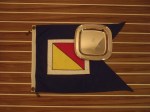
POYC burgee and the official flags of BVI and the BVI Regatta.

POYC burgee and the official flags of BVI and the BVI Regatta

After the BVI Regatta, the POYC burgee took its second tour of duty in French Polynesia, having visited the Society Islands previously in 2010. This year it flew for two weeks in Raiatea, Bora Bora, Maupiti, Tupai, and Tahaa aboard a 46 foot Moorings catamaran.  No racing here, just beautiful days of tropical breezes, crystal clear water, swaying palm trees, and the roar of waves crashing on the reefs around each island. Inside the lagoons coral was bountiful and pristine.  Warm waters and an abundance of tropical fish made snorkeling a must-do activity every day.

Taravana Yacht Club, Tahaa, French Polynesia

Taravana Yacht Club, Tahaa, French Polynesia

Next the POYC burgee flew over the turquoise waters of Turkey. Larry and Diana Caillouet sailed along the Mediterranean coast of Turkey on a 45 foot Sunsail Jeanneau monohull.  They boarded the boat in Gocek and sailed as far west as Marmaris and as far east as Kalkan. Turkey is not exotic like Tahiti, but is beautiful in its own way. The rugged mountains come right down to the sea creating many bays and harbors.  The days are sunny and warm, but at night you sleep with a blanket or two. The waters are turquoise blue and so clear you can see fish swimming 15 or 20 feet below the boat. The people are genuinely friendly and the food is great!

The POYC burgee keeps a solitary watch over Mersin Limani

The POYC burgee keeps a solitary watch over Mersin Limani

After two weeks in Turkey, the POYC burgee hopped over the Aegean Sea to board a 42 foot Moorings Beneteau monohull in Lavrion, Greece. Its itinerary for two weeks was to sail to the Cyclades islands of Kythnos, Syros, Mykonos, Paros, Ios, Santorini, Folegandros, Sifnos, Serifos, and Kea before completing the cycle at Lavrion.  These islands are 20-30 miles apart and the winds can be strong, so each day saw some serious sailing.

A view of the ancient Chora on the island of Serifos from the town dock.

A view of the ancient Chora on the island of Serifos from the town dock.

The POYC burgee is now completing its world tour by returning to its “home away from home” the British, US, and Spanish Virgin Islands.  Larry and Diana are sailing there with friends for four weeks in July before returning to the real home of the by-then tattered burgee, Barren River Lake.

 POYC represented at the Reggae Festival in Cane Garden Bay, Tortola, BVI.

POYC represented at the Reggae Festival in Cane Garden Bay, Tortola, BVI.

Don’t let anyone from a fancy “white pants and blazer” yacht club disparage the Port Oliver Yacht Club.  Its burgee has been seen around the world.

~Submitted by Larry Caillouette

Seychelles Journal- Larry and Diana Caillouet

June 15, 2013        7500 air miles
After a pleasant morning of finding ways to pack the 69 kilograms of clothing and equipment for snorkeling, diving, boat navigation, water safety, and communications that we had brought with us to Australia into the 60 kilogram allowance of Emirates Airlines, we said goodbye to the Whitsundays.  A one hour flight brought us to Brisbane where a 6 hour layover gave us a chance to catch up on some correspondence.  The Brisbane airport was the most spacious and thoughtfully comfortable airport I’ve ever seen.  For instance, in the gate areas instead of the normal crowded rows of worn plastic seating there were tables and movable chairs where groups could gather or individuals could work while waiting for their departure.
We flew to Dubai in darkness for 14 hours and 20 minutes because our plane was fleeing the sun chasing us from the horizon behind us.  Flying over the parched Australian outback we could see large strips and patches of wildfires burning in the night.  Over Borneo, Sumatra, Malaysia, and India I couldn’t see much because I was watching three movies.  After another 4 hours and 40 minutes in the air we arrived in Seychelles where a taxi waited to take us to the Sunsail base at Eden Marina.

52  Our vessel was a 40-foot Robertson & Caine catamaran named Tharius.

Sunday, June 16        11.5 nautical miles
Even though we were eager to cast off dock lines, we took time to go with Lilly, the wife of the Sunsail base manager, to an outdoor exposition in celebration of Nation’s Day, the anniversary of the founding of the current Seychelles government.  The exposition was a lot like a county fair, except without the Ferris wheel and the Tilt-a-whirl.  The aroma of barbecuing chicken, pork, and fruit bat was intoxicating and the music was comfortably familiar: A Seychelles reggae version of the Everly Brothers’ “All I have to do is Dream,” Kenny Rogers’ “The Gambler” and the all-time islands’ favorite “Hot, Hot, Hot” sung in Seychellois Creole.
When we finally cast off we headed north to enjoy a good downwind sail.  The feel and handling of a catamaran was rather awkward to a confirmed monohull sailor. The wheel had little “feel of the water” and the handling seemed unwieldy and imprecise.  I could have been driving a 1992 Crown Victoria, which has some resemblance to a catamaran–large, squarish, and clumsy.
Our first night at sea was spent on anchor at Baie Beau Vallon–Beautiful Valley Bay.

DSC_0905 The anchoring system on a catamaran is different from that on a monohull, and we weren’t sure that we had figured it out, so we put plenty of space between us and the two boats already anchored there.  This margin of error proved to be important because the confused sea moved the three boats around in strange and inconsistent ways.  Instead of all three boats swinging to the north together as you would expect with a wind shift to the south, one would go north, one east, and one west.  During the night, the other two boats got so close to each other that one of them had to move to be sure that they wouldn’t collide.  It was good entertainment since we weren’t involved in the paso doble the two boats were dancing.

Monday, June 17        10.9 nm
I let the tracker on the iPad run all night and by morning it had colored a wide swath of yellow track where we had swung around the anchor all night.  Diana was feeling sick, and so we thought at first it was seasickness, which would have been quite understandable, but it turned out she had a slight fever, so we doctored her much of the day and by evening she was feeling better.
We made a short day of sailing down the west coast of Mahe looking for a quiet and pretty place to spend the night.  Along the way we saw strange human habitats—some people here live in birdhouses and glass cubes!

53 We investigated Anse Major, a pristine beach with access only from the sea, but settled on Baie Ternay in the National Marine Park on Mahe.  Our little corner of the bay was so pretty it would make a fabulous Hollywood set.  Large bare granitic stone poked through luxuriant green tropical foliage surrounding a secluded beach.

DSC_0882 We moored close enough to the beach that I could snorkel ashore.  The bay was filled with coral but the star of the show was a hidden pool of fresh water beyond the beach.  It was fed by a small stream that flowed down through the valley.  This shallow pool on the island had its own small sandy island.  Hollywood couldn’t have done better.
Swimming ashore was easy, but getting back to the boat was a different matter.  The tide was surging in and would have been difficult to swim against, so I hitched a ride on a motor boat that was visiting the beach.  When it got me beyond the breakers I bid them adieu, jumped into the water, and swam back to our boat.

Tuesday, June 18    3.5 nm
We gave up the paradise of Baie Ternay to explore further down the coast.  Immediately that seemed like a bad idea when we were hit with 20-25 knots of wind and 4-8 foot waves.  The winds and waves were moving north and we were heading south, not the catamaran’s strong suit, so the boat labored to get around Cape Matoopa.  The boat pitched and rolled severely, contradicting the catamaran’s vaunted stability, but eventually we were able to turn in at Port Launay.  It was as though we had jumped to a different world–the water inside this protected bay was as flat and calm as lake water and the wind became a gentle breeze.
Launay was the paradise de jour.  A broad sand beach with palm trees, lounge chairs, and vacationers was in front of us and tall green mountain ridges flanked us on port and starboard.  Behind us a rocky reef protected us from ocean rollers.  Ironically, on this reef a large cross was erected in memory of the lives that were lost when a ship foundered here.  In the distance one lofty mountain top was shrouded in the mystery of fog, while another mountain peak was bathed in sunlight.
After our daily ministrations with the anchor, we dinghied ashore and enjoyed the soft sand beach.

55 We got good glimpses of Seychelles culture by talking with Cristobel and David.  Christobel is a young guy who runs the kayak and Hobie cat rental.  He wore a knit cap to hold his long hair, maybe in dreadlocks, and took great pride in welcoming us to his homeland.  If we were in the Caribbean I would guess him to be a Rastafarian, but here he is just a laid back dude.  David is a middle aged man who books trips on fishing boats.  Diana talked with him at length about topics ranging from corruption in the Seychelles government to U.S. history.
Back at the boat we tried out a feature unique to catamarans–the trampoline between the two hulls.  We took a couple of glasses of iced tea, a box of chocolate chip cookies, and a couple of pillows and stretched out on the tramp.  The boat gently rose and fell as the sounds of children playing in the water and waves lapping on the shore lulled us into a state of supreme relaxation.  Snorkeling or anything that required effort lost its appeal.

Wednesday, June 19       19 nm
Today was Indiana Jones Day for us.  We left the tranquility and safety of Port Launay to explore Therese Island.  It is uninhabited now, but legend has it that people from Madagascar came here several centuries ago and carved steps in the rocks all the way up to the granite summit of Therese and used it for religious rites.  Diana and I anchored outside the reef and sent a landing party ashore (the two of us) to find and climb those steps.  We enjoyed a wonderful stroll on the beach and a picnic under palm trees, but we never found the steps.  Through binoculars we could see an area high up on the mountain side that looked like steps, but if there was a path to those steps, tropical foliage has done its work and preserved the sacred secret of the Madagascan steps.
After our shore excursion we sailed up the west coast of Mahe, around the top, and then motored hard down the east coast to arrive at Eden Marina in time to dock.

Thursday, June 20            33 road miles
You can learn more about people by talking to them than by looking at them from the sea, so we rented a car and set out to meet the real people of Seychelles, not just the yachties at the marina.  Meeting them wasn’t hard.  The rental car was delivered to us with almost no gasoline in the tank, so we had to find a fuel station (yes, that’s what they call them here.  They are government operated and are large but few–not on every corner as in the USA.).  I had a map that had stations marked on it, but since there were no street signs and few directional signs, just finding a fuel station brought us into contact with a woman waiting for a bus and a man outside a hardware store when we stopped to ask them for directions.
After fueling up we set out for Beau Vallon on the west coast of Mahe.  Along the way we talked to two men digging a big hole in the road, the guard at the Hilton hotel, an Indian running a small grocery, and some young Seychellois men selling fruit and vegetables beside the road.  Finally we found Big Blue, the dive shop I’m going to dive with in Mahe.  There we spoke to Charise, the precocious 10-year-old girl running the shop.  Charise had beautiful light caramel skin and spoke authoritatively in a slightly British accent.  I had corresponded by email with her mother who owns the shop, but meeting Charise was an unexpected delight.
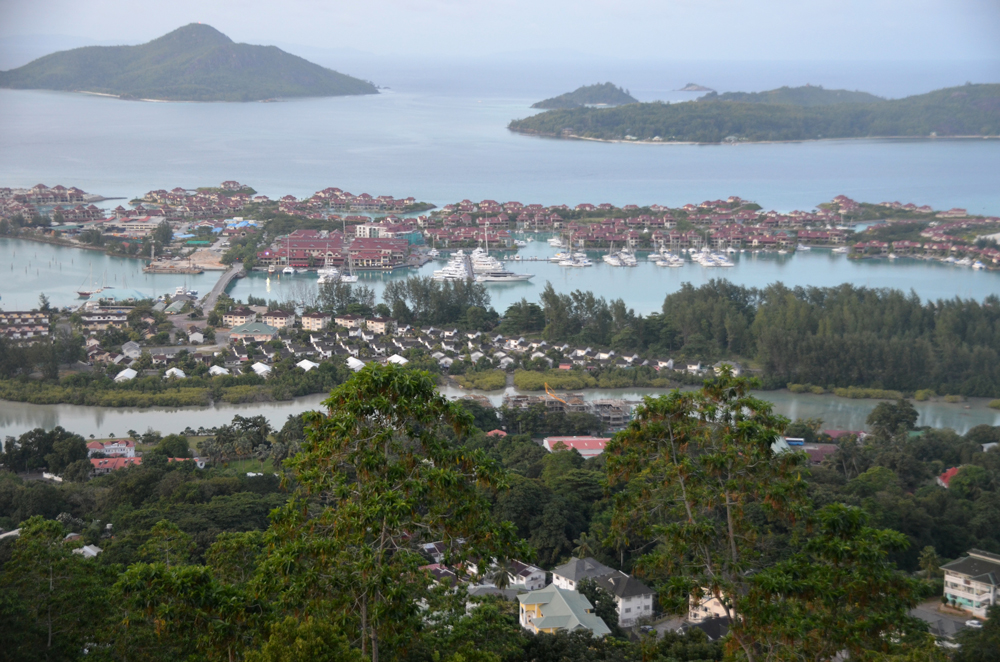
After one more stop for directions, we found the road over the mountain and managed to safely negotiate a twisting road that sometimes narrowed to one lane and often dropped off sharply with no guard rail of any kind.  The foliage became more lush and tropical the higher we climbed because the top of the mountain is often cloaked in clouds and receives the most rain.  We marveled at the inventiveness of people who found ways to build a house here and there in this terrain.  The road took us to Port Glaud and Grande Anse on the south coast and then looped back over the mountain on a road parallel to the first mountain road (if you can call two snaky roads parallel.)  Finally we arrived at a lookout point where we could see the modern upscale beauty of Eden Island Marina below us.  We were “home” again.

Friday, June 21    29 nautical miles
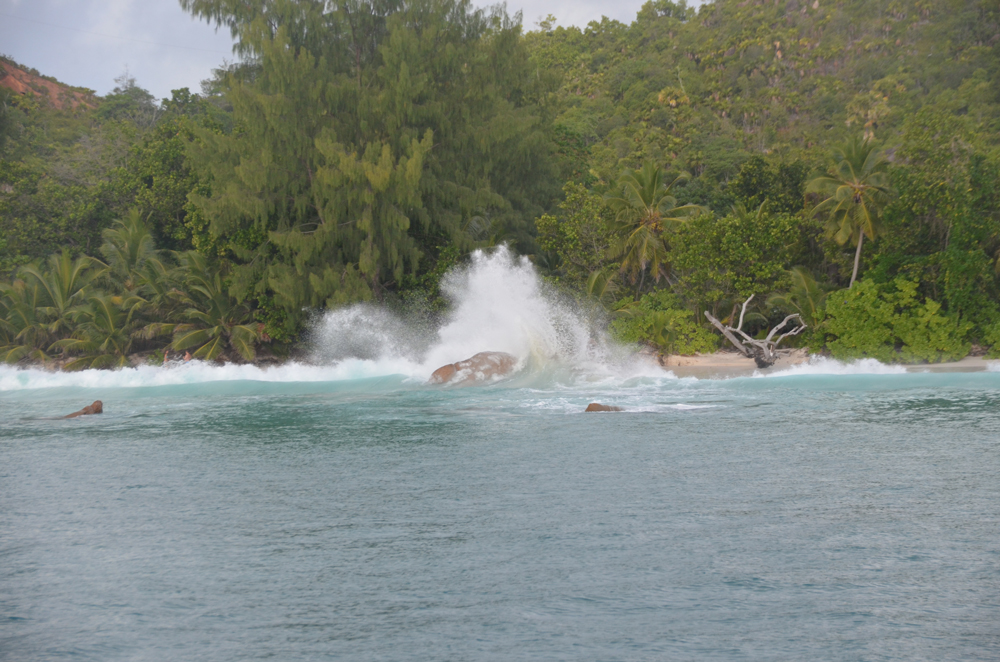
I’m writing this sitting on the front deck of Tharius while listening to surf pounding the rocks and beach of Anse L’azio 200 meters ahead of me.

DSC_1047 A steady southeasterly breeze pushes us back on our anchor chain safely away from the breakers.   A halo glows around an almost full moon above me.  We have one neighboring boat to port and one astern of us.  The rest of the bay is ours because the swimmers and sunbathers have left the beach and retreated to their favorite bars and cafes.  Well, it’s ours except for non-human species.  Just before sunset a squadron of 7 brown sting rays crossed in front of our boat, but having no business with us glided out of sight.
Today was our longest sail so far in the Seychelles, 29 nautical miles on a beam reach from Mahe to Praslin.  Praslin is smaller and much less populated than Mahe, but is renowned for its beaches, bays, and forests.

Saturday, June 22    2.5 nm
Just around Point Chevalier from Anse L’azio is Curieuse Island, home to giant land tortoises.  It’s in a national marine park so park rangers are in charge of the beaches and the tortoises.  After dinghying ashore we hiked a rough 40 minute trail over a couple of hills and through some mangrove swamps to the tortoise sanctuary.  When we first saw them with shells 2 feet high and 3 feet long, we weren’t sure they were real.  They looked like large stationary lawn ornaments.  But when we approached a tortoise it would move slowly toward us.  Thinking of American snapping turtles we were cautious at first, but we sensed how sweet and gentle these huge tortoises are.  One, which we named Alice, moved glacially over to where Diana was sitting on a bench and put its head on Diana’s leg.

61Diana petted its leathery neck and it acted like a dog in slow motion.  When I brought it a green leaf from a tree, it opened its mouth wide and slowly munched it up.  These tortoises have lived here for 50 to 100 years under the care and protection of the park rangers and are not afraid of humans.  They seemed to enjoy human interaction and we counted it a special privilege to interact with these grand animals that were as old as us or older.
We were warned by the park ranger that our mooring in San José Bay might get rough in the night, but we assessed the situation and decided to take our chances at San José.  It turned out to be the calmest night we have had in Seychelles, maybe even too calm.  I like the boat to rock me to sleep.  The full moon lit the bay almost like a baseball field, and we were the only boat in the bay.

Sunday, June 23    2.6 miles
We moved back to Praslin at Anse Volbert, the most developed locality on Praslin.  It has several restaurants and shops and two or three hotels.  The bay at Volbert is extremely shallow and has some covered rocks in places so we moored behind Chauve Souris, a big rock with a small elite hotel on it about 0.3 miles from the Volbert beach.  We dinghied in to shore at low tide and had to drag the dinghy 20-22 meters up on the beach so the high tide wouldn’t reach it.  It was too heavy for just the two of us, but we recruited some help from a local Seychellois man named Roland.  With three of us it was no problem to drag the dinghy up on the beach close enough for me to tie it to a palm tree.  Roland said the high tide would reach the dinghy but that he would keep an eye on it.  When we returned just before dark the tide had lifted the dinghy further up on the beach than we had left it, but Diana and I were able to spin the bow toward the sea and drag it down the beach to the water.  Dragging a heavy dinghy down a beach is easier than dragging it up the beach.
We rented a car to tour the island and we covered most of it, but the highlight of the day, and maybe of the whole trip was hiking through Vallee de Mai.  Some of the locals jokingly call it Jurassic Park because the wild topical foliage grows to immense size.  Imagine walking under a philodendron plant and you begin to get the idea.  This forest is a UNESCO World Heritage Site because of the unique and ancient coco de mer forest.

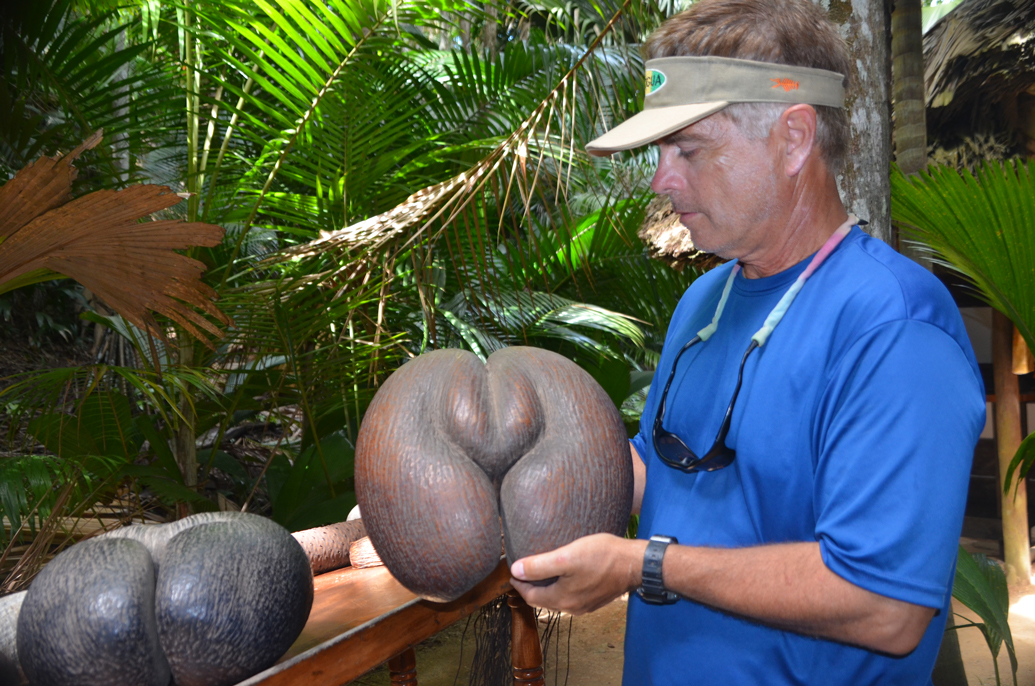
56The coco de mer tree grows the largest nuts in the world, some weighing over 40 pounds.  Their size puts them in the Guinness Book of World Records but their shape has put them in the hearts of sailors and explorers for hundreds of years and now in the hearts of tourists.  The female coco de mer bears the huge seeds that appear to need a pair of panties on them.  The corresponding part of the human male anatomy is easily seen in the catkin of the male coco de mer.  As one lady in a shop told us, they vary in size just like humans.
When we went into a shop to rent a car we were surprised to hear Kenny Chesney on the radio.  The clerk at the cash register told us that he is very popular here and that the radio station always plays country music on Sundays.  That is the same surprising custom that we learned in Saint Lucia–country music on Sundays.
One of Kenny’s island anthems tells about waking up on the beach with a hundred mosquito bites.  Diana and I have about a hundred bites on our legs and arms from No-see-ums.  They may be the same insect as the Canadian No-see-ums.  We don’t know.  We can’t see ‘em.

Monday, June 24    0.6 nm
Diana spent the day relaxing on the boat while I went for two scuba dives.  The first was at a site called Ave Maria.  The water was rough and waves were splashing hard on this outcropping of rock with a few trees on top.  Someone suggested in jest that we should say the Ave Maria prayer before diving.  In the rough water it seemed appropriate, but when we got below the surface it was calm and peaceful.  There is a sermon or a speech illustration in that if you think about it.
The real adventure came at supper time.  We dingied ashore before dark to eat at La Pirogue Restaurant which had been recommended to us.

57Diana ate curried octopus and I had curried fruit bat.  Both were delicious but the fruit bat required a lot of work to get a little bit of meat off the bone.  It had a high effort-to-payoff ratio.  If that wasn’t enough of an adventure, we had to dinghy three tenths of a mile back to our boat in the dark.  We had left the boat’s anchor light on and it guided us back but motoring through choppy water in the dark isn’t my favorite thing to do.  Fortunately the outboard motor is very reliable.

Tuesday, June 25    5.9 nm
After an easy sail from Praslin to La Digue, another adventure in mooring began.  We had been warned and instructed about the unique mooring system in La Digue.  The island is completely surrounded by reef except for a small harbor inside man-made rock breakwaters.  When you enter the harbor you have to turn the boat 180 degrees, drop anchor, back toward the rock quay at the back of the harbor, launch the dinghy, and take a long heavy line ashore to tie to the rocks.  Easier said than done.  We were prepared with fenders in place and the shore line ready to deploy, but it was impossible to visualize what we would see in the harbor until we got there.  Fortunately the harbor was not busy and a young Seychellois man who goes by the name Zorro (his real name is Bradley) was waiting to help boats moor.  He shouted instructions to Diana and me and waited on the rocks for our line.  Wind had pushed our boat sideways making the line too short to reach the shore, so I tied the end of the shore line to the dinghy painter, revved up the outboard motor in reverse, and backed up to the shore.  Zorro and a Canadian volunteer grabbed the line and began pulling it in.  I went back to Tharius and worked the shore line from the boat end.  Eventually we got everything tightened up and our boat securely moored.
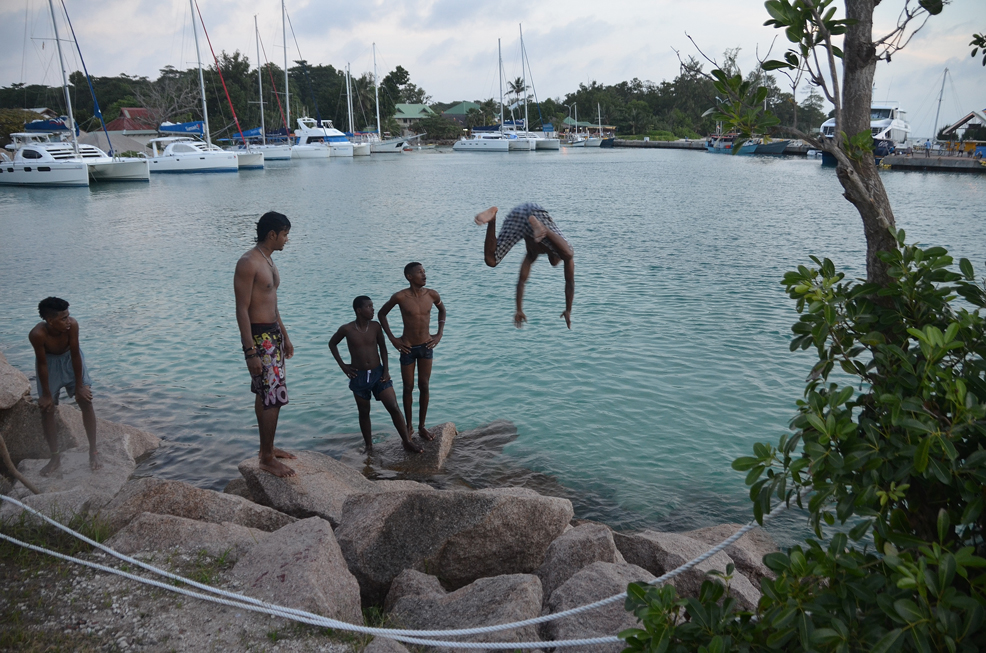
Like any good adventure/suspense story, just when you think the scary part is over, it isn’t.  Another sailboat came in, a 46 foot catamaran, and although it was loaded with people, they were unprepared for the mooring routine.  Two men did all the work while the women and children watched.  Well, one boy took their dinghy and picked up Zorro to help them.  The wind blew them toward us so Diana and I stood on deck to fend them off.  We did this successfully several times and then they decided to pick up their anchor and reset it.  When they did, they hooked our anchor chain with their anchor.  We shouted instructions to them and their oldest boy jumped into the water, climbed into their dinghy, rowed under their boat between the hulls, and lifted our chain off their hook.  Meanwhile I was standing on deck holding their shore line which was now attached to the shore but not to their boat.  They backed down on their reset anchor, picked up the shore line from me, and got properly moored.  We drew in some of our anchor chain to make sure our anchor was still set, and it seemed to be.  When the rain quit (I hadn’t mentioned that it had started raining during all this), Diana and I locked up our boat, dinghied to shore, and got the bicycles that Zorro had rented us.  58At the edge of the harbor we watched Seychellois boys showing off their diving prowess.
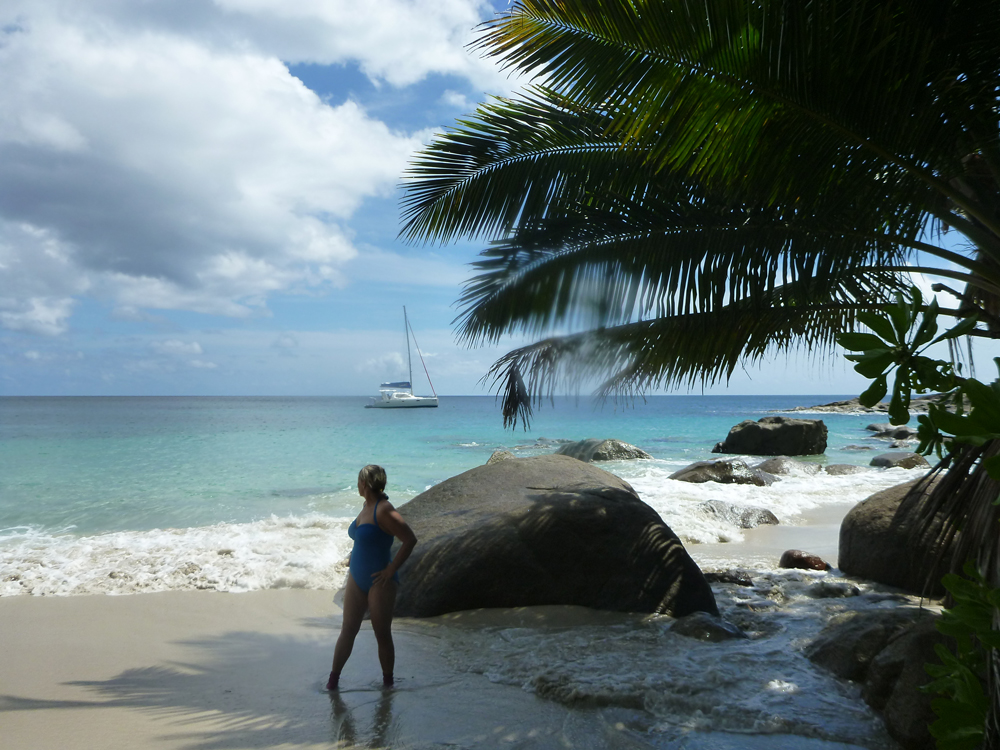
La Digue is more famous for its beach than its harbor.  Anse Source d’Argent (Money Beach) is ranked by National Geographic as the #1 beach in the world.  I was eager to see what made it #1, because we have seen some really spectacular beaches in the Caribbean, the Mediterranean, and the Pacific.  It was not what I expected.  The beach was long but giant granite boulders broke it into many small beaches, sometimes only 25 feet long, sometimes over 200 feet long.  Palm trees and other tropical foliage fought to upstage the boulders; sometimes they won, sometimes they lost, but the overall impression was wonderful.  This is why many photoshoots are done on this beach.

DSC_1208 There was an unplanned casualness that unified the whole beach while creating many picturesque spots.  People found places to play, to sunbathe, to share a picnic, to retreat from the sun, to walk in the water, and to snorkel through the coral off the beach.  A South African man caught a Hawksbill turtle and let other people hold it.  A Russian man stood in the water feeding the large angel fishes and taking photos of them.  A group of Italians had mastered the art of changing clothes on the beach with a towel wrapped around them for a dressing room.  A Seychellois entrepreneur sold plates of fruit from a stand under the palm trees.  An island dog chased fish in the water.  And an American couple took photos of these things while strolling down the beach.59

Wednesday, June 26        5 or 6 bicycle miles
We had bicycled to the southern end of La Digue yesterday, so we went north today.  The road was a good concrete road undoubtedly built at considerable expense because there was little room on this edge of the island for a road.  It cut through granite in places and then perched on granite fill in other places.  In some places careless cycling would be punished by a ten to fifteen foot plunge off the side of the road.
Nevertheless, it was a good road for biking.  We stopped at a house where a French girl sold fruit and vegetables from the family’s garden.  Diana bought bananas and a papaya.  Further along, the road wrapped around the north end of the island and went down its east coast.  There we stopped at a roadside snack bar for much needed fruit smoothies.  Other bikers rested on benches at this popular spot or stopped to look at the tortoises the proprietor kept in a pen by the road.  In true Seychellois style, Robert was happy to talk about his tortoises, his garden, or life in the Seychelles whether people bought anything or not.
The highlight of this stop came when I glanced up the road and saw a tortoise the size of a Volkswagon waddling toward us.  65 Robert said this tortoise didn’t belong to him, but he had raised it from the time when it was tiny, 31 years ago.  Viuviu was as large as tortoises twice his age because Robert fed him mangos, bananas, and coconuts in addition to the grasses and leaves that Viuviu found on his own.  Like the tortoises we had played with on Curieuse, Viuviu liked to be petted, but unlike them, he could do tricks!  On command from Robert, he would extend his legs and rise to his full height or lift his front foot like a dog shaking hands.  But he couldn’t roll over or walk on his back legs.
We stopped to play with three puppies on the side of the road, and then biked back to the harbor.

Thursday, June 27    16.6 nm
Today was a scary day, a lazy day, a day of contrasts and contradictions.  The stern line that was so much trouble to set came off with surprising ease.  We had a gentle 4 mile sail to Illes de Cocos where we planned to snorkel, and then became apprehensive about the current and the surge of waves in this rather exposed mooring.  We went ahead with the plan to snorkel and found the current to be strong, so we swam against it as hard as we could so that the return to the boat would be easy.  The surge set us to the left and then brought us back to the right.  The fish were affected the same way.  When we learned to live with it, just as the fish do, we relaxed and actually enjoyed the primordial rhythm.  The coral was disappointing but we saw some beautiful fish.  A few Moorish idols and a spumoni colored fish mixed with a large school of blue tangs  which were painted in Nautica colors–strong royal blue, yellow, and white, with a touch of black on the face. While we were watching them, a large iridescent fish swam under us.  It was neon blue/green down its spine with spots and dashes of iridescence on its sides and belly.  When a sting ray glided by the picture was perfect.
We set sail for St. Pierre and Praslin expecting a swift ride down wind.  For the first time since we have been in Seychelles, the wind was weak.  I tweaked the jib and the main, the traveler and the jib leads, and rarely coaxed as much as 5 knots out of it.  We decided to save St. Pierre for later and sailed on to Anse Georgette on Praslin, reputed to be as beautiful as its more famous neighbor, Anse L’azio.

DSC_0922We had the bay to ourselves so we anchored in the center of the bay with shallows and rocks on both sides and a gorgeous beach with palm trees in front of us.  The fickle wind tricked us and as night fell we were being pushed west by an abnormal east wind.  The wind is supposed to come from the south/southeast and I anchored accordingly, so the east wind pushed us closer to the rocks on the western side of the bay than I had planned.
The night was beautifully and scarily black.  We could hear breakers crashing on three sides of us, but because the moon had not yet risen, we couldn’t see where we were to verify our position.  My electronics said we were holding in the same location, but at times like this you remember that electronics can be misleading and shouldn’t be depended on too much.  I turned off all lights but the anchor light to let my eyes adjust to the darkness and went out on deck in hopes of seeing an outline of the shore.  I discovered a black velvet sky studded with celestial sparklers.  Ursa Major, Orion, the Southern Cross, and hundreds of other stars that I couldn’t identify gave reassuring relief from the blackness.  While I sat and gazed at the starry heavens, I became aware of sparkles beneath me.  There were sparks of light in the water all around me.  This bay has bioluminescence so that when the water is agitated, it sparks.  The action of the waves was setting off little sparks of light below me to compete with the twinkles above me.  The stars and sparks couldn’t answer my question about our position, but it was somehow reassuring to know that the night was normal, the creation was magnificent, and we were tucked away in it.

Friday, June 28    6.1 nm
Aride is an island dedicated to the conservation of birds.  Many thousands of birds live there, but no people live there except for the park rangers and a few scientists who study the birds.  Few people go there in the Southeast season because the landing beach is completely unprotected from the sea and the breakers on it can be 10 to 12 feet high.  We were only the third and fourth visitors to Aride in a month.  Because the seas have been calm for a couple of days we received permission from the Island Conservation Society administrator on Aride to come ashore.  We sailed 6 miles north to the island and took the only mooring ball.

64The breakers were about 5 or 6 feet and looked plenty ominous.  The rangers launched their rigid bottom inflatable boat through the surf and came out to pick us up.  They brought life jackets for us and a dry bag to put our stuff in. When the skipper told us to sit on the floor and hold on, I sensed an adventure coming up!  The skipper drove toward the beach, hesitated while studying the waves for the right moment, and then gunned the outboard full throttle.  The boat roared toward the beach and became airborne in the surf before landing on the sand and sliding up the beach.  This ride alone was worth the fee for seeing the island!
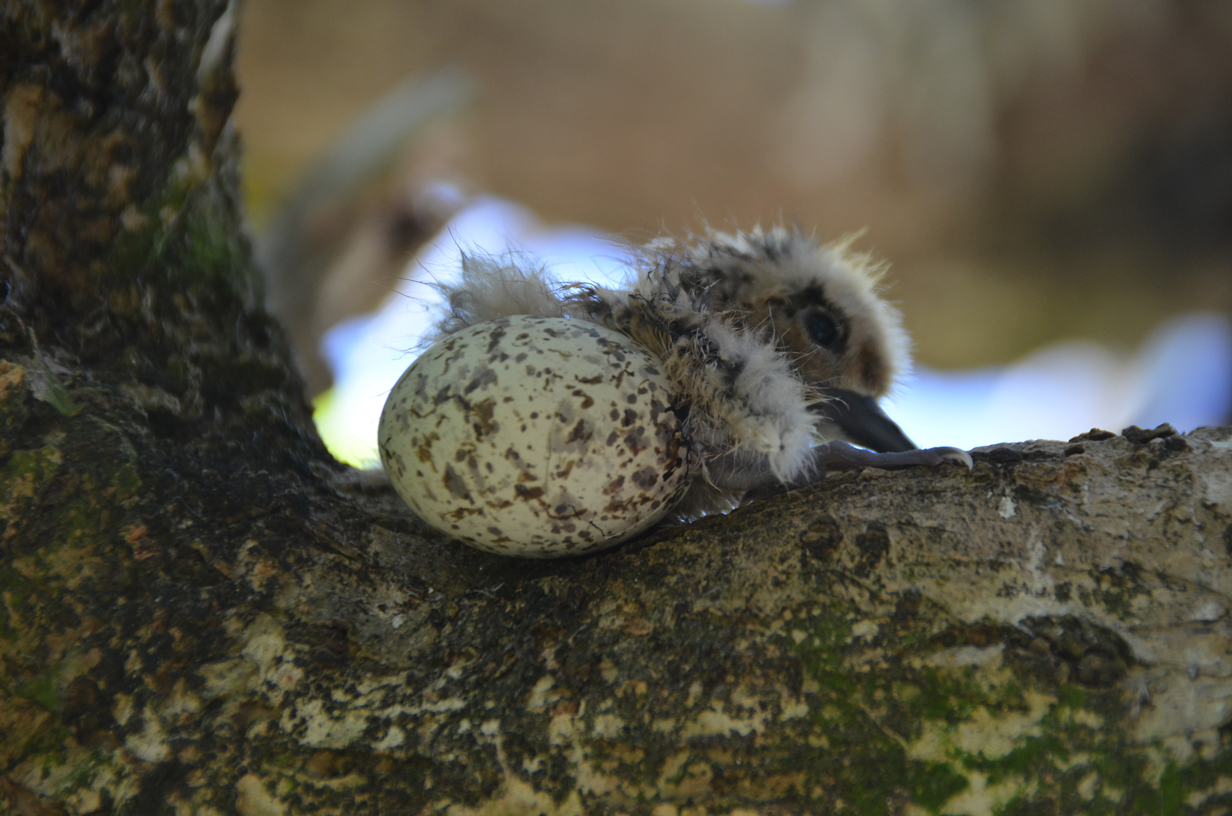
After we got our equipment and ourselves reorganized, two of the park rangers gave us a tour of the island with detailed information about the different birds nesting there.  Since there are no rats or cats on Aride, it is safe for the fairy terns to make their nests on the ground.  They found cozy spots between the roots of a tree, under bushes, even in an abandoned barbecue pit.  Some had fuzzy chicks with them.  The long tailed tropical seabirds don’t build nests but lay their eggs on a flat tree limb.  62We saw a 2 hour old chick that still had half a shell on him.  The magpie robins will let you walk right up to them.  If you sweep the leaf litter with your foot they will run over to check for any insects you might have exposed.
When the tour was over and we had eaten the lunch we had packed, the rangers took us back to our boat.  We helped move their boat down to the water and then dove headfirst into it when the rangers yelled “Get in!”

64b As soon as the water surged under the boat, the skipper fired the engine up and we rocketed through the breakers.  Back on Tharius life resumed its leisurely pace.  A big sea turtle came up to eat seaweed beside the boat.  Waves continued to break on the beach behind us.  And the chatter of thousands of birds flying sorties over the island and the sea in search of food and mates never ceased.

Saturday, June 29    36.1 nm
Tharius had pitched, rolled, and heaved with the irregularly regular rhythm of the sea all night, but we slept well.  It’s hard to beat a real waterbed for a good night’s sleep.
We set out for Silhouette island 30 miles to the west of us. The wind had shifted to the south or south-southwest so we sailed a delightful close reach most of the way.  This was the best sailing day we had experienced in a month, and it inspired us to play great music.  I had saved  Crosby, Stills & Nash, Fleetwood Mac, and Phantom of the Opera for a day like this.
Silhouette is another island administered by the ICS.  We had applied for permission to go there a few days in advance.  The limiting factor on Silhouette is no harbors.  There is a man-made harbor on the southeast corner, but it is for the schooner that brings guests to the posh resort on the southeast coast.  The only other anchorage is Anse Mondon bay on the north side, and it’s only large enough for two or maybe three boats.  Mondon is protected from the southeast winds, so we went there.

P1020584What a joy to be the only boat in this small but beautiful bay with palm trees on the beach, boulders on the flanks, and mountains towering into the mystery of clouds behind it.

Sunday, June 30    20.5 nm
After snorkeling, exploring the beach, and climbing some boulders, we sailed from Anse Mondon to Beau Vallon on Mahe.  Unfortunately the wind was right on our nose so we began a long tacking operation.  After most of the afternoon slipped away in zigzags aimed north and west of Mahe, the pragmatist in me overcame the sailing purist in me, and we motored into the bay.   Twelve miles turned into twenty, but what difference did that make?

Monday, July 1
While Diana relaxed on Tharius, I went scuba diving with Big Blue Divers.  The dive boat picked me up on the yacht and we roared with 400 horse power to Baie Ternay.  It was a wonderful easy dive in about 20 meters.  In addition to beautiful coral, I saw a moray eel and a huge sea turtle, but my best discovery was three large lion fish.  I swam over to look at a crevice in the rocks and found a large lion fish at knee level.  At first I didn’t notice that another larger one was above my head and still another one was to my left.  Lion fish are gorgeous but very poisonous.  Fortunately they are also very docile.  Since I didn’t touch them, they were no threat to me.
Our second dive was within sight of our yacht.  In a completely unmarked spot that Big Blue knew how to locate, we swam through an extensive coral garden in about 10-12 meters.  Coral spread across the ocean floor like wheat across a Kansas field.  Colonies of small fish of every color made their home in the coral, so we were visiting a fish metropolis with its own ethnic neighborhoods.
After dinner on Tharius listening to Norah Jones, Diana and I lounged on the front deck trampoline and studied the stars above us and the lights of restaurants, shops, hotels, and houses along the shore.

60Which was better: the solitude of Anse Mondon or the comfortable sense of social connection at Beau Vallon?  I’m glad we didn’t have to choose.

Tuesday, July 2    29.5 nm
We have seen all of the granitic Seychelles except for the southern end of Mahe, so today we sailed down the west coast of Mahe and across the south coast to Anse La Mouche, 29 miles including all the tacks.  The day started with gentle wind but by the time we reached Cape Matoopa and were ready to head east, it had increased to 20-25 knots.  To have a little shelter from the wind we sailed behind Conception Island and Ile Therese.  The channel narrows between Therese and Mahe so we had to tack several times to get through it.  On one tack we were laying a course directly toward an anchored yacht with people on board.  I didn’t want to see them jumping ship and swimming for the shore, so I didn’t wait to see the whites of their eyes before tacking.
When we finally cleared Therese, we headed out to open sea to get good wind and long open tacks.  The strategy paid off with long wave periods and strong steady winds that made Tharius fly.  We hit 8.8 knots at one point and probably could have gone faster if I understood catamaran sail trim better.
We finally reached Anse La Mouche, a huge circular bay with brilliant turquoise water.  It seems to be a non-tourist destination, the Seychelles equivalent of Coral Bay in St. John.  This may be where the most authentic Seychellois people live.

DSC_1485

Wednesday, July 3    33.2 nm
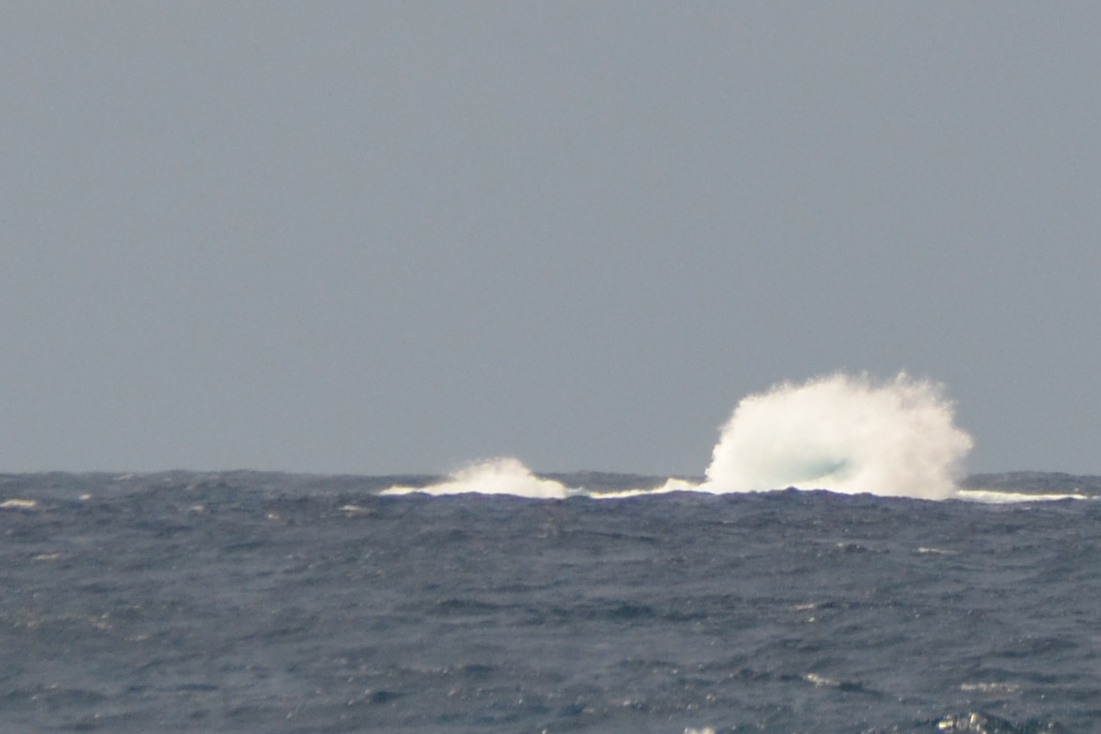
For our final day of sailing we chose a lonely course around the Capucin tip of Mahe.  We sensed that this is not a popular sailing area when we noticed that we had not seen another sailboat since we left Anse La Mouche.  Actually we were the only boat of any kind until we reached the Victoria port area.  The seas were 3-6 feet with an occasional 8 footer and the sailing was brisk, but the highlight of the day was seeing Capucin Rock.

DSC_1529 Well, not actually seeing it but knowing where it is.  Capucin is barely underwater except at low tide, which makes it especially dangerous.  But we could see the breakers crashing over it from three miles away.  The waves would explode in white spume and resembled a geyser in the ocean.  No careful sailor should ever hit Capucin.
Once we were docked in the Marina, the inevitable began again–finding all the things we had stuck in nooks and crannies on the boat and packing them away for the next flight.  Next destination:  Nairobi by way of Dubai for a week of safari in the Masai Mara.

The Colors, Sounds, and Flavors of Seychelles
Reflections of Nineteen Days  July 4, 2013

The colors of Seychelles are easy to describe.  There is the cobalt blue of the sky, a different blue from the indigo and turquoise of the sea.  There is the verdant green of the land, except where black granite refuses to allow the palms and pines and mangroves to grow.  There is the pure white of the fairy terns, circling and swooping in mated pairs overhead.  And there is the golden tan of the sand on the beaches.  Seychelles is colorful.

The sounds of Seychelles are easy to describe.  They can be relaxing, annoying, or scary.  The rhythmic washing of the seas against the shore is as comforting as a mother’s heartbeat, but when the tide floods and the breakers build, the crashing of waves over reef, rock and sand becomes menacing.  The cries and calls of the seabirds welcome you to each island and announce that life is good and the day is promising, but unlike the birds at home, these birds don’t know when it’s quitting time, and their cacophony never ceases.  Seychelles is noisy.

The flavors of Seychelles require deeper observation and reflection.  When you think you have identified the Seychellois flavor, a contradiction occurs and you realize that you aren’t ready to name the flavor.  One flavor is like a warm pound cake fresh from the oven with a spicy sauce poured generously over it.  This is the flavor of Cristobel, the young man renting kayaks on the beach at Port Launey.  “I welcome you to my homeland!” he exclaimed as we pulled our dinghy up on his beach.  We had no need of a kayak but that didn’t diminish his enthusiasm for telling us about his islands and warmly inviting us to enjoy their wonders.

Another flavor is mellow, like the scent of old vanilla.  This is the flavor of Miriam, the woman selling vanilla, coconut oil, and island trinkets at her shop near Anse Source d’Argent.  She made a small sale, and then spent half an hour telling us about her life in Seychelles.  Selling souvenirs was a good excuse for her to pass time in pleasant company.

Yet another flavor is tangy, like the orange-lemon fruit that grows in Seychelles.  This is the flavor of Zorro, the alias of Bradley, who was waiting on the fuel dock at La Digue to be the first to contact us so that we would rent our bicycles from him.  He eagerly helped us with the complicated process of mooring in the small harbor and then charged us double for his bicycles, a price that was well worth his assistance.  Zorro is a man who wants to get ahead, not just get by.

Is the flavor of Seychelles sweet and delicious like its pineapples?  Not entirely.  There are too many contradictions.  There was the bitter taste of the hostess at La Pirogue, who would not bother to speak to us when we asked if the restaurant was open for dinner.  Instead she spoke to a waiter who relayed her message that we could sit down.  There was the noxious taste of the postal clerk who refused to acknowledge me standing in front of him at his window as he filled out papers for a client who was not present.  There was the sour taste of more than one clerk who would stare off idly into space when announcing apathetically how much you owed for your purchase.

What is the true flavor of Seychelles?  It’s a goulash of so many flavors that it defies description.  The flavor depends on where you dip your spoon.

Whitsunday Islands Australia Travel Journal Larry and Diana Caillouet June, 2013

May 27-30, 2013
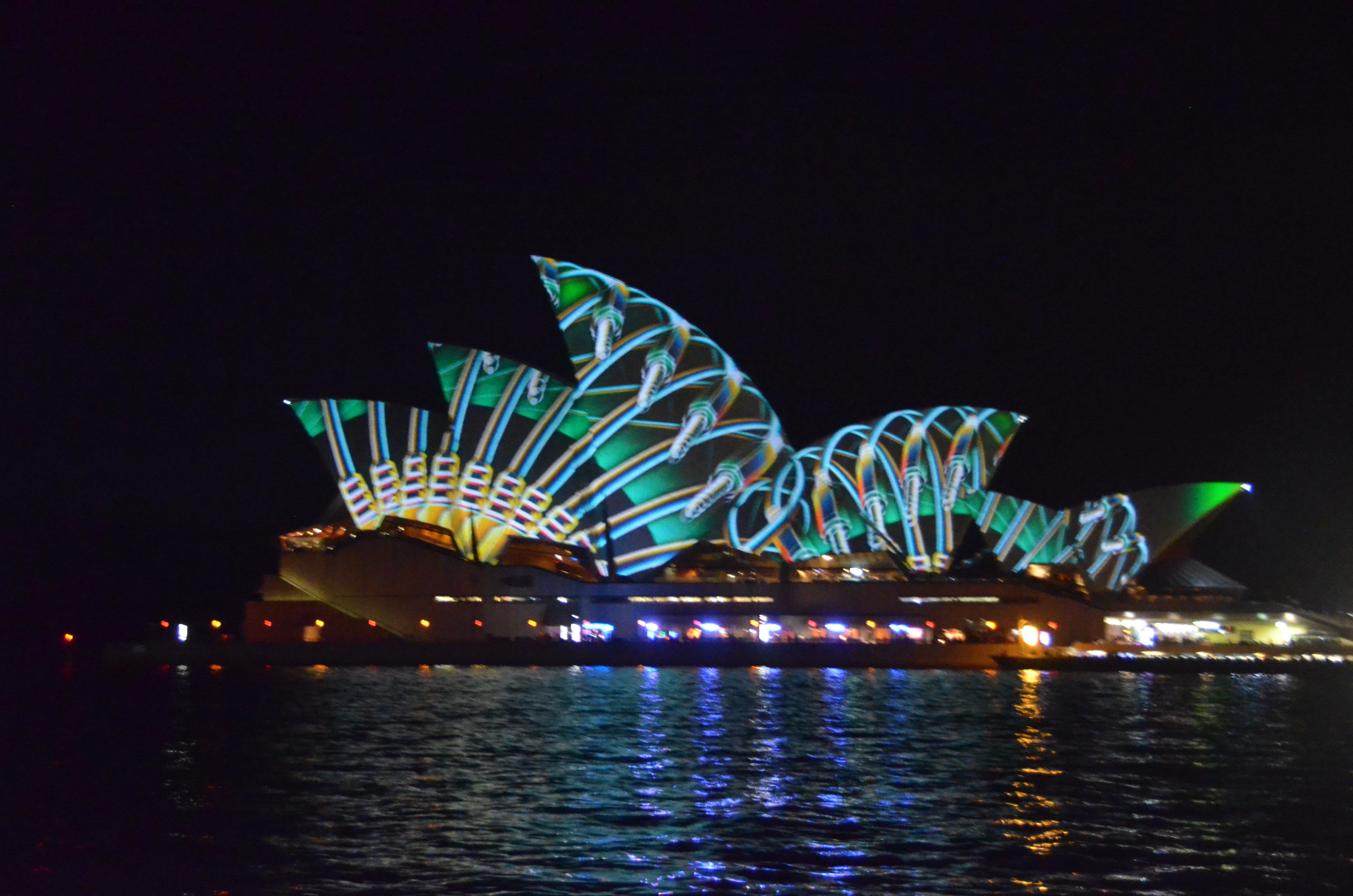
We spent four days in Sydney before sailing the Whitsundays, and Sydney was wonderful.  This was the time of the annual 3-day Vivid light show when fantastic images are projected across the harbor onto the roofs of the Opera House and on other buildings.  Sydney would be wonderful without Vivid, but this made it even more memorable.

12
Friday, May 31
We flew Virgin Australia from Sydney to Hamilton Island, the “capital” of the Whitsunday Islands off the northeast coast of Australia.  They are the jumping off point for the Great Barrier Reef and a vacation destination in themselves.  The GBR doesn’t have any habitable islands, so boats leave from here or from one of the nearby towns on the mainland like Airlie Beach to take divers, snorkelers and sunbathers to the GBR.
Hanna, the friendly receptionist at the Sunsail base, met us at the airport in the Sunsail van and drove us five minutes to the base in Hamilton Marina where we had a 49-foot Jeanneau waiting for us.  The marina is well equipped for sailors with not only several restaurants, a general store, and a laundry, but also high end sailing shops like Slam and Henri Lloyd.
Provisions had been delivered when we arrived and had been put away by the provisioner.  Nice touch.  We had our chart briefing and boat briefing and settled into putting our clothes and equipment away.  I went through my famous 25-point checklist to see if the boat is ready to go to sea or not.  As usual, I turned up a few minor problems to be corrected the next day.

Saturday, June 1        16.0 nautical miles
The weekend staff is small at Sunsail, so it took a little while to get a few shortcomings corrected on the boat.  When that was done we set sail for Cid Harbor on Whitsunday Island.  It was going to be too short a sail to be satisfying so we motored south against the prevailing wind to go around the southern tip of Dent Island instead of taking the shortest route around the north end.  That set up a nice long broad reach in 18-20 knots.
We passed Henning Island, Reef Point, and Cid Island before turning into Cid Harbor and making our way to Sawmill Bay.  Cid is a very large and well protected harbor, but there were only a dozen boats in it, including 4 of us in Sawmill Bay.

Sunday, June 2        15.2 nm
We must have been tired.  We went to bed at about 7:45 last night, and woke up at 7:30 a.m. today.  I haven’t slept that long since I was a baby.  The day was overcast and brooding, so bed was the best place to be anyway.
We finally got ourselves together and got underway.  Passing Daniel Point and Lion Point we headed straight for the southwest corner of Hook Island.  When we rounded it we put up spread sails and enjoyed a beautifully smooth ride all the way up the coast into Stonehaven Anchorage.   This passage is lined with very broad reefs on both sides, so we checked our charts frequently and kept a close watch on the water ahead of us.  We maintained the wing on wing sail all the way through The Narrows between Stanley Point on Hook and Groper Point on Hayman Island.  Hayman is the ultra high end resort island.  The others in the Whitsundays are only high end.
3

We finally had to drop sails and motor into Butterfly Bay where we took a mooring.  This bay with wide coral reefs on three sides is shaped like a butterfly and actually has butterflies ashore.

Monday, June 3        19.6 nm
After another 12 hour sleep marathon (why can’t I sleep like that at home?) we dropped the mooring and headed out to sea to get a radio signal.  The high mountains around Butterfly Bay block VHF radio waves and cell phones.  After checking weather with the Sunsail base, we headed to Manta Ray Bay and Pinnacle Bay with the intention of snorkeling there.  25 knot winds with higher gusts made the water very choppy, even close to the beach, so we decided that the better part of wisdom was to skip the snorkeling and just explore the beaches from the boat.
We motored through heavy seas until we got in the lee of Hook Island.  When the seas settled down our ambitions rose so we circled around Hayman Island, the snooty resort island and inspected its beaches and anchorages.   Heading south we came to Langford Island, a small uninhabited island with the longest sandbar extending from it that I’ve ever seen, nearly a mile long.  Even beyond the tip of the sandbar you could wade far out into the water, so we gave it wide berth and passed between it and Black Island into Stonehaven Bay.  We continued south until we rounded the southwestern tip of Hook Island and headed into Nara Inlet.  Nara is a fiord about two miles long, very well protected from the wind by high ridges lining both sides.  It is open to the Whitsunday Passage so long swells can roll in, but that suits me fine.  Gentle pitching of the boat will make for another good sleeping night.
4
We dinghied ashore to an Ngara Cultural Site, a place the native Ngara people had used for centuries for shelter. It still had some drawings on the side of the rocks. The park had done a very nice job of informing visitors about the site and the people.  Not only were there the typical park signs explaining the history and the significance of the site, but there were recordings of eight descendants of the Ngara people reflecting on their memories of their ancestors and what it meant to live under the Aboriginal Act.  One said the Ngara were people of the salt water.  Maybe there is some Ngara blood in me.
A noisy visitor boarded our boat before sunset–a big white Baretta-style cockatoo.  He sat on the spreader just above the Port Oliver Yacht Club burgee for a while and then when Diana put a slice of bread on the deck, he flew down and grabbed it, squawking all the way.  He flew back up to the spreader and sat there eating the bread until he finally flew away to join the raucous cockatoo flock gathering in the trees onshore.
5
There is virtually no ambient light in Nara Inlet, so the stars look incredibly bright.  While watching them from the deck of the boat, a brilliant meteor streaked across the sky and dissolved in phosphorescent green.

Tuesday, June 4        8.4 nm
Leaving Nara we threaded our way down the center of the inlet and met big rollers at its mouth.  Powering through the rollers and watching a suspicious sky, we debated raising the sails long enough to make it not worth doing, so we motored to our intended destination back at Sawmill Bay again, at the foot of Whitsunday Peak.  There is a 2.5 kilometer trail that ascends from the beach to the peak at 1427 feet above sea level.  That is approximately the height of a 142 story building, or 1.4 times the height of the former World Trade Center.
Diana decided to stay on the boat while I hiked the trail.  I stuffed some essentials into my backpack and dinghied ashore.  I met a newlywed couple from Melbourne on the beach who were getting ready to hike the trail, so we started out together.  I kept pace with these 30-somethings for a while, but when my heart rate maxed out, I told them to go ahead and I’ll see them later.  The trail was well-marked and had good footing, but it was steep in places.  With five rest stops along the way, it took me an hour and twenty-five minutes to reach the summit.  The couple was still there, so we took some photos and rested.  The view from the summit was truly breathtaking.  I could count a dozen islands to the west and another dozen to the east.  I could even see our boat at anchor down below me.
6
After half an hour I started back down the trail, determined to make it non-stop.  About two thirds of the way down, the brakes in my knees started looking for a runaway truck ramp, but I rolled on.  I caught up to the couple at the bottom of the trail, and we helped each other drag our dinghies off the beach.  It took me only 45 minutes to hike back down the trail.
Back on the boat I completed my collapse as Diana prepared hot tea for me and worked on getting supper ready.  I felt a sense of accomplishment–and sore muscles.
7

Wednesday, June 5        22.5 nm
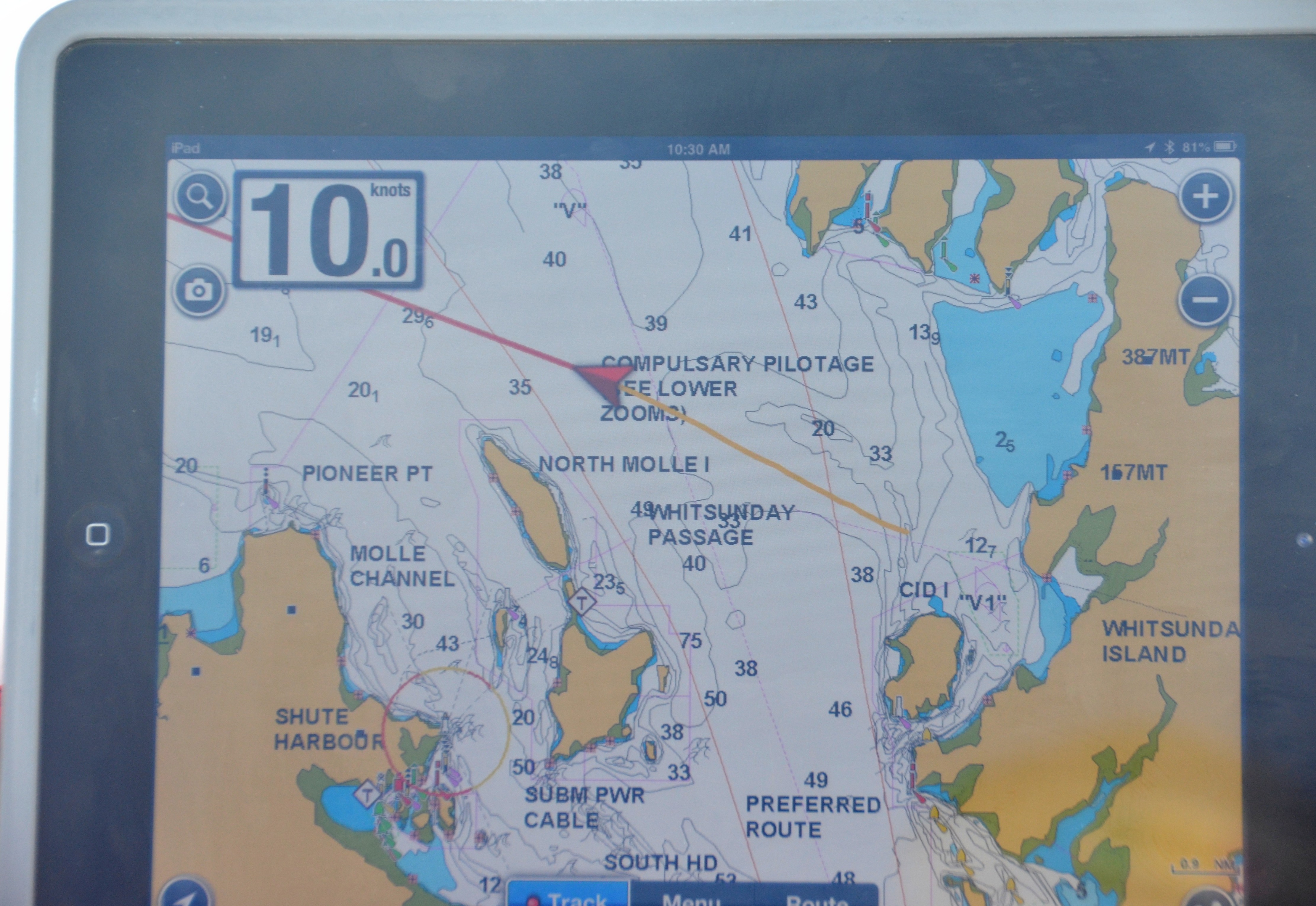
It was a ripping good sailing day!  Although the early sky was gray and negative, it brightened by the time we weighed anchor.  We set off on a beam reach in 15 to 20 knots and soon were cruising at 8-9 knots.  Occasionally we touched 10 knots and finally 10.6, which I’m certain is above the boat’s rated speed.  When the waves in the Whitsunday Channel became too uncomfortable and we began fighting them, we jibed and fell off to a fast broad reach to Hayman Island.  We still made 8 knots but it felt much smoother.
8
The mooring at Blue Pearl Bay was fairly calm and the coral is reputed to be excellent there so we wriggled into our wet suits with a lot of complaining and fretting, put on fins, mask, and snorkel, and hit the cold water.  The wet suits helped, but it was still cold until we generated some body heat by exertion.  It was a fairly good distance to the coral shelf along the shore, so we were warm by the time we got there.  Unfortunately, the visibility was very poor, so the effort was mostly wasted.
As soon as we got back to the boat we dropped the mooring and motored off to Butterfly Bay, our anchorage from three days ago.  We took a mooring near the entrance, even though it was rather rolly, because the coral shelf was only a few meters away, an easy swim.  Since I still had my wet suit on, I couldn’t resist giving it another try, and I was glad I did.  Such variety of shapes and colors I had never seen before.  I particularly loved the delicate lacy coral that grew here.

Thursday, June 6        12.5 nm
“Rather rolly” was an understatement.  “Very rolly’ is more accurate, but the worst part of it was the habit of the tide to push the boat forward against the mooring ball.  When the hard plastic ball banged against the hull, generally against the forward part of the hull where we were sleeping, it sounded like being inside a base drum at a parade.  Sleeping athwart the king sized bed converted rolling into pitching, which I don’t mind at all, but the base drum was too much.
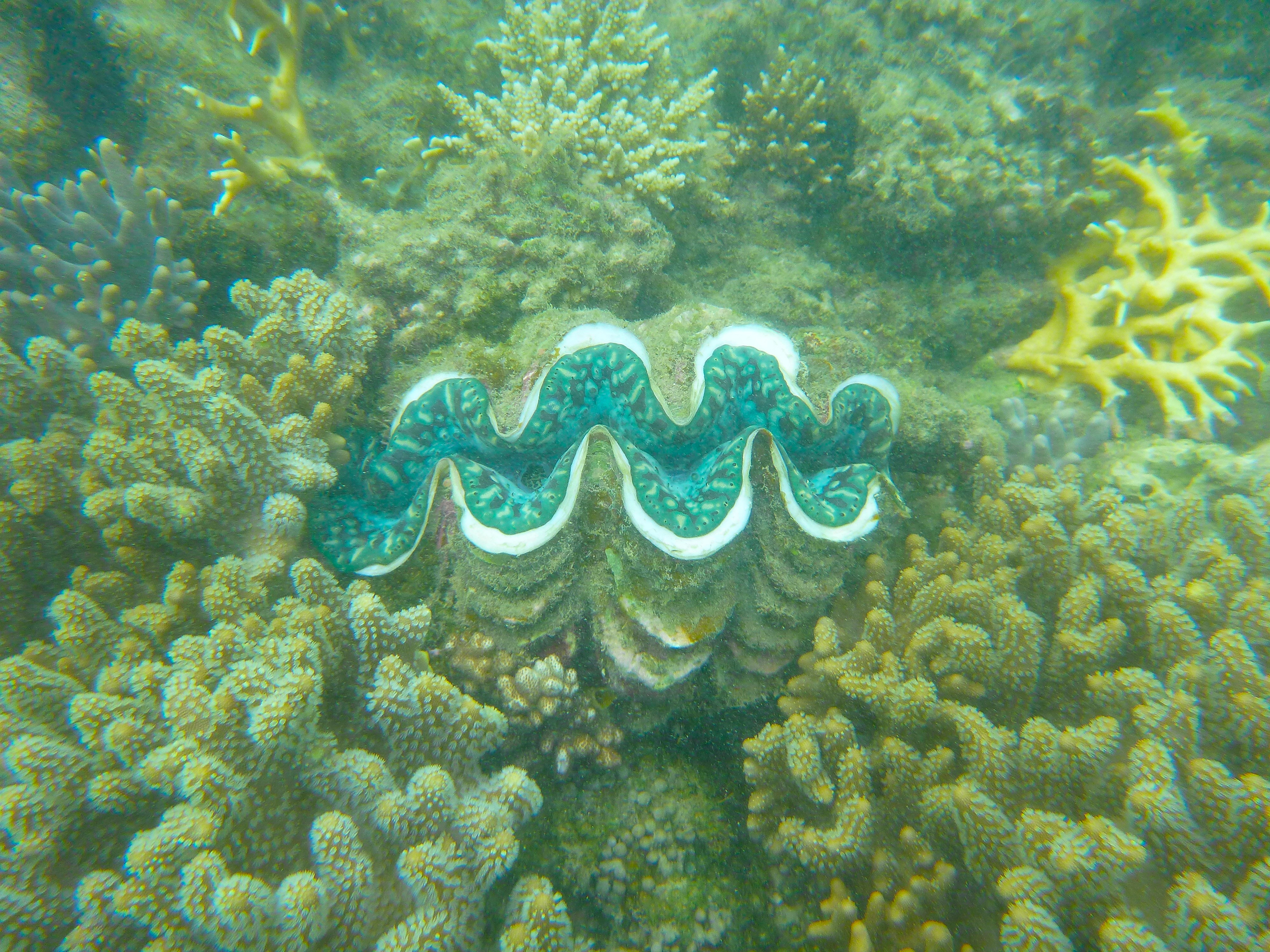
After paying the price of a much interrupted sleep, it was incumbent on us to enjoy snorkeling the nearby reef.  We put on every piece of water wear we had and swam to shore.  The corals were absolutely amazing in their variety and profusion.  It was a very healthy reef.  There were soft corals and hard corals in shapes and colors I have never seen before.  But my favorite discoveries were two giant clams with blue lips.  One was approximately 4 feet wide, the other about 3 feet.  They were open and their nutrient filtering factories were operating.
9
Still pinned by strong and blustery winds from the east, we sailed down the protected west side of Hook Island and rounded up into Nara Inlet again.  We went about 2 miles back in the fiord and anchored in water so still a marble would hardly roll across the deck.

Friday, June 7        17.4 nm
To sail or not to sail, that was the question.  Whether ‘twas nobler to stay in a peaceful harbor or to take arms against the slings and arrows of a stormy sky and by opposing, escape it.  After several tentative decisions, we chose to sail.  This decision looked questionable for the next two hours as threatening skies persisted and the pervasive gray cast gloom upon everything.  From the mouth of Nara Inlet to the bottleneck of Hook Passage, the seas and winds were rough, but there was no rain.  After passing the small resort and underwater observatory on Hook Point we entered open sea.  To our surprise, it was no rougher than what we had been experiencing, even though the wind was stronger.  More than 3 hours and 15 miles later we got our first glimpse of the world famous Whitehaven Beach.
Whitehaven is rated by some travel authorities as the third most beautiful beach in the world.  It consists of two and a half miles of nothing by white silica sand.  No docks, no houses, no vendors, no kiosks, just sand.  Behind the wide beach is luxuriant green foliage, an unusual mix of deciduous and evergreen trees and tropical foliage.
10
After consulting the tide charts to make our low and high tide calculations, we selected a spot in 5 meters to drop anchor.  Even though the sky still looked questionable, we dinghied ashore and joined two or three dozen other tourists enjoying the wide hard packed beach.
Back onboard Avanti, we enjoyed a comfortable evening with gentle rocking of the boat, contrary to the warnings of an unpleasant rolly anchorage. We shared the harbor with only two other boats, a big private cat with a couple from Munich who have been living in Bali recently, and a Sunsail 444 cat which came in just after dark.

Saturday, June 8        0 nm, 3 miles on land
For the first time in 8 days, the morning sky was clear and blue.  We decided to devote this beautiful day to walking terra firma.  Having learned to be suspicious of the weather here, we packed raincoats in my backpack along with sandwiches, apples, and water.  As we were preparing to go ashore, a seaplane landed with presumably VIP tourists and taxied across the water right up to the beach.  Then a second seaplane landed along with two or three tourist boats.  So by the time we reached the beach, it was well populated.
11
We walked about a mile down the beach away from the other tourists, and then walked back.  As we were looking for the start of the Solway Circuit trail, we became part of a small crowd watching first one, then two, and finally four goannas that were waddling dinosaur-style around the picnic area.  Goanas are monitor lizards native to Australia.  These were each about 3 feet long, with stripes and spots of green, yellow and black.  They had long claw feet, but seemed docile although unafraid of humans.  I tried tempting them with pieces of apple, but apparently that’s not part of their diet.
11b
The goanna watchers that had gathered were all members of the same tour group.  Their host set up a barbecue, and since we were talking with several of them, he invited us to join the barbecue.  We felt a little awkward crashing their barbecue, but would have felt more awkward declining their hospitality.  So we had lunch with them.
After doing some hiking we went back to our dinghy which was now beached like a whale about 15 feet from the water.  While we worked to drag it down to the water, a couple of Aussie guys, Jay and Ryan, came down to help us.  It was a mutual assistance because they needed a ride back to their boat.  This spirit of sharing, cooperating, and generally being friendly seems to typify Australians.
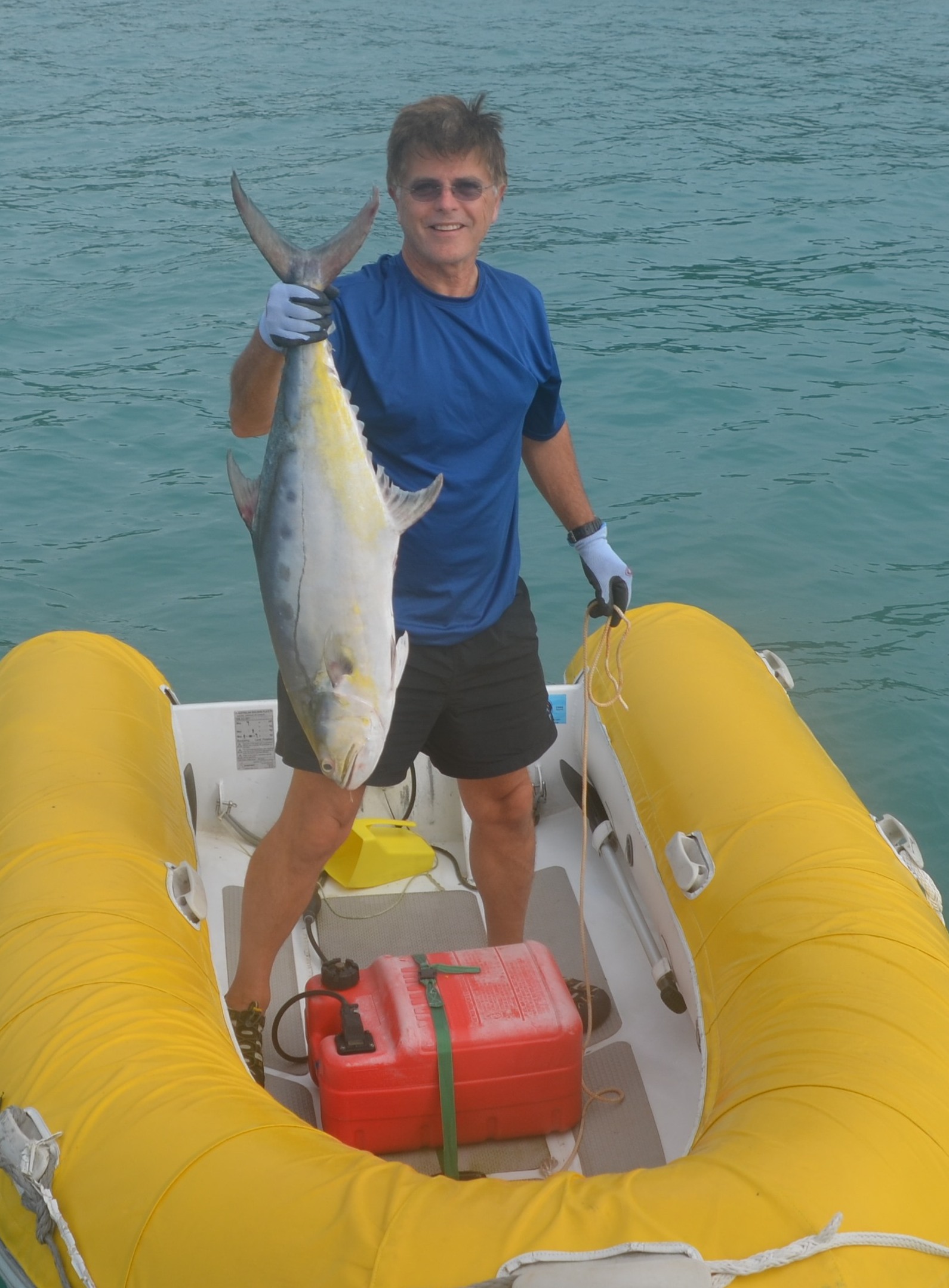
As if the day had not been full enough, after dark I went out to investigate a strange clattering sound I was hearing at the stern.  I thought the dinghy was banging against the boat.  I was shocked to find an 18 pound fish thrashing around inside the dinghy!  I know it sounds like a fish tale, but it had jumped into our dinghy and couldn’t get out.  I didn’t even have to bait a hook!  I poured several buckets of salt water into the dinghy to keep him alive until morning when we could decide what to do with him.  The only thing I knew for certain was that I was not going to get into the dinghy on a dark, chilly, blustery, bouncy night to fight a frantic 18 pound fish.
12

Sunday, June 9    12.2 nm
We identified our fish as a queenfish, a premium fish to eat, but since he had been dead for several hours in our dinghy without refrigeration, we decided to treat him as an unfortunate quirk of the ocean rather than as a meal.  I climbed into the dinghy to get trophy photos and to weigh him.  17.8 pounds to be exact.  We gave him a proper burial at sea.
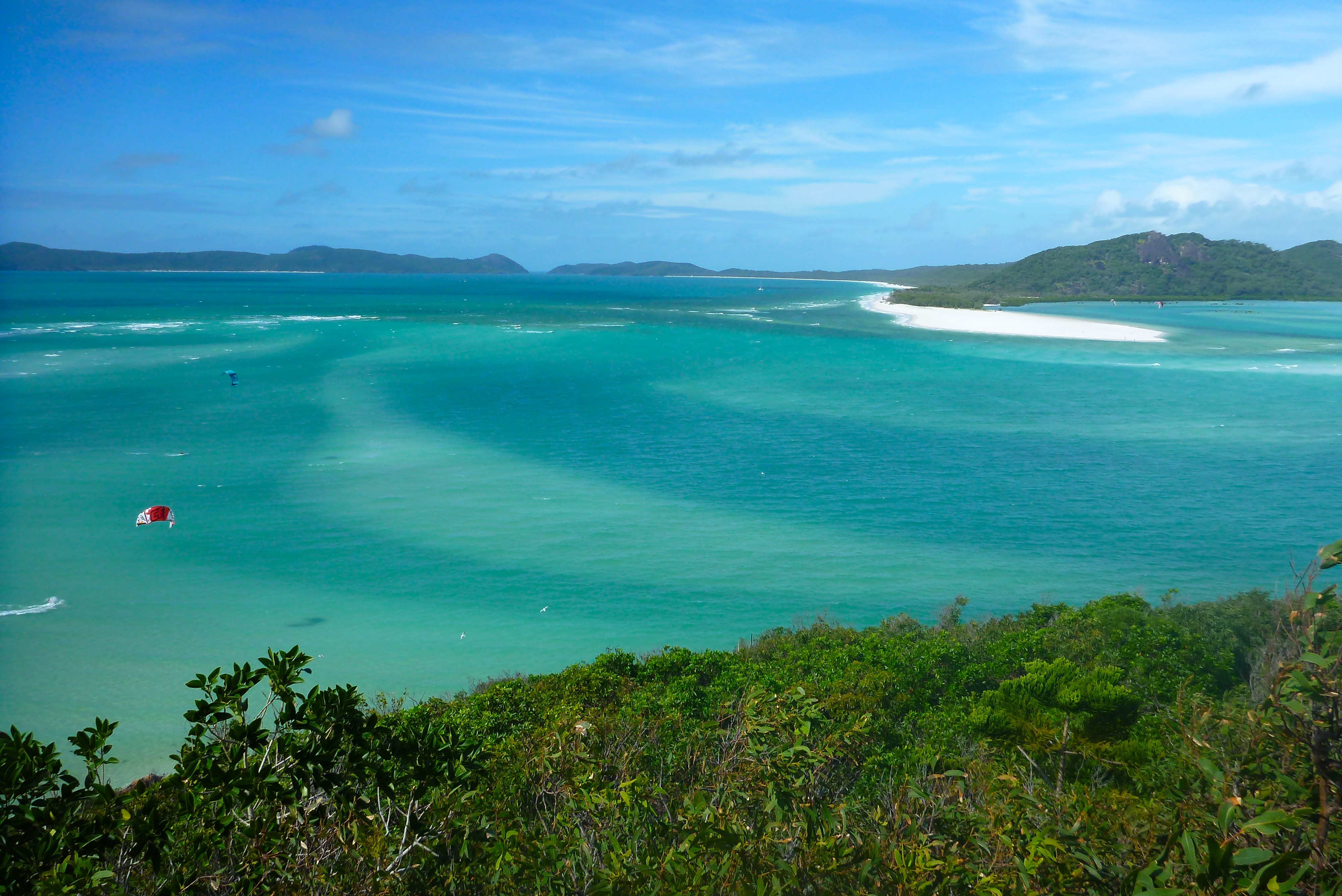
The Hill Inlet looks like a large swampy estuary on a map, but folks we met on Whitehaven Beach told us that it was a beautiful shallow inlet of the sea with swirling patterns of sand created by the tides.  We sailed by it and couldn’t see anything special about it, but on good advice we rounded Tongue Point which separates Hill Inlet from Tongue Bay and dropped anchor in the Bay, also fairly shallow but navigable.  There is a Whitsunday National Park trail from a beach in Tongue Bay to a lookout point over Hill Inlet, so we dinghied ashore and hiked it.  Wow!  Hill Inlet is a gorgeous broad spread of pure white silica sand.  Imagine an oversized football field covered with white sand surrounded with water in various shades of turquoise and you almost have Hill Inlet.  Add several dozen sunbathers, eight or nine kite boarders, a few manta rays swimming in the shallows, 15 knots of wind in your face, the slight smell of salt air, and breakers rolling in on the beach and the picture is as complete as I can describe.
13
After absorbing as much of Hill Inlet as we could, we returned to the beach where we had left our dinghy.  Another dinghy was picking up people from one of the large tour boats.  Nothing special about that except that the driver was dressed in a gorilla costume with a tuxedo and top hat!  You don’t see that every day.
Somewhat reluctantly we departed Tongue Bay and sailed north to Cateran Bay on Border Island.  We were the only boat in the bay until one came in at sunset.  The wind howled all night but it was a nice steady howl so the boat rode steady on its mooring.  We cracked the forward hatch open one inch and got all the ventilation we wanted.

Monday, June 10    27 nm
Part of the sky was blue and happy and part was gray and gloomy.  We decided the sky was half full, so we raised the sails and sailed downwind to Pinnacle Point on the northeast corner of Hook Island.  Pinnacle Point has a small lighthouse on it to warn sailors off of it, but just east of the point is Double Rock, which barely reaches the surface.  These are the rocks to worry about, not the big obvious ones.  They are like Chihuahuas–you don’t notice them until they slip up on you and nip you on the leg.  Hitting Double Rock would be more than a nip.  We spotted it and avoided it, rounded Hook Island, and breezed through the Narrows, a one mile stretch of good water between two large reefs a quarter mile apart.  After a short stop at Langford Island’s one mile long sand bar, we sailed on and finally motored into Sawmill Bay, a large, pretty, and comfortable anchorage.  Being our third night in Sawmill, it’s beginning to feel like home.
14

Tuesday, June 11    17.2 nm
From our first day on Hamilton Island we have been warned about three difficult passages: the Hunt Channel, the Fitzalan Passage, and the dreaded Solway Passage.  These are pinch points where tidal flow and winds can create very rough waves, confused water, eddies, swirls, overfalls, etc.  Having pretty much explored all of the bays, beaches, and inlets of the three major islands, we decided to live dangerously and challenge all three of these hot spots.  Except for some 6-8 foot waves in the open ocean between Fitzalan and Solway, all three turned out to be cream puffs.  We hedged our bet by entering the Solway Passage on an ebb tide just past slack water, but the experience of these mythic passages was quite a bit less than the anticipation.  We will get to do Solway and Fitzalan again tomorrow.
Transiting the Solway Passage put us at the southern end of Whitehaven Beach, the exquisite 4 mile white sand beach we had visited previously from its north end.  We anchored, ate lunch onboard quickly and dingied ashore to hike a trail through the woodlands to a beach on the other side.  We had seen the beach and it didn’t begin to compare with Whitehaven Beach, but that wasn’t the point.  The trail would be an interesting nature trek and a good opportunity to stretch our legs.  4 miles of mixed woodland and tropical vegetation later, our legs were adequately stretched. When we got back to the beach, all the boats were gone except ours, and the only new footprints in the sand were ours.

Wednesday, June 12     13.2 nm
After 12 days of howling wind, we awoke to a whisp of breeze that would be a disappointment on Barren River Lake.  But when we raised our sails–nothing.  So we motored through the Solway Passage with both sails up, something that would have been unthinkable until today.  Out in the open ocean we found enough wind to move along at about five knots, a very pleasant sail.
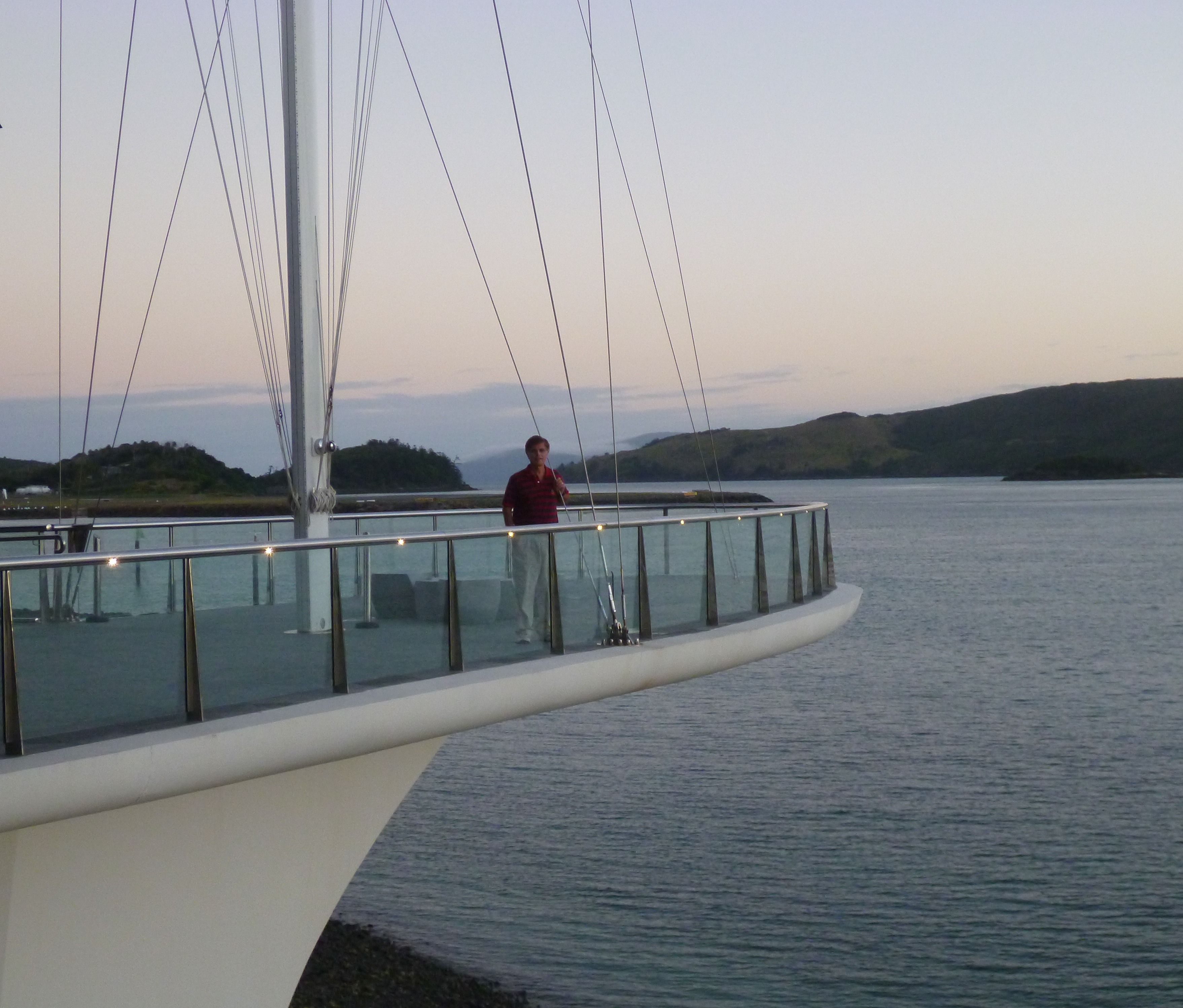
Back in the marina we made plans to go to the Great Barrier Reef with Cruise Whitsunday on a giant motor catamaran.  Then we walked down to the Hamilton Island Yacht Club, a club for the yachtie aristocrats of Australia.  It was an architectural masterpiece that evoked reverence and awe—and envy.  It had sweeping lines that could be interpreted as a stylized whale, but many elements demonstrated its loyalty to the yachting world.  The corners projected over water like the bow of a boat.  The roof looked like a sail from many different perspectives.  The stairs and railings could have been taken from a 150 foot luxury motor yacht.  The hand rails were silky smooth mahogany.  The door handles looked like the stylized hull of a 12 meter America’s Cup boat.  The colors were elegant, restrained, and warm at the same time.  And on one platform that projected over the bay, a mast stood with the flag of the Hamilton Island Yacht Club flying gloriously but discretely from the top.  The overall impression of this structure was even more overwhelming than the Sydney Opera House, with which it bore some resemblance.
1516

Thursday, June 13
No sailing today.  We booked a tour on Cruise Whitsunday and went to the Great Barrier Reef, about 50-60 miles northeast of the Whitsundays.  On the way there we saw two whales.  One breached a couple of times, and the other repeatedly slapped its tail flukes on the water.  The guide on the boat said that behavior might be to impress the other whale.  It impressed us.
17
At the GBR Diana snorkeled while I dove.  One dive cost $99, about double the normal price, but I saw about 10 times more coral than I usually see on two dives.  The profusion of coral in all kinds of shapes and colors was astonishing.  Diana enjoyed her snorkeling too.
When we got back to Hamiliton Island, there was only one thing left to do, but it was a big one—pack for the flight to Seychelles.

Phuket Travel Journal Larry and Diana Caillouet March 2-26, 2013

Saturday, March 2

Flew from Nashville to Los Angeles to Shanghai to Phuket, Thailand.

Monday, March 4 3 nm

What happened to Sunday? It was Saturday a few minutes ago and suddenly some imaginary line across the ocean made it Monday. After briefly saying hello to Shanghai, a few more mini-naps brought us to Phuket. A taxi driver holding a card with our names on it took us to the Ao Po Marina where our boat waited for us, a 41 foot Jeanneau monohull named Malee. After spending all afternoon in an extensive chart briefing and putting away provisions on the boat, we finally set sail for Koh Nakha. (Koh or Ko means island in Thai.)
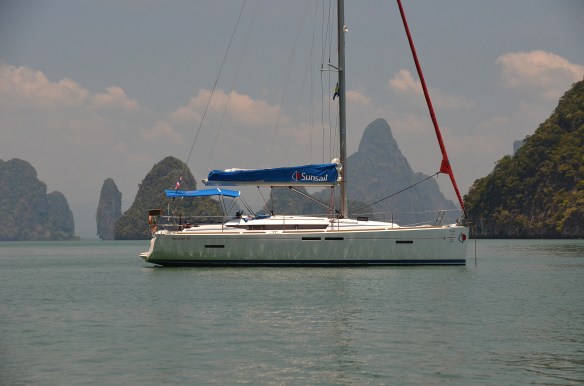
Malee

Malee

Tuesday, March 5 20 nm

We slept late but woke to the sounds of “long tail boats” plying the waters around us. Long tail boats are the boat of choice of Thai fishermen. They have a dramatic sheer line that sweeps up into an impressive prow that cuts through waves, but the name comes from their method of propulsion. Automobile engines are mounted in the stern but not down low in the hull. Instead, they are mounted above the freeboard and have long drive shafts that reach into the water about 10 feet behind the boat. They look something like a giant weedeater with a propeller on the end. The helmsman steers the boat by swiveling the apparatus left or right, so propulsion and steerage are combined in one piece of equipment.
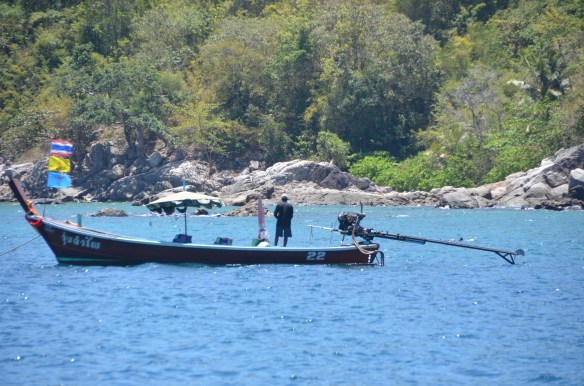
DSC_3OLYMPUS DIGITAL CAMERA

‘Sup? Koh Sup. Koh Sup is two monolithic stones that rise 35 meters straight up out of the water. They lay in our path to Koh Yao Yai, which was fortunate because we didn’t have to alter course to get a good look at them. When they were still far in the distance Diana referred to them as “bunny ears” sticking out of the water. Closer, they were even more interesting with greenery growing on them in places, and even a few trees. The relentless tide had whittled away at their bases so that they were smaller at the water line than higher up.

DSC_2

As we neared Koh Yao Yai we were approached by a long tail boat with a Thai fisherman and his wife. They had caught a fresh bucket of giant prawn. He circled behind us and after we slacked our sails, he pulled up beside us with a big grin and his wife holding up a string of prawn. His broken English was only a little better than my Thai, but we conducted business and closed the deal with me tossing him a Coca-Cola, one of the few English words he could almost say.

Wednesday, March 6 25 nm

After a hearty breakfast on board we set sail for Koh Phi Phi Don. First, a word about pronunciation: In Thai, Phi Phi is pronounced more like pee pee than fee fee, but the lips don’t quite touch to form a plosive as in English. So it is a “soft p” with more breath than the English “p”, as indicated by the “h” in Phi Phi. Try it a few hundred times and you’ll get it right.

Koh Phi Phi is a huge tourist center. Although there are several beautiful beaches and bays around the island, most of the development and activity is at Tonsai Bay on the southern end of the island. What I had expected to be Paradise was “Paradise Squandered.” The town was a cross between Wang Fu Jing street in Beijing and Hee Haw Village in Gatlinburg. But at the far west end of the beach we found the bay’s only redeeming feature: a small group of bungalows with a tiny restaurant on the beach. The restaurant was an open-air wooden deck raised about one foot above the sandy beach. A charming Thai waitress brought us a very nice dinner and the password to Mama Beach’s wifi!

Thursday, March 7 5 nm

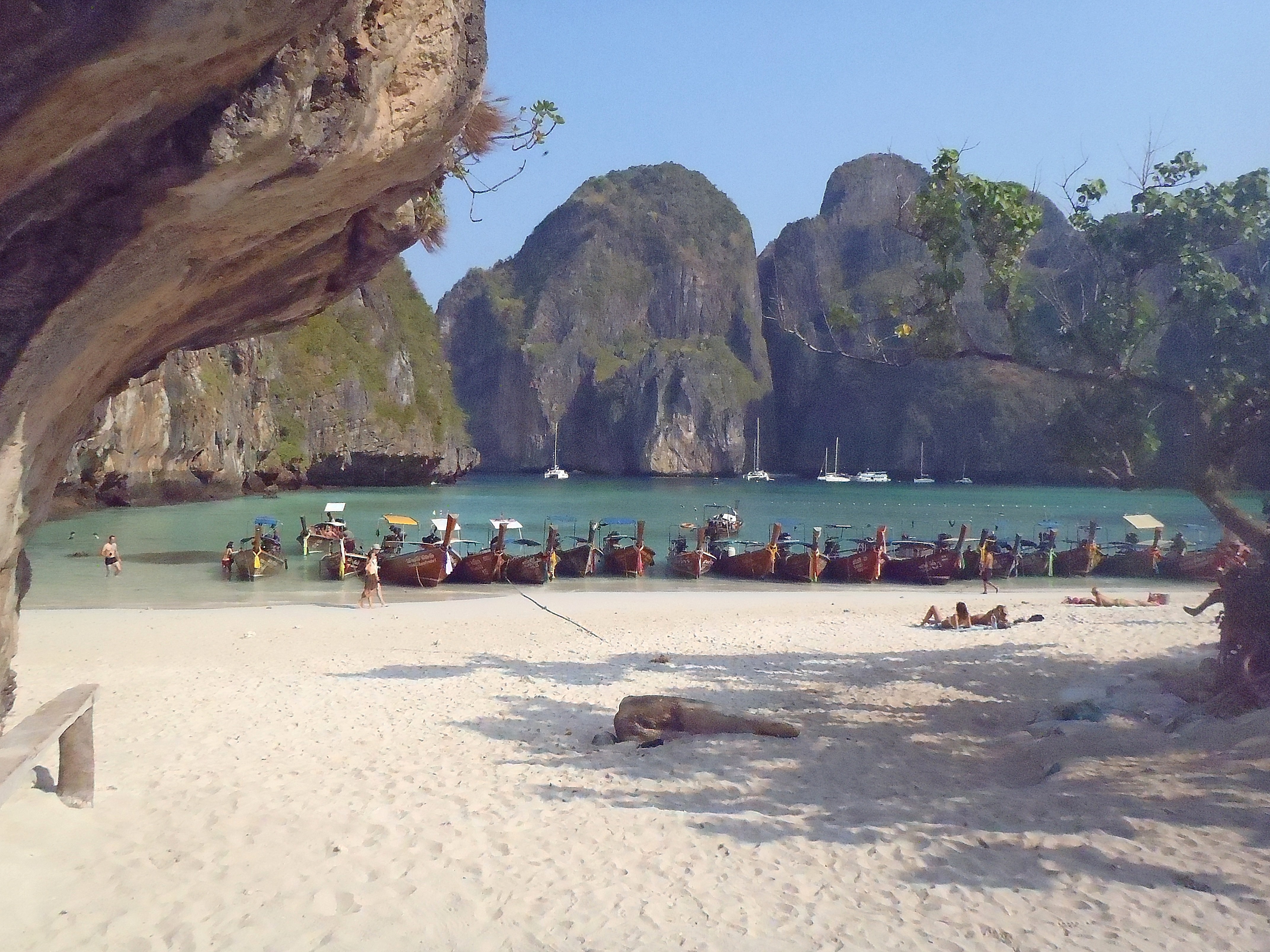
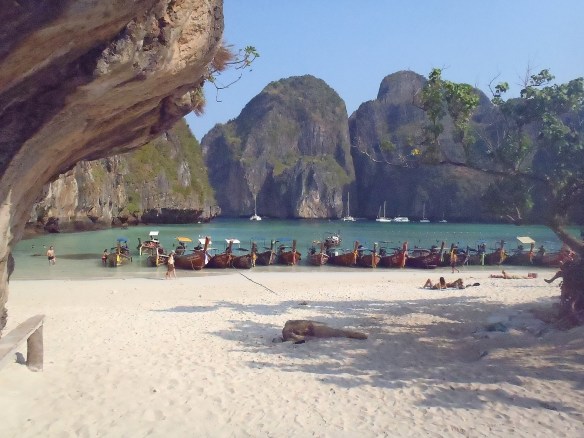
We raised anchor and hustled out of Tonsai Bay at first light. Our objective was to be the first boat into Maya Bay on Koh Phi Phi Le, the smaller neighbor to the south of Koh Phi Phi Don. This is the island where Leonardo DiCaprio’s movie “The Beach” was made. The island rises straight up from the water to a height of 375 meters. The sheer limestone cliffs are an imposing sight from miles away, but when you enter Maya Bay through an opening in these towering cliffs, you see a gorgeous spread of pure white beach. The sand is so fine that it’s hard to discern individual grains of sand.

Koh Phi Le

Koh Phi Le

As the day progressed the beach was lined with speed boats and long-tails bringing tourists, but there was plenty of beach for everyone. After walking the beach and swimming, we found a trail through the tropical forest. The trail itself was a delight–cool, pleasant, and beautiful under the palm fronds. It ended on the other side of the island where a narrow channel of water separated the main island from a free standing tower of rock. A few long-tails brought tourists to snorkel there. Later in the afternoon we motored around the island to visit this area in our dinghy. As if this place wasn’t special enough, we found a small hidden beach in a deep narrow canyon–we were the only feet on this beach.

If you can tolerate the strange movie, watching “The Beach” will reveal the marvelous beauty of this Jewel of Thailand.

Friday, March 8 28 nm

Today’s adventure began with an adventure of its own. During the night a submerged line from a derelict mooring ball had wrapped itself around our rudder where it meets the hull. I saw part of the line trailing just behind the stern of the boat and tried to free it with the boat hook, but to no avail. This predicament presented the opportunity to dive under the boat with my new Spyderco nitrogen-hardened serrated-blade knife and slash away at the rope that had snared us. With mission accomplished we left Maya Bay and headed southeast toward Koh Lanta.

Kantiang Bay on Koh Lanta is the home to a posh resort, Pimilai, where really-white white people stroll the beach–probably British or German. It’s also the home of the Why Not? Bar, an establishment more suitable to our station in life. The Thai food there was good, and the Bob Dylan and Cat Stevens songs were truly music to our ears.

After dinner we talked to a young British accented woman named Phoebe who told us that her boyfriend’s wife died on Koh Phi Phi in the Tsunami. The social destruction of the tsunami seems to have extended beyond the physical damage because we have talked to several people who told us stories of friends and relatives lost in the disaster. They brought it up, not us.

Saturday, March 9 10 nm

What a day! We started with Swedish massage by two Thai Muslim women at Surawee Massage. Then we rode through the jungle for an hour on an elephant named Natalie. After the ride we fed her big pieces of pineapple. I took a bite out of each piece before giving it to her–just to make sure that it was OK–and she waited patiently for her turn. She ate everything, even the bristley thing on top, but she was very gentle and careful.

Back to the boat we weighed anchor and headed for Old Lanta Town to find a guy named Steve who might have some marine supplies we needed. Old Lanta is a true Thai town, mostly a fishing village with a long concrete pier for fishing boats and ferries–not a single resort in sight. As we dinghied toward the dock we heard music playing and saw banners flowing in the breeze and rows of white tents. We didn’t know it, but this was the final day of the Lanta Province Festival! What serendipity, and what a hoot! Vendors were selling a thousand kinds of food, from fried things that I can’t even guess what they were to gelato and coconut custard pie.

We wandered through the maze of vendors and wound up in a large clearing with a stage and an enthusiastic announcer. Then serendipity struck again–two policemen came through clearing a path through the crowd and leaving us on the front row to watch a parade filing into the arena. The paraders were representatives of each town in the province. Each town group was led by two beautiful girls in ornate outfits carrying a banner that announced their town. After the girls came a group of young and old people from the town, many of them playing instruments or drums.

After video recording enough of the parade, we set off to find Steve, the owner of Lanta Marine Services. We kept asking people where Lanta Marine Services was. Nobody could really tell us, but they said that a Frenchman named Bean (maybe they meant Ben) at the Mango House restaurant probably knew where to find Steve. We went there and Bean tried phoning Steve, but with no luck. Since Steve frequented the Mango House, we decided to eat a little. This accomplished not only eating, but also resting our feet, checking our email on the wifi, and waiting for the serendipity of the day to bring Steve around. Before we finished eating, Steve appeared and introduced himself. Yes, he had the parts we needed and would bring them to our boat in the morning. I have grumbled daily about the boat not being properly prepared for our charter, but if it had been, we would have never experienced the Lanta Festival, which would have been a real loss.
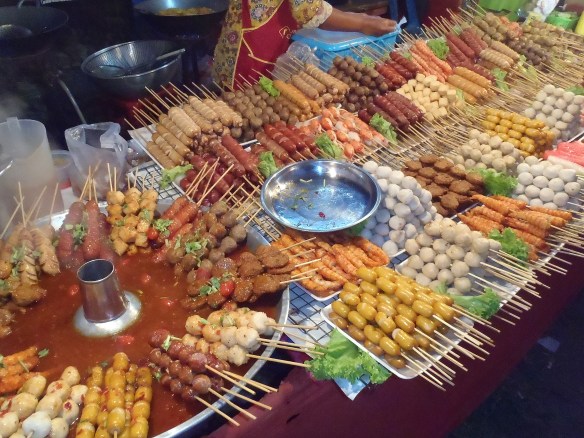
Food at the Koh Lanta Festival

Food at the Koh Lanta Festival

We were also on a quest for ice. Steve connected us with a shop owner who sold us about 30-35 pounds of ice for 60 baht, about $2. We lugged it back to the dock where our dinghy was tied and discovered that the tide had risen and floated our dinghy away from the dock where I had tied it. How could we get into the dinghy without swimming in the dark water? Serendipity struck again! Three young Thai men were standing on the dock wondering how they could get to their boat which was even further from the dock than ours. So one of them climbed down a concrete post on the dock near our dinghy, jumped into the dinghy, and paddled it to where we could get in. Then we took him out to his boat and he went back to get his two friends. I tried to pay them for helping us but they absolutely refused. We have found all the Thai people to be friendly and generous with their help.

Sunday, March 10 17 nm

An almost windless day made motoring the only good option, so we motored toward Ko Ngai. We stopped to snorkel at a tiny neighboring island, Ko Ma. Our next stop was Koh Mook, an island that is best known for its Emerald Cave. Over dinner at a local restaurant we were surprised to hear a Willie Nelson duet about the silver eagle meeting the great speckled bird!

Phuket Travel Journal, Week 2

Monday, March 11

Diana relaxed on Malee while I went with Princess Divers to Ko Kwuen for a couple of dives. The dive boat was a long-tail, the first I had ridden on. The floor of this rather crudely built boat was laid with one-inch thick teak planks that would be worth big money at an exotic woods retailer in the USA.

The fish were super abundant including some beautifully colored ones that I had only seen in pictures before, but the sea fans and soft corals were even better. The soft corals came in a variety of delicate colors including pink, lavender, and frosted white.

After lunch we moved Malee up the coast to a spot near Mot Muk cave, also known as the Emerald Cave. This cave is about 150-200 feet long and open to the ocean. At low tide we swam through it to a canyon with a beach inside the island! The light from the opening on the ocean side of the cave dwindled and vanished just before the light from the hidden canyon reached into the cave. By keeping going through the darkness we came into the light again. I think there is a sermon in there somewhere. The canyon was incredibly beautiful with towering tropical trees reaching up a hundred feet or more toward the top of the canyon. Heavy vines covered the sheer walls of the canyon, and a bird’s strange song echoed through it.
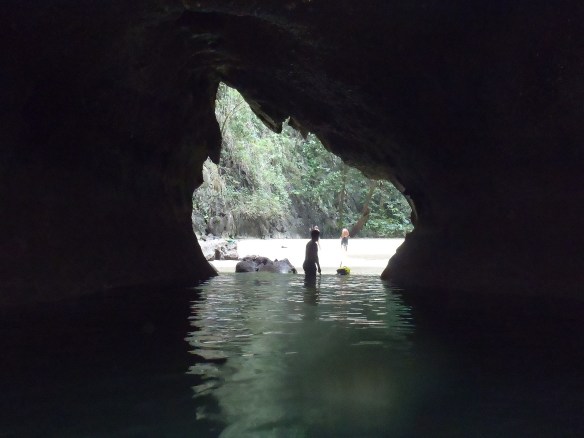
OLYMPUS DIGITAL CAMERA

Tuesday, March 12 18nm

As much as we enjoyed Ko Mook, it was time to move on. Ko Rok, a pair of islands 16 miles to the southwest, are uninhabited but have a beautiful channel between them. Coral heads in the shallow water made going ashore tricky, but they were great for snorkeling. At low tide I snorkeled over coral close enough to touch without diving at all. This coral field was a great fish metropolis with neighborhoods of yellow fish in one area, blue fish in another, and a few neighborhoods of mixed ethnicity.

Fish hiding in the Urchins

Fish hiding in the Urchins

Wednesday, March 13

In the morning long-tails and speed boats shipped in snorkelers and sunbathers. By the afternoon the day boats had cleared out and we walked the beach alone. Some more snorkeling and a swim back to Malee concluded the day.

DSC_9b

Sunset at Koh Rocha

Sunset at Koh Rocha

Thursday, March 14 16nm + 16nm + 2nm 34 nm total

We have learned that the wind blows early here, dies in the middle of the day and then blows again in the late afternoon. With an early start we estimated that we could reach the Ko Ha group of islands before the wind died. Koh Ha consists of five rocky outcroppings that rise up from deep water. Between the middle island and the two smallest islands is a bay of beautiful aquamarine water, an idyllic place to snorkel and spend a night. When we arrived we found the tiny bay crowded with huge dive boats including several live-aboards that were loaded with divers and tanks. There was only one mooring ball left so we cautiously headed toward it. Two dive boats began blowing their horns and three boats had people waving their arms shooing us away. I don’t know if they knew something about that ball that I didn’t know and needed to know or if they were just saving it for one of their own kind. As the only sailboat among a half dozen dive boats and two hundred divers, we felt definitely unwelcome. Since the water outside the bay was much too deep to anchor in, we chose a new destination.
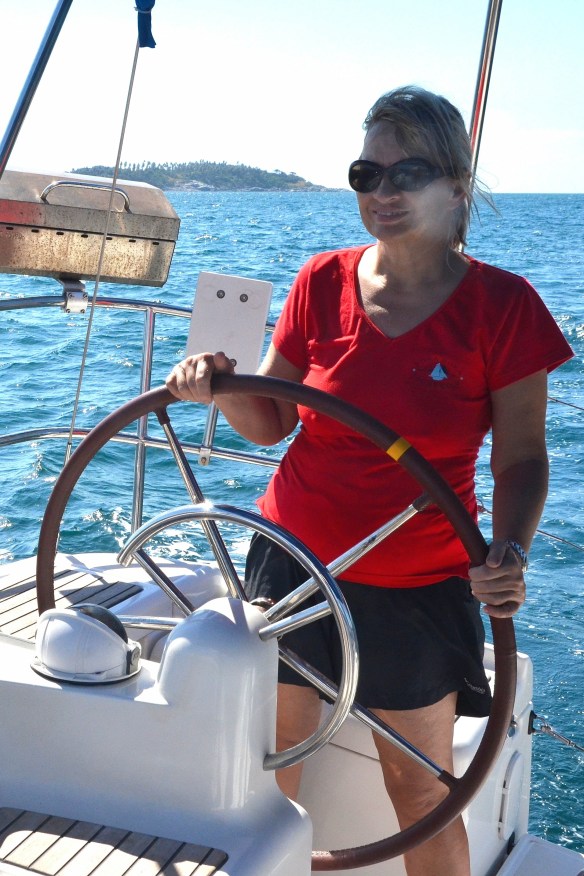
DSC_10DSC_13

Just south of Ko Phi Phi Le are two small islands, Ko Bida Nai and Ko Bida Nok sitting on a shallow shelf, perfect for anchoring. We motorsailed the 18 miles there only to find two more obstacles. First the shelf shown on the charts just didn’t exist.. The water was 90 feet deep, much too deep to anchor. One of the dive boats came toward us blowing its horn, and while I wanted to stay just to assert sailors’ rights to the anchorage, anchoring really wasn’t possible so we chose a new destination again: the familiar waters of Maya Bay on Ko Phi Phi Le, four miles north.

Maya Bay was much more hospitable than Ko Ha and Ko Bida. We anchored in 20 meters, and enjoyed watching the last of the day boats leaving just before dark. We shared the large bay with only one other boat.

Friday, March 15 26 nm

We awoke to a mild northeast wind, just what we needed to sail a broad reach west to Ko Racha Yai, 26 nautical miles away. It felt great to be under sail power with no engine noise to intrude on the solitude of the sea. The splashing sounds of water against the hull and the occasional creaking of the boom were great sailing music.

The wind died before we reached Ko Racha, but it had carried us most of the way. We motioned to the bullpen and brought in the engine to pitch the final inning. We closed out the game by dropping the hook in 10 meters of water in Bungalow Bay by the 5-star Racha Resort.

After snorkeling along the rock shore near Malee, we cleaned up and went ashore to have a meal like proper folks. That meant a shower, hair combed, and a shirt with a collar for me and a sporty dress for Diana. The restaurant at The Racha Resort had live music from a Filipino trio, a lovely view of the bay at night, free wifi, and baby back ribs that no self-respecting Kentuckian would serve to a guest.

Saturday, March 16 24 nm

The wind and seas were up so we sailed a strong beam reach south to Ko Racha Nok, two almost connected uninhabited islands with a reputation for great snorkeling and diving. We saw the biggest seas of the trip, still only 4 feet, and the strongest winds, around 19-20 knots, so the sailing was exhilarating. Snorkeling was a different matter. The seas were so deep around Ko Racha Nok that anchoring was impossible without getting too close to the rock shore.

Sunday, March 17 21 nm

The wind and seas were still favorable so we made great time in the passage to Ao Patong, a very large bay and tourist city on the Andaman Sea coast of Phuket. This city, Ban Patong, was directly exposed to the 2004 Tsunami and sustained extensive damage, but the reconstruction was meticulous. Every dingy little side street and alley was restored to its previous condition. Every garish t-shirt shop and pirate video kiosk was rebuilt. Every ugly utility line was strung through the air just as before. It was just like the tsunami never happened, except for a memorial on the main street and the tsunami evacuation route signs.
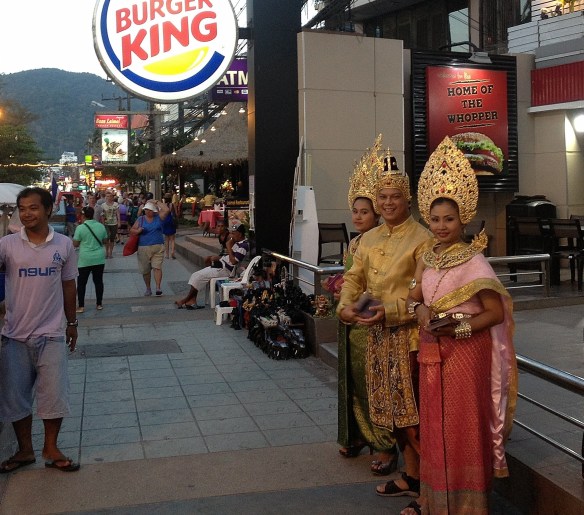
Thai Burger King

Thai Burger King

The beauty and glamor of Ban Patong didn’t stop us from hitting the tourist trail. We bought a fake Ralph Lauren shirt for me, a dress for Diana, and a few gifts for friends at home, but our real mission was the Quest for Nam Keng (also known as looking for ice). Our most precious purchase was 13 small bags of ice.

Although we had never been there before, Ao Patong had a familiar feeling. The bay itself felt like Charlotte Amalie harbor in St. Thomas–large and round in shape and shallow enough for easy anchorage. The beach felt like Rio de Janeiro–a long broad expanse of sand covered with sunbathers who needed to be covered with something. Beach activities felt like Daytona –parasailing and jet skiing gone wild. And the city itself–just name your favorite tourist trap.

Phuket Travel Journal, Week 3

Monday, March 18 28nm

Heading south, we rounded the tip of Phuket island and turned northeast toward the Ko Khai islands, a group of six small islands about halfway between Ko Phuket and Ko Yao Yai. Ko Khai Nok, the largest island, could be called the Island of One Thousand Umbrellas for the massive spread of beach umbrellas across its sand. Under the umbrellas two thousand beach chairs provided temporary refuge from the sun for the hundreds of tourists brought to the island by a fleet of fine speed boats. The tourists were mostly Europeans and Japanese. It was easy to tell which were which–the Europeans wore bikinis and Speedos, while the Japanese wore life jackets.

After investigating this phenomenon, we retreated by dinghy to Malee which was moored near a tiny rocky island in this group, Ko Khai Nui. We chose this island because it was away from the commercial craziness of Ko Khai Nok and because of the Chok Dee restaurant perched on stilts there. This restaurant came highly recommended for its Thai food. Unfortunately the recommendation failed to mention that Monday is the cook’s day off.

DSC_12

As night began to fall several long-tail boats became our neighbors on nearby mooring balls. Our sophisticated, spacious, and comfortable boat provided a stark contrast to the simple long-tails. They were live-aboard boats for fishermen known as “sea gypsies.” By day they were working boats, and by night they were lodging. Each had a small covered area which contained the essentials of life. We saw a family of four eating dinner after dark on the long-tail next to us. In addition to the soft white light over their table, the front of their boat was flashing red, green, and white lights like a panic-stricken Christmas tree. I suppose this is so other boats will see them and not run over them in the dark. I was impressed with their intimacy with the sea, but not attracted to their life. To reverse George Gobel’s famous phrase, we felt like a tuxedo in a room full of brown suits.

Tuesday, March 19 19 nm

We began our day by snorkeling over the coral between Malee and Chok Dee. The fish were an enthusiastic welcoming committee swimming up to us literally in hundreds. Black and yellow striped fish, green and orange fish, angel fish, yellow tangs, butterfly fish, trumpet fish. They not only swam near us, they swam up in our face to study us through our snorkel masks and they accompanied us as we swam around the area. Thai fish are very friendly, especially if they think you might feed them.

It was almost 11:00 a.m. by the time we finished snorkeling and cleaned up, so that meant lunch at Chok Dee. We dinghied up to the restaurant and one of the staff waded out to meet us and pull our dinghy up to the steps. After we got out he took our dinghy and tied it to the dinghy line in front of the restaurant. Our meals were beautifully presented and delicious–New Zealand mussels with garlic sauce and salmon with dill sauce. When we were ready to leave we got into their dinghy and a staff person took us out to our dinghy. Valet dinghy service at tiny Ko Khai Nui!

While sailing north to our next anchorage at Ko Phanak we passed by several lovely pink and lavender jelly fish about the size of pumpkins. We could see them pulsating slowly in the water but we were too mesmerized to think to take photos.

Ko Phanak is the southernmost island in the fairy wonderland of Phang Nga Bay. Dozens of relatively small islands have the most fantastic shapes–witches’ hats, Mohawk haircuts, stegosaurus ridges, mushrooms, fingers, vases, camel humps, and other improbable geological formations with ghost islands lurking in the background.. These shapes defy depth perception so you are never sure if there are passages through the islands, but when you get closer you find them.

Wednesday, March 20 16nm

We spent the night anchored in a bay on the west side of Ko Phanak that has the entrance to a large hong. A hong is a canyon inside the island. Some are directly accessible from the sea in a small boat and others are accessible through a cave that is open to the sea. This one has a cave which is well known for its length, about 200 feet of dark twisting cave with stalactites and rocky protrusions, and for its smell, the aroma of hundreds of bats that live in the cave. We got an early start to beat the hordes of noisy tourists that power boats would soon be depositing and to catch the tide at the right height. Our headlamps were fairly feeble but gave enough light that we could row our dinghy through the cave. In places the cave ceiling was high, but the exit into the canyon was so low that we had to crouch down in the dinghy to get through it. At high tide it would be impassible. (I checked the tide charts–we would leave before being trapped.)

We entered into a rather large canyon with walls that went straight up about 200 feet. Trees and bushes and grasses grew on the canyon walls and the lake inside the canyon was very shallow at low tide. Although going through the Bat Cave was quite an adventure, the canyon seemed fairly unremarkable until we saw a troupe of monkeys sitting on a large rock that came down to the water. There were six adults, four adolescents, and two babies. We watched in silence as they went about their morning grooming exercises at the monkey salon. They picked through the fur of the monkey on their left, then they reversed and picked on the right. The babies crawled onto their mothers then they scampered off a little distance to play.

Monkeys at Koh Phanak

Monkeys at Koh Phanak

Over on the other side of the lake a large monkey dove into the water and swan underwater for at least twenty feet before he came up. I don’t know if he was fishing or practicing for the Monkey Olympics. Maybe he was just swimming for fun. Later on three monkeys climbed a rock and cannon balled into the water from about ten feet up. Diving must be a Monkey Olympics event. It was clear that the monkeys were doing this just for the fun of it because they had to go out of their way to climb the rock.

The monkeys seemed completely unconcerned about us although the breeze inside the canyon had blown our dinghy close to them. One monkey took interest in us and waded out through the shallow water to look at us. He came to about ten feet from our dinghy and just pondered us for a while. I wasn’t sure of his intentions so I watched him watching us but I had my hand on my oar in case this encounter went sideways.

There seemed to be two families of monkeys, the Eastbanks and the Westbanks. After the Eastbanks had closed their grooming salon the Westbanks got into a ruckus. I think the fuss started when one monkey was monkeying with another monkey’s monkey.

The rest of the day was anticlimactic after our Jane Goodall experience with the monkeys. We sailed to Ko Hong, which as the name suggests, is almost all hong. The entrance was easy, but no primates here, except for the tourists in sea kayaks. Then we sailed on to an island which is known as James Bond Island because of its use in the 1974 James Bond movie, “The Man with the Golden Gun.” The rock formation there was especially impressive–a stone monolith rising straight up from the water but smaller at the bottom than at the top. We bought a few souvenirs from some sweet Thai ladies, one of whom had sold souvenirs on this island for 20 years. They asked about our families and we learned about theirs.

James Bond Island

James Bond Island

Thursday, March 21 25 nm

We had to sail south to get around a large shallow area in Phang Nga Bay, so we sailed back to Ko Phanak where we had seen the monkeys. We went back to the cave at the same time as yesterday, but our monkeys weren’t there. That was disappointing but because the tide was a little higher today, we were able to row into a second part of the hong that we couldn’t get into before. Fun, but still not as much fun as a barrel of monkeys.

We sailed a crooked course from Ko Phanak to the east side of Phang Nga Bay in order to avoid shallow spots. At one point the water was barely deeper than Malee’s keel, but we held our breath and picked up our feet and made it through to deeper water.

Just before dark we anchored near the Ko Yao Noi Resort. We were ready for some solid land and some solid food, and we weren’t disappointed. The resort was casually elegant. The meal was delicious and the service typically Thai gracious. The resort had an outdoor movie screen and was showing–guess what–“The Man with the Golden Gun.” We could see the screen from our table and could hear the movie so we watched part of it. The action was hokey and the repartee was embarrassingly campy. How did we ever think this was glamorous? But when the James Bond theme music came up it evoked the same sense of allure, romance, intrigue and excitement that it did in 1974.

Friday, March 22 17 nm

The Quest for Nam Keng Trilogy entered its final phase with a trip in the back of a pickup truck taxi into the village on Ko Yai Noi. You might be in Thailand if the big supermarket in the principal town of a large island is a 7-11. It had several items we needed but no ice, meat, fruit, or fresh vegetables. Those items required going to several specialty grocers. By asking at a few shops as we worked through our grocery scavenger hunt, we learned that the shop next to the Fresh Mart had ice. We filled our insulated bag with several bags of hard frozen ice and happily climbed into the taxi for the fifteen-minute ride back to the resort where our dinghy was tied to a palm tree on the beach.

We sailed south to weave our way through the Ko Ka group of small but towering islands. High on the smooth side of one of them was a cave opening where a bird nest collector had set up camp. He will live there for months guarding the bird nests that are highly prized in China for bird’s nest soup. When he harvests and sells them he will earn his year’s income for living like a hermit.

Bird Nest Collector

Bird Nest Collector

Next stop was Ko Hong Krabi, similar to Koh Hong except located in the Krabi district. It had a the largest hong we have seen, probably 800 feet in diameter, and we didn’t have to swim through a cave to see it. It had a narrow passage that connected to the sea so we entered it in the dinghy. It had beaches inside it including one long strip of sand in the middle of the hong. Inside the hong birds sang and starfish crawled slowly along the bottom. We hated to leave but we had miles to go before we slept.

We passed the King of Thailand’s summer palace on the way to our anchorage at Rai Le Bay. Rai Le was just as described to us, a small Rio de Janeiro. It had its own Sugar Loaf, but no Corcovado. Its long beach was not so glamorous as the real Rio’s, but unlike Rio, it faces west and allowed us to enjoy the most glorious sunset we have seen. Sashes of fire draped through the cobalt blue sky and became richer and redder as each minute passed. When night arrived the shore came alive with lights from restaurants and the swirling glow of a fire dancer. Soft samba music floated across the bay and made us wonder if perhaps we really were in Rio.

Saturday, March 23 22nm

We got an early start while the wind was good and sailed to the twin islands Ko Dam Hok and Ko Dam Khwan. Both islands have good beaches but their most interesting feature is a sand bar that connects the two. At low tide you can walk on sand from one island to the other, about 1100 feet apart, but we arrived at high tide. All the better for the challenge. We went ashore on one island in the dinghy and then waded across to the other island. The water was never over my head but I had to tow Diana part of the way across. We were almost alone on the beach but that didn’t last long as speed boats and long tails began arriving. That was our signal to leave so we waded back across the sand bar, dragged the dinghy off the beach, and motored back to Malee.

We rounded Chicken Head, an odd shaped rock tower on the tip of the island–which got its name for a reason that you can easily guess–and then settled into a long broad reach to the southern tip of Ko Yao Yai. Rounding Ko Yao Yai we set a course for the restaurant-on-a-rock that we discovered last week, Chok Dee Restaurant on Ko Khai Nui. Unlike our first visit, it was busy with a party of about twenty people including adults and children. We met the ambassador from Panama and Peter, the owner, and enjoyed a good Thai meal in a relaxing atmosphere. This little rock could be our home away from home in Thailand.

DSC_17

Sunday, March 24 22 nm

It’s our last day onboard Malee. We set sail toward Ao Po Marina today with mixed feelings–sorry to leave Thailand because there is so much more to see, eager to get home where we have air conditioning (although we probably won’t need it), dreading packing all our equipment into luggage not exceeding 50 pounds each, eager to catch up on news and everything happening at home, reluctant to face the 28 hour flight home, but eager to see family and friends again.
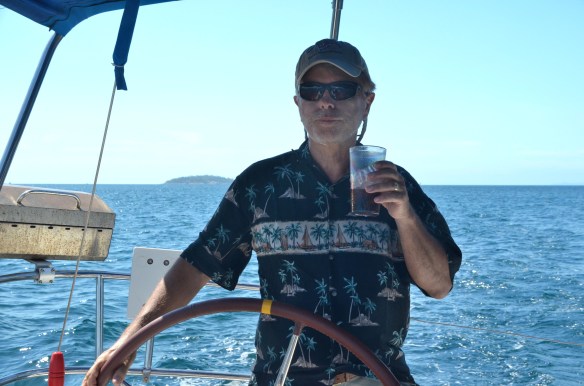
Larry at the Helm

Larry at the Helm

We stopped to snorkel at Ko Sup, the “bunny ears” islands we passed on our second day. They rise 35 meters straight up from the sea, so we assumed that the water around them would be fairly shallow and good for snorkeling. Wrong–20 meters deep, much too deep to see anything except the minnow sized fish that swim at the top. But even a dud adventure can turn out well. While we were anchored there eating lunch, a long-tail fishing boat approached us. It was the same man and woman who sold us a batch of prawns when we passed here before. This time they had tiger prawns. They are like lobsters without claws. So our fishing friends made a sale and we had tiger prawn dinner–yum yum! This is a good life, living off the sea!

My Top Ten Experiences in Thailand

1. Watching the monkeys in the hong at Ko Phanak

2. Rowing through the dark bat cave to the hong at Ko Phanak

3. Seeing the fairy wonderland of odd shaped islands in Phang Nga Bay

4. Swimming through the Emerald Cave to the hong on Ko Mook

5. Experiencing the province festival in Old Lanta Town

6. Riding and hand-feeding pineapple chunks to an elephant in Ko Lanta

7. Seeing Maya Cove at Ko Phi Phi Le (the site of DiCaprio’s movie The Beach)

8. Wading across the neck-deep sandbar from Ko Dam Hok to Ko Dam Kwan

9. Snorkeling in crystal clear water over coral at Ko Rok

10. Enjoying the gentle rocking motion of the water while sleeping on Malee
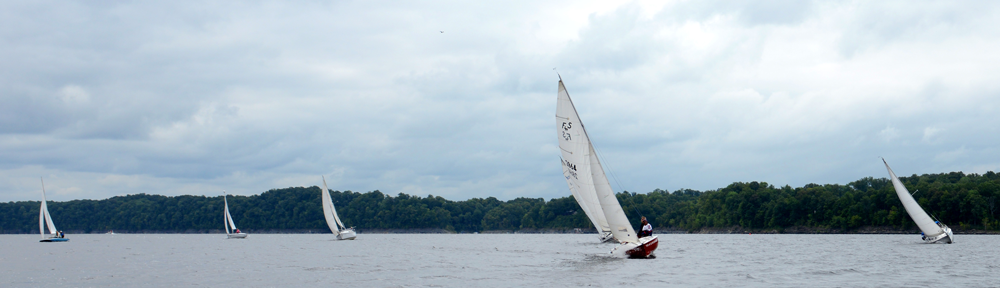
Caillouet’s in the BVI for Christmas

OLYMPUS DIGITAL CAMERA

Willie’s in the BVI

[Larry and Diana Caillouet have spent three Christmas Eves in the British Virgin Islands. The Bight is a large and popular harbor on Norman Island in BVI. Willie’s refers to the Willie T, a floating bar that looks like a pirate ship. It is anchored in the Bight.]


‘Twas the night before Christmas, O holy night!
Diana and Larry had returned to the Bight.
It was here in ‘96 and again in ‘07
that tropical paradise co-mingled with heaven.

God’s gifts were abundant: sand, sea and wind,
but the greatest gift that he could send
was the gift of a baby, one of great favor,
humbly born, the glorious savior.

He had no harbor, no room at the inn,
a stable his birthplace, wise men his friends.
A needy world waiting, enslaved to sin,
the battle with Satan was his to win.

Full moon on the Bight, spirits are high,
anchor lights looking like stars in the sky,

Music at Willie’s filling the bay,
Sailors celebrating the coming Day
when Santa sails in with his water-sleigh

He will bring gifts for the good little girls and boys,
candy and games and all kinds of toys,

But none can compare to forgiveness of sin
when angels sang “Peace on Earth, Goodwill to Men.”

Joy to the world–the Lord has come!

Sailing in the BVI

Sailing in the BVI

Antigua Race Week by Larry Caillouet

Saturday, April 28            Around the Island Race

                Forty three boats entered the Around the Island Race, but we were one of only three bareboats in the race.  The other two were Jeanneau 41i and 44i.  Richard was at the helm for a perfect start and we immediately took the lead over the other two bareboats.  The seas were big, 8-10 feet, and the winds were strong, 18-25 knots, so it favored the bigger boats.  We pounded through the waves and steadily built our lead over the other two boats.  The glamour boats started after our fleet, but soon caught and passed us.  The highlight of the day was when the 115-foot ketch Sojana passed us doing about 16 knots and made us look like we weren’t moving.  She was carrying five sails including a gigantic spinnaker.  It takes about 15-18 people to sail her, but I counted 25 people on deck, including the waiter who was serving sandwiches and drinks.


                Battling winds, waves, competitors, and the clock, Spindrift III was proud to be first to finish among the bareboat fleet.  See the news story of this race at the end of this journal for details.


                After the race, which ended at the Pillars of Hercules near English Harbor, I radioed the Sunsail dock that we were coming in.  The manager who answered said, “Sorry, we have no space.”  I replied something to the effect of “Negative, Sunsail—make some space!  We have a reservation!”  After checking his paperwork he radioed back that they would make some space.  So they shoved the boats down the dock and cleared a space of about 10 feet between two boats and crammed our 16 foot beam into that space.  It was dockyard magic.


Sunday, April 29               Antigua Sailing Week, Race 1

                The wheels fell off the wagon.  We misunderstood our place in the starting sequence and were 8 minutes late to the starting line.  Our jib furler jammed and we couldn’t get the jib out for a maddening  few minutes, so we started the race deep in the hole.  We couldn’t get our stretched out sails to shape properly, so we fell further behind.  Then as we sailed the final upwind leg on starboard tack, the jib sheet snapped.  We quickly tacked to port to get the jib under control, but we knew we had to tack back to starboard to finish the race.  We considered retiring from the race, as one boat had already done due to equipment failure, but we had enough jib sheet left to tie to the jib, so we did that and finished the race—dead last.  Spindrift III is rated as a slower boat in our fleet, so on corrected time we finished fifth, our worst finish in the regatta.


Monday, April 30             Antigua Sailing Week, Race 2

                A much better day.  Nothing broke and we started well.  We had rolled the bimini back so we could see the sails and masthead fly better.   The sails were still misshapen with the leaches of both sails fluttering limply, but we improved to fourth place.

                The winners of Race 1, a group of Germans sailing Monet, a Harmony 52, retired from the race when their boom snapped at the start.  We saw their boat as we walked around the dock admiring the beautiful boats that evening, so we stopped to talk.  They were understandably frustrated with having to retire from the race and take ninth place, but were even more frustrated with the bureaucracy they had to fight at the charter company in Guadeloupe.  The boom couldn’t be repaired without voiding their insurance until the owner of the boat had been contacted, so they would have to lose at least one more day of racing.  We invited them to sail with us on Tuesday and they accepted.


Tuesday, May 1                Antigua Sailing Week, Races 3 and 4

                There were two shorter races on Tuesday, each only 10-12 miles.  Reinher , Max, and Raphael from Monet joined our crew.  Having a crew of seven made everything easier, especially tacking, and gave us more ballast on the rails, but our performance remained the same—two fourth place finishes.  That put us solidly in fourth place for the regatta.


Wednesday, May 2         Lay Day

                Wednesday was a lay day.  I guess they call it that because you can lay around and take it easy.  No sailing races, but there were some parties and other stress relieving diversions on land such as tug-of-war and piggy-back races.   Our crew skipped all of that and used the day to rest and to make some adjustments to the rig.  I added better tell tales to the jib and Bill shortened the leach cord.  We also worked on the main sail.

                In the evening there was live music at Nelson’s Dockyard.  A soca band played first—genuine island music.  It was Hot, Hot, Hot and loud, loud, loud.  The beat, the volume, and the mood reminded me of Carnival in St. Vincent except that the band was stationary on the stage, not on a flatbed truck moving down the street.  A legendary reggae and soca singer named Sparrow was a special guest singer, and he was great.  A woman at the chandlery in Falmouth Harbor told me that he was about 80 years old, but you couldn’t tell it when he was on stage.  The headliner act was Ky-Mani Marley, one of Bob Marley’s sons.  He was a huge disappointment, so I left after three or four songs.  It didn’t matter—I  could still hear him all the way back to our boat.  Fortunately, with the air conditioning running and the hatches and ports all closed, we couldn’t hear him at all.


Thursday, May 3                               Antigua Sailing Week, Race 5

                We were confident that with better sail trim we would improve our standing.  We knew we were improving our team work and felt that our speed was better.  Unfortunately other crews were improving also and Monet was back in the race with a repaired boom.  We finished fifth.

                Chris had brought the dinghy around from AYC on Wednesday so for supper we used it to go across English Harbor to a cute French dockside restaurant named Catherine’s.  I wanted to eat there because on the day of Race 1 when we had done so badly, their staff cheered us as we motored back into the harbor.  I knew that they must have cheered all the racing yachts because they didn’t know us and didn’t know how we had done, but it felt good and I appreciated the nice touch.

                We were greeted by a petite French woman who spoke lovely French-accented English.  We ordered typically over-priced and under-sized French meals and enjoyed listening to a four-piece jazz band.  We thought the band was the floor show until a loud argument erupted between the manager and one of the serving staff.  Actually, the loud all came from the waitress.  The manager was doing his best to calm her down and avoid an ugly scene.  She chose to make an appeal to the court of public opinion by loudly explaining to all the diners that the management was cheating her of her wages.  Every time the manager moved toward her, she screamed, “Don’t touch me!”  She made quite a scene for several minutes.  The hostess and the manager came to each table apologizing for the unpleasantness.   And they took the charge for our bottle of wine off our bill.  All’s well that ends well.


Friday, May 4                     Antigua Sailing Week, Race 6

                We sailed a new course, but the result was the same—fourth place.  Our consistency worked against us when the Race Organizing Committee dropped each boat’s worst score to determine the regatta’s final outcome.  Our worst score, 5, was not much worse than our best score, 4, so our regatta score didn’t benefit from the throw-out as much as some of the other yachts.  Nevertheless,  we finished the regatta in fourth place in the Bareboat 1 class, one place off the podium.

                The awards assembly that night was suitably impressive with Antiguan government officials and old-money yachties presiding.  The stage was filled with three tables of beautiful silver trophies.  Scenes from the races were projected on two large screens as trophies were awarded.  The night ended with a live band playing reggae and soca music.


Saturday, May 5              

                We planned a 6:00 a.m. departure, and actually left at 7:00 after a breakfast of French toast.  The wind, which had been blowing 18-25 knots all week had died to almost nothing.  We motored out of English Harbor, across the south coast of Antigua past Cades Reef, and set a course of 300° True for British Virgin Islands.  The seas were calm, sometimes even glassy, so the Yanmar diesel moved us along at 7-8 knots, even with the dinghy trailing behind us.  We had heavy cloud cover most of the day, sometimes a little rain, but we missed the heavy rains we could see in the distance ahead of us and behind us.  Even with the haze we could see Montserrat, Redonda, and Nevis as we left Antigua.  St. Kitts appeared to the west just as Montserrat faded to the south, and later Saba appeared just off our port bow.  Far to the east we could see the faint outlines of St. Barths and St. Martin.

                After supper we divided up the night watches.  Richard stood watch 8:00 to midnight, I took midnight to 3:00 a.m. and Bill took 3:00 a.m. to 6:00.  On Richard’s watch a waterspout came down from the clouds and bounced the boat around.  My watch was completely uneventful, but that made the time productive for reflection.  It was the night of full moon, except the moon was completely covered by thick clouds covering the entire sky.  It was truly a dark and stormy night.  Still, I was amazed at how much light there is on the ocean, even with no moon or stars.  I could see the horizon scribing a 5.6 mile radius all around the boat.  There wasn’t a single light on the sea until about 2:15 a.m. when the masthead light of another sailboat peeped over the horizon.


Sunday, May 6

                We made excellent time with the Yanmar pushing us at almost 8 knots though mostly calm seas.  We reached the Round Rock Passage to the British Virgin Islands at 6:00 a.m., 23 hours after we left Antigua.  We had a day to relax so we turned north and headed for the Baths on Virgin Gorda.  We were the third boat to arrive so we got the premier mooring ball right in front of the beach with the entrance to the trail through the giant granite boulders.  After working our way through all the boulders and arriving at Devil’s Bay, we snorkeled for about an hour, and finally hiked up the trail to the restaurant that overlooks the Baths and most of the Sir Francis Drake Channel.  Reluctantly, we left there and sailed down to Road Harbor to begin packing to leave.  All good things must end.

Larry’s back in the Caribbean – Antigua

I’m in the Caribbean again.  This time while Diana is at home working to keep me in the manner to which I would like to be accustomed, I’m sailing with three buddies to race in the Antigua Sailing Week regatta.  We decided to expand the outing and add open ocean sailing.  We flew to Tortola to get our boat, a Beneteau 50, and sailed from there to Antigua.  That sounds ambitious until our 180 mile route is compared to the yachts that came in from Europe, South America, and other far-away places.  We arrived at Jolly Harbor on the western side of Antigua just after dark on Wednesday.  It’s usually better to arrive and set anchor during daylight, but I was familiar with that harbor from being there last April and I’ve got excellent navigation software.  We spent a peaceful night there and then on Thursday morning we did some work on the boat to prepare it for racing.

Jolly Harbor with POYC Burgee

We are sailing in the Bareboat Division.  Since our boat is usually just used for cruising, it wasn’t fully prepared for racing.  The mainsail had lost all five telltales, and a hole that had been patched was open again.  Fortunately I had gotten some sail patching cloth and some material to make telltales at the sail loft at the Moorings/Sunsail base.  So we added those things and adjusted some of the standing rigging to give the sail a better shape.  

Falmouth Harbor

Yesterday we sailed from Jolly Harbor to Falmouth Harbor as sort of a practice and tuning drill.  We will do some more of that today.  Falmouth harbor is crowded with super sized sailing yachts, many of them over 100 feet long.  There are at least 2 that are over 200 feet long.  One of them has a navy hull, a red and a white water line stripe, and lots of varnished teak and mahogany above deck.  What a beauty!  We will do some practicing today, then at 8:00 a.m. on Saturday, our first race starts.  It goes completely around Antigua, about 55 miles.  The races on the next days will be more traditional races around markers and they will be shorter. 

Athos - A 203 foot beauty

More to report to you later.
Larry