Racing Rules Class – May 21st Saturday

Introduction to Racing Rules Class – Saturday 5/21
Understanding the rules of Sailboat Racing will increase your enjoyment of the sport. The most basic rules of Sailboat Racing are similar to the boating “rules of the road” that govern navigation and how boats interact when meeting each other. Understanding these right of way rules will greatly reduce the risk that you might injure yourself or damage your boat while participating in a race as well as improve your general sailing knowledge.

Four main right of way rules: [Part 2, Section A]
1. Boats on a port tack shall give way to boats on starboard tack (Rule 10).
2. When boats are on the same tack and overlapped, the boat to windward (the boat closest to the wind) shall keep clear of a leeward boat (Rule 11).
3. When boats are on the same tack and not overlapped, the boat that is astern shall keep clear of the boat ahead. (Rule 12).
4. When a boat is tacking (changing tack) it shall keep clear of boats that are not tacking Rule 13
Four rules with general limitations: [Part 2, Section B]
1. Even if you have right-of-way, it is your duty to avoid a collision, once it becomes apparent that the other boat is not giving way (Rule 14).
2. If you acquire right of way, you must initially give the other boat room to keep clear, unless you get right of way because of the other boat’s actions. [Rule 15]
3. A boat that changes course, even if it has the right-of-way, shall do so in a manner that gives the burdened boat a chance to “keep clear” and give way (Rule 16).
4. If you catch up with another boat and you want to pass it to leeward, you may not sail above you proper course i.e. you shall not luff higher than you would have done if that boat wasn’t there [Rule 17]

Rob will again conduct an introduction to racing rules class on Saturday, May 21st. This was a great session last year and really helped many of those new to racing sailboats get a basic understanding of the rules. It is also a good refresher for those of who have raced before, but have a question about the rules. Come on out to the club on Saturday morning (10 AM).

Race the Course – by Doug Roberts Racing Chairman

Race the Course
One way to ensure your best finish is to get around the course as fast as you can. This seems rather obvious, but as other competitors enter the picture you are tempted to alter your original race plan and soon you find yourself playing follow the leader. One approach is to develop your race plan focused on racing the course and not your competitors; the course is the constant in the equation.

Before the start of the race you will see boats racing along with what seems to be enough speed to win the race. During the pre-race sailors sail their boats at maximum speed without regard to the course or other competitors. During a race, however, some sailors get distracted by competitors on the course, resulting in them adjusting their race plan and sailing less effectively.

This doesn’t mean you ignore the competitors completely, but you should only use them to gain an advantage on the course. Look at the competitors who are windward (upwind) of you to help judge the changes in the wind and on Barren River Reservoir there are plenty of them. The best way to help ensure a win is to sail at your boat around the course as efficiency as possible. This means tacking as soon as a shift occurs to take maximum advantage of a wind shift rather than waiting so that you can have an opportunity to disadvantage another boat. Of course you have to be mindful of the rules so you do not place yourself in a disadvantaged position, but this still allows you to race your plan and not someone else’s race plan. You can quickly lose control of your race plan when you start factoring in the variable of other boats. Remember, you can be fast enough to win as long as you spend more time going fast and sailing a shorter distance. Next month – Pinching the Wind

Great Minnow Results

The Great Minnow Regatta Results
Dinghies: 1-Dale Sturm, 2-Doug Bebensee, 3-Larry Caillouet, 4-Barry Sanders, 5-Joe Brownfield, 6-Allen Graf, 7-Rob Wyatt, 8-Connie Polk, 9-Randy Edwards
Cruisers: 1-Debbie Champion, 2-Kevin Klarer, 3-Lee Huddleston, 4-Greg Glass, 5-Gary Reimer, 6-Bill Miller, 7-Richard Sagastegur
Multi-Hull: 1-Don Novosel

Pictures and Video
Race Scoring

Racing Tips – Sailing Downwind

More tips for improving your racing !
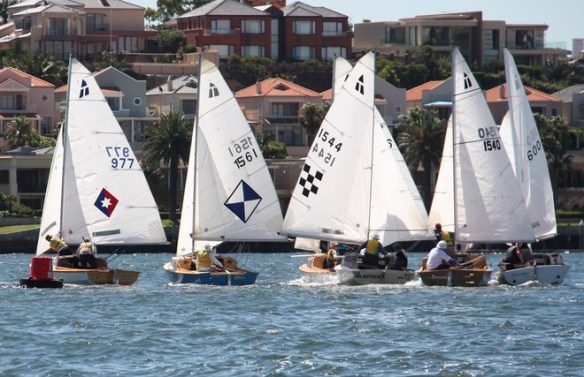
Running (going downwind) is the slowest point of sailing. Here are some tips they should help with running legs of a race.
Sit slightly toward the back – This is the opposite to the beat where you have to sit more forward, in the run you have to sit more backward. This is because the running boat naturally pushes the bow into the water creating drag or in especially high winds capsizing the boat. Instead sit slightly back and allow the bow to right itself.

Don’t go on a dead run – Dead runs slow down boats. The worst point of sail you can be on is a dead run as there is no aerodynamics creating forces. All that is pushing the boat along is the pressure of the wind against the sail. The fastest point of sail is the broad reach as there is a force created through the aerodynamics as well as the pressure of the wind against the sail. At all times try and get on to a broad reach to go to the next mark, because it is much, much faster than a dead run or even a training run. The sails are far more efficient at broad reaches than runs. You may have to weigh the speed gained to the most direct route when considering a run versus a broad reach.

Take off the kicker, cunningham and out haul – The whole point of these devices are to depower the sail on other points of sail. Make sure all these ropes are hanging loose and that the sail is at maximum power. To remember whether or not you have kept them on or off, check out the speed of other boats and see if they are traveling faster or slower than you and then tweak to compensate.

The next regatta is the Great Minnow on October 2. This is a one day race this year, so if committing to two days of racing has kept you from participating in the Great Minnow in the past, come on out this year and enjoy the last official race of the season.

Doug Roberts –  Racing Chair

The Racers Corner – Rounding Marks by Doug Roberts

Rounding Marks
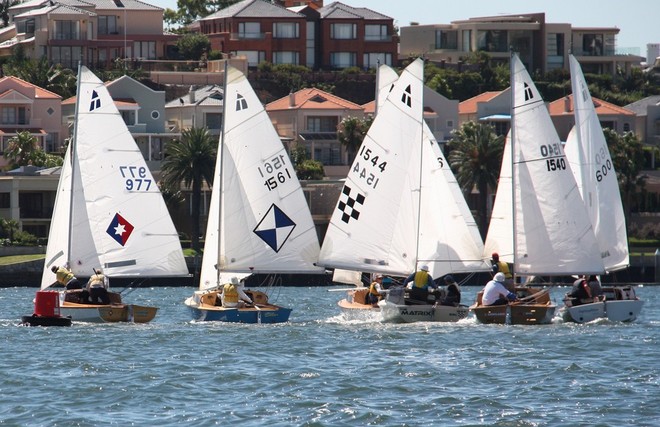
In a typical course, there are three marks: the windward mark, the gybe mark and the leeward mark. Of course all courses will be more complicated than this, but all marks can be assigned one of these types.
There are some great rules you can utilize at marks in order to take the advantage when you reach the mark.
• The windward rule – The windward rule is an important rule when approaching a mark and you are not overlapped at the 3 boat length point. It states that a windward boat must keep clear of a leeward boat (your boom is on the leeward side). This is very important at the windward mark, because it means that the leeward boat can push the windward boat further up in order for the leeward boat to go round the mark first. This only applies when the leeward boat’s bow or stern overlaps the windward boat’s bow or stern.
• Keep your wind – The boat behind you when you approach a mark on a beam reach will try to go windward of you so that they take your wind and you slow down. Instead of letting them take it go windward yourself and push them higher up on the course until they decide it isn’t worth it. Remember though that reaches are faster than going up wind so you have to calculate whether or not it is worth going up wind.
• The water rule – This is exclusively for mark rounding and states that the inside boat that has an overlap with in 3 boat lengths of the mark can call for water in which the outside boat must allow the inside boat room to round the mark. The rule has been changed in the ISAF 2009-2012 rulebook to 3 boat lengths and you must take this into account and work out if there is an overlap at that point or not. If there is an overlap call for water, if not make space for the outside boat to round the mark.
• Wide in and Tight out – This technique is used to start beating just as you round a leeward mark. If you go slightly lower to leeward than the mark and then tighten up as you round the mark, you should end up with a little burst of speed and be higher than a boat that doesn’t use this tactic.

Hopefully these tactics help you in rounding the marks and make for better finishes.

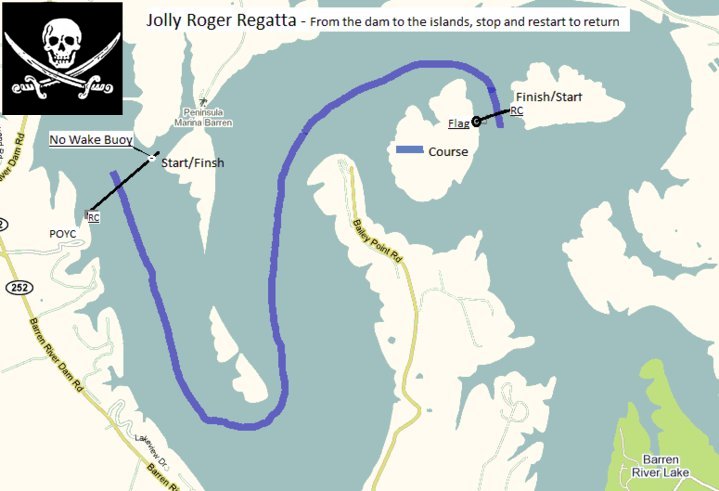
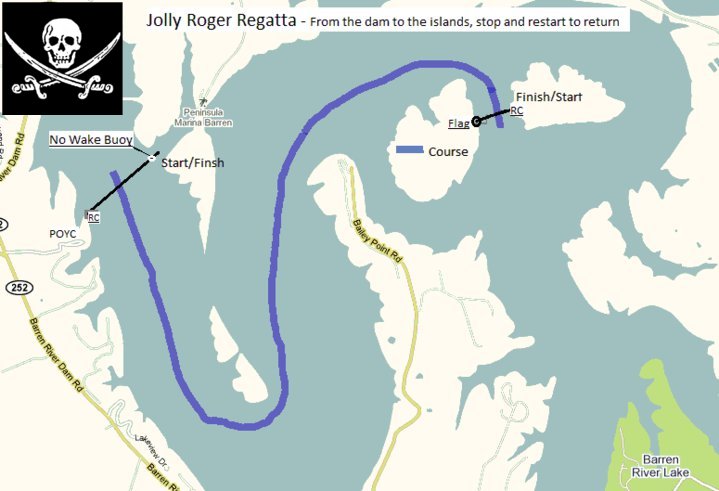
The Jolly Roger Long Distance Regatta – August 28th

This is a new event this year. Join us as we navigate to the far flung reaches of Barren River Lake.

Skippers meeting at 10:30 AM for an 11:00 AM start.
Cruisers – Dinghies – and Sunfish Classes – Cats too if we can get 4 boats. Dinner in the evening
For more Information or to RSVP see our event on the POYC Facebook page event section

We have special prize flags just for this event, see if you can snag one of them.