Results of the Jolly Roger Regatta

Results of the Jolly Roger Regatta:
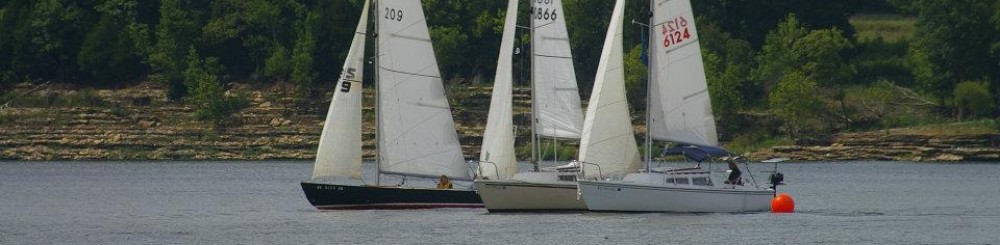
Dinghies: 3rd- Allen Graf, 2nd – Larry Caillouet, 1st Barry Sanders
Cruisers: 3rd – Kevin Klarer, 2nd – Bill Coleman, 1st Jim Seibert
Overall and Multi hull: 1st – Richard Seaton
Pictures: http://picasaweb.google.com/dmroberts07/JollyRogerRegatta2010#
Complete Timing and Scoring: http://groups.google.com/group/poyc/files

August Meeting Recap

Our Commodore, Bill Miller was in a motorcycle wreck and is now home mending after several injuries including a bruised lung, some broken ribs and a broken clavicle. Also in the sickbay were Bill Grapes and Herb Siewert although they are back out now as well. Our good wishes and prayers go out to these and all of our ailing mates. Our Purser reports that we are fiscally sound, although there is not much money left for frills. Please remember to pay your dues on time for the good of the club, and make sure to save energy by turning out the lights and turning off the fans when you leave. We would like to welcome a new member, RP Watson, who has recently purchased the Reimer’s old boat . They moved up in size and purchased Randy Edwards luxury yacht. Please say hello to RP and welcome him into our midst.
While the season got off to a slow start due to the high water, we are now in the midst of a flurry of races, the Jolly Roger Long Distance race is August 28th, followed a week later by the Dixe Cup on September 4th, and the Great Minnow on October 2nd. ( The Minnow will be a one day Regatta this year). Come on out and join in the fun. As we turn towards fall its the time to start thinking about scheduling our Fall Cleanup, which will be held on November 13th this year. Our Hardmaster Reimer is compiling a list of what needs to be done. We’ll report more on this as we get closer to the time.
Your Scribe Gary Guss

The Racers Corner – Rounding Marks by Doug Roberts

Rounding Marks
In a typical course, there are three marks: the windward mark, the gybe mark and the leeward mark. Of course all courses will be more complicated than this, but all marks can be assigned one of these types.
There are some great rules you can utilize at marks in order to take the advantage when you reach the mark.
• The windward rule – The windward rule is an important rule when approaching a mark and you are not overlapped at the 3 boat length point. It states that a windward boat must keep clear of a leeward boat (your boom is on the leeward side). This is very important at the windward mark, because it means that the leeward boat can push the windward boat further up in order for the leeward boat to go round the mark first. This only applies when the leeward boat’s bow or stern overlaps the windward boat’s bow or stern.
• Keep your wind – The boat behind you when you approach a mark on a beam reach will try to go windward of you so that they take your wind and you slow down. Instead of letting them take it go windward yourself and push them higher up on the course until they decide it isn’t worth it. Remember though that reaches are faster than going up wind so you have to calculate whether or not it is worth going up wind.
• The water rule – This is exclusively for mark rounding and states that the inside boat that has an overlap with in 3 boat lengths of the mark can call for water in which the outside boat must allow the inside boat room to round the mark. The rule has been changed in the ISAF 2009-2012 rulebook to 3 boat lengths and you must take this into account and work out if there is an overlap at that point or not. If there is an overlap call for water, if not make space for the outside boat to round the mark.
• Wide in and Tight out – This technique is used to start beating just as you round a leeward mark. If you go slightly lower to leeward than the mark and then tighten up as you round the mark, you should end up with a little burst of speed and be higher than a boat that doesn’t use this tactic.

Hopefully these tactics help you in rounding the marks and make for better finishes.

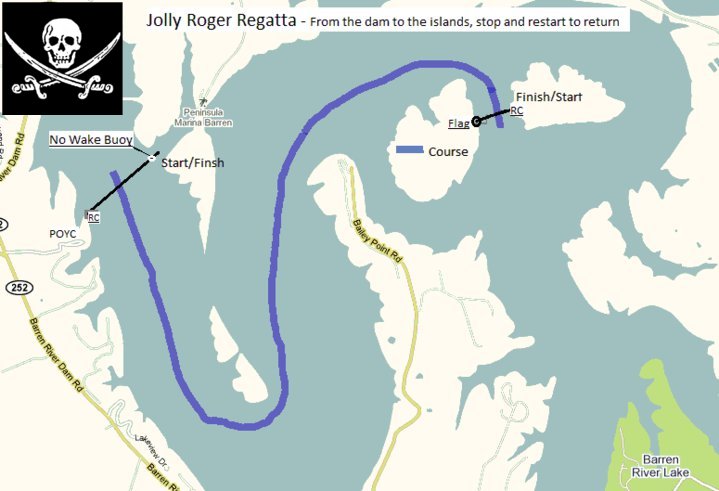
The Jolly Roger Long Distance Regatta – August 28th

This is a new event this year. Join us as we navigate to the far flung reaches of Barren River Lake.

Skippers meeting at 10:30 AM for an 11:00 AM start.
Cruisers – Dinghies – and Sunfish Classes – Cats too if we can get 4 boats. Dinner in the evening
For more Information or to RSVP see our event on the POYC Facebook page event section

We have special prize flags just for this event, see if you can snag one of them.

The Racer’s Corner – The Start and On the Beat

So you didn’t do as well as you wanted to in the first race of the season. This month we will review some tips that are sure to improve your ranking in the next race, the Huddleston Cup, July 24 & 25.
Tip Number One: The Start
The start is the most important part of any race and many novice sailors do not understand the significance of the start in relation to the rest of the race and this is where they go wrong.
The start is the single most important part of the race for most sailors as if they are only moderately skilled, a bad start will break them. Only very skilled and experienced sailors can claw back to the top from a bad start.I am expecting you to be quite good, but always coming between last and middle place. You want to start to get some wins under your belt.
Well look no further, the start is the most important part of the race.
Here is a list of strategies that you should use on the line if you want to have a good start and a potentially good race:
• Get a stop watch! – All serious sailing racers need a stop watch in order to start on time and in the right place without being caught unawares
• Learn the Flag types – The flags are there to tell you what is going on in a race. So not knowing them is hardly going to help you understand what is going on in the race. It is highly advisable to find a good rulebook from your national sailing organization or the ISAF (International Sailing Federation) and learn all the flag types that will be shown at any given race. Preparation make Perfect!
• Learn where the marks are – If you are thinking of club racing regularly, then you should learn where the common marks that are used for racing actually are so that when the committee boat shows the marks you don’t have to glance at a map constantly during the race.
• Do a Transit – This little known tactic is a very useful technique in order to have a good start. A transit is where you put the boat between the committee boat and the pin buoy and look for a recognizable object on the other side of the pin. This tells you exactly where the starting line is and if there is a black flag shown, you will know whether you are over the line or not.
• Find out if there is a bias – A biased line is one in which a certain tack is favoured. To find out if there is a port bias, a starboard bias or if it is square (no bias), you can do it accurately or roughly. Doing it accurately requires a compass. Go along your transit and note the compass bearing. Then add 90 degrees to that bearing and turn to that heading. If the boat tacks then the current tack is the favoured tack and the bias. If the boat doesn’t tack then the current tack is the favoured tack and the bias. If the boat goes head to wind then there is no bias and it is a square line. You can roughly do this by seeing if you are beating up one end of the line and broad reaching down the other end. If it is a square line then you should be beam reaching from one end to the other
Starting Position – This is also highly important for competitive racing. If there is a bias then most of the boats will be there. If you don’t want to be in a scrum and get a rubbish start, then start slightly lower than the bias end or start on the opposite tack and then tack on to the biased tack after horn goes off. By doing this you will have your own unique heading and start.
If you can master most of those tactics, then your starts will become better and better. Make sure that you go over the line on the horn and at full speed as well as using the above tips.
So now the boat has crossed the line. You are on the beat! Tip Number Two: The Beat
This is the hardest point of sailing to master and this is also where the fleet spreads out with the well trimmed and faster boats at the front while the untrimmed and slower boats lag at the back.
Here are some great tactics to try and improve your position on the beat.
• Keep the boat flat! – Another incredibly common past time that I see on the race course is boats heeling constantly though out the race. This is terrible for boat speed as the sail is pulled away from the wind. Make sure that the boat is flat at all times. To actually achieve this make make sure boat crew members are hiking out of the boat in a comfortable position. If this doesn’t help then let out some main sail and pinch (go further up wind), this should bring down the heel. the moment this happens pull the main sheet back in so that when the boat is flat the mainsail is fully in. This has the effect of a massive pump on the boat, which causes a burst of acceleration. Continue to do this throughout the beat and you will find yourself overtaking everyone who is heeling constantly, greatly improving your position. You can also use the kicker and cunningham in especially high winds to depower the sail and keep the boat flat, but you must remember to remove the kicker and cunningham when the wind dies down or there is a lull.
• Sit forward in the boat – When the boat is not heeling your crew should be sitting on the centreboard and you should be sitting up against the shroud. If you both sit forward the stern comes out of the water and the boat is no longer hampered by an extra dead weight in the water.
• Make sure that the slot is trimmed – The slot is the distance between the Genoa and the mainsail. If the slot is too small the airflow becomes constricted and the front bottom of the mainsail begins to luff. If the slot is too large the Genoa begins to luff. The slot must be trimmed correctly so that the Genoa is about one and a half inches off the leeward shroud so as to provide optimal airflow. This slot distance changes with wind speed so it must be constantly watched by the crew.
• Take lifts and avoid headers – Lifts and headers are where the wind changes direction. If the change is more to windward, it is called a lift and if the the change is more to leeward it is called a header. You should always take lifts and avoid headers by changing the boat’s direction. In a lift turn windward and in a header bear away. In big lifts you should always expect a large header, which could make you tack so be careful about overshooting and taking the lift too far. Lifts are useful by taking you more windward of your opponent, which means closer to the windward mark.
Follow these tips and you are sure to improve your position
Remember that a season champion for both Cruiser and Dinghy class racers will be awarded at the end of the season. The top scores for each skipper for 50% of the races in the 2010 season will count toward the calculation for the season championship in each class.
Doug Roberts – Racing Chair
July Meeting Minutes


The dock has been re-attached to the arms and the water is finally back down to almost summer pool, the lake is looking better every day and we will have a full schedule of racing coming up in the next few months.
The Huddleston cup will be held on July 24th and 25th this year. Bill Miller and Jeff Mitchell will be cooking roast pork butt. Commodore Miller will be handling the Committee boat duties, but could use another person to help with timing and flags. All mates are encouraged to come out and race.
Purser Sanders stated there are 15 people in arrears, which is a total of $2700 in fees owed the club. Barry will be sending out reminders and please pay your dues in a timely manner.
Barry is asking for permission to commission one more Sunfish for the club, he believes this can be done for a minimum amount of expense and will get used in the upcoming races.
We also need someone to step up and take some ownership to get the Coronado 15 that the club owns ready for the water, it needs some work on the mast stand and also some TLC. If you have an interest in this please contact Bill Miller or Barry Sanders.
We had an extremely high electric bill last month which we believe was mostly caused by the hot water heater leaking and running continuously . The water heater has been replaced thanks to Gary Reimer and Troy Monroe, and we now have plenty of hot water. In other electrical news, Debbie Champion mentioned that the lights are out on some of the poles and we will try to get these fixed for better security and improved visibility.
Commodore Miller stated that he has come to the club on several occasions and seen the fans and lights running with no one else present. Please remember to turn off all the lights and close and lock the shed and head if you are the last one to leave.  Do not the lock the gate to the premises. As per the Corp. of Engineer rules, it must be left open as we are considered a public ramp.
The Committee boat broke a steering cable before the Yankee Doodle and we had to steer it by hand, a new cable has been purchased  for $270 and  thanks to Max Vinson it has been hauled out so it can be repaired and used for the Huddleston Cup and the rest of the racing season.
Rob Wyatt is willing to teach another Sailing School in August or September, we are looking for a marketing type person to help publicize this effort and out reach. Contact Rob if you can help..
We now have a new giant first aid kit living in the shed which was donated by an anonymous benefactor.
Debbie Champion has posted a large weatherproof list in the pavilion so people can sign up to cook for regatta’s and meetings, we also need people to sign up for some of the regatta breakfasts. You will be re-imbursed for any expense.