Larry’s Adventures in Paradise

Part 3:  Pelée, Paris, and the Pitons
St. Pierre is the original capitol of Martinique but was completely destroyed by the eruption of Mt. Pelée in 1902.  It has been rebuilt on a smaller scale and looks like most Caribbean seaport villages with a prominent church in the center of town, a front street of small shops, a dock, and a variety of restaurants along the waterfront.  We ate dinner at La Tamaya, a tiny French restaurant at which we were the only customers.  As the French say, “Ooh la la!”

Next came Fort du France, known as the “Paris of the Caribbean.”  We took a ferry to it from our anchorage at Anse Mitan.  It was not as I remembered it. The city had a very worn look to it with too many shops closed, the park overgrown, and the cathedral under renovation.  So much for Paris.

The next day we set sail for St. Lucia with the intention of putting in at Rodney Bay on the northwest corner of the island.  The wind was so favorable we didn’t want to quit sailing so we skipped Rodney Bay and sailed on to Marigot Bay.  What a jewel!  It’s a long narrow bay with high mountains protecting it on three sides and it was delightfully prosperous.  Moorings Yacht Charters had expanded its facilities to include everything a sailor could want from provisioning to laundry to shops and even a spa with massage.  Best of all, there was a Customs and Immigration office in the complex! A fine Mahi Mahi Creole dinner at Juliet’s on the mountain at the end of the bay provided a postcard view of the sunset through the palm trees at Doolittle’s, the end of a perfect day.

Seeing an island from the sea is wonderful, but you don’t know the island until you have experienced it by land.  We rented a Honda CRV with its steering wheel on the wrong side and set off to see the Pitons and beyond.  The Pitons are the most amazing geological feature of the Caribbean.  From the water’s edge they stab at the sky like enormous shark’s teeth, 2400 and 2600 feet high.  They are the highest points on the island.  After admiring them from multiple view points on the twisting highway and fending off numerous vendors who wanted to tell us about the Pitons, we reached the ultimate observation point, Dasheen restaurant at Ladera Resort, a place we first fell in love with in 1993.  Perched on a ridge further back on the island, it looks down at the sea through Petit Piton and Gros Piton.  We finished the day by negotiating another two or three hundred hairpin curves around the southern tip of the island, up the Atlantic coast, across the central rain forest with its washed out roads, and back to Marigot Bay.

We thought it couldn’t get any better than that until we sailed from Marigot to Anse des Pitons, the cove between the two Pitons.  A local man in a boat named Believe It or Not came out to form a business relationship with us and I told him we wanted him to save us the best mooring at the foot of the Pitons.  Since it was late in the afternoon, we were afraid there would be no mooring balls, and it is illegal to anchor there.  He did his work by leading a catamaran that was ahead of us to a mooring in Soufriere Bay.  Then he came back and directed us to the only available mooring below the Pitons.  It was a pleasure doing business with him!  Soon after that a Rasta man in a boat named Distant Thunder came by to sell us bananas, mangoes, pineapples, and papayas.  After snorkeling at the foot of Petit Piton we concluded that this really was as good as it gets.

Part 4:  Sailing the Night Away
After a leisurely breakfast and more snorkeling at the Pitons, we slipped our mooring and set sail at noon.  It was a late start but we were counting on sailing 48 hours to Montserrat, so we knew we would be sailing all night, perhaps even two nights.  We would be sailing in the lee of St. Lucia, Martinique, Dominica, and Guadeloupe, so we set out about 12 miles offshore in hopes of having good wind.  We were blessed with a steady wind of 12-13 knots so we sailed along at 7-8 knots, significantly above the 5 knots we had used to estimate our sailing time.

Richard and Gretchen took the 9 p.m. to midnight watch.  Diana and I took the midnight to 3 a.m. watch, and I stayed up with Dan on the third watch until Richard relieved me at 4:30 a.m.  Night sailing was a pleasure, even if it interfered with getting a regular night’s sleep.  The night sky was beautiful, lights on the distant shores kept us company, and sunburn was no issue at all.  A couple of times when the wind died down we had to run the engine to maintain our desired minimum speed of 5 knots.  Clipping through the wide open Caribbean at night was a little spooky, but was a thrill.  At one point Diana noticed the faint lights of another vessel in the dim distance.  At night the chief danger is collision with another ship so we went on constant alert until we ascertained that it was a cargo vessel heading to Dominica, and though it was close to us it would not intersect us.

When morning dawned we had reached Les Saintes and the southern tip of Guadeloupe.  The wind was growing fickle so we motorsailed on toward Montserrat.  A gray naval warship drew our interest when it sped toward us, but apparently it wasn’t interested in us–it steamed past us and over the horizon toward Puerto Rico or Cuba.  Twice we were entertained by schools of dolphins.  They raced the boat and did circus tricks all around us.  From the bow I could count 8 or 10 adult dolphins weaving back and forth in front of the boat, sometimes coming so close that the boat almost touched them.  I think they had power in reserve and just enjoyed having something to play with.

We had planned to sail up the Atlantic side of Montserrat to avoid any ash that might be coming from Mt. Soufrierre, the volcano that destroyed half the island in 1995, but the wind shifted to a rare westerly breeze.  That would have put us in the lee of Montserrat and in the path of ash, so we tacked to port and sailed up the Caribbean coast instead.  This gave us a close-up view of the enormous lava flows that reached all the way down to the sea and extended the shore in several places.  It also covered the city of Plymouth leaving not much more than roof tops exposed to mark the place where the capital once thrived.

We reached Little Bay on the northwest corner of Montserrat at 5 p.m.  This gave us 90 minutes of daylight to anchor and relax over dinner.  While we were eating in the cockpit, a storm brewed up.  Then the most entertaining event of the day occurred–a waterspout develop about a hundred yards from us.  As we watched it, it moved toward us, hitting the boat next to us and bouncing it all around.  It missed us but hit another boat and rattled it strongly before reaching the shore and sucking the surf into it for a fascinating display of Mother Nature Power.  We’ve got photos and video of it to amuse ourselves later.

There was nothing special on Montserrat to keep us, so we set sail at 6:00 a.m. the next morning with St. Barts as our destination.  We saw the Kingdom of Redonda up close,  Nevis and St. Kitts in the distance, and finally St. Eustatius in the far distance.  We made good time and reached Gustavia harbor just before 6 p.m.  We had just enough daylight to find an anchorage in the crowded harbor.  The sun set as we set a big pot of chili on the table.

Today we will go into Gustavia to do customs and immigration, a little shopping, and wifi before sailing to Anse Columbier, a quiet bay with a lovely beach at the end of St. Barts that is only accessible by sea.

Attacked by Pirates ! by Larry Caillouet

A boat in a marina is not a great place to sleep, so after a wonderful dinner at a dockside restaurant we treated ourselves to a night in a hotel with real air conditioning. In the morning as we were getting dressed to go back to the boat and depart for Les Saintes, the phone in our room rang and it was Charlotte Bonin, the manager of the Sunsail base. With the sound of trouble in her voice she told us that during the night thieves had boarded Vagamonda, smashed the wooden doors to the companionway and robbed us. I had locked the hatches, the cockpit lockers, the dinghy and its outboard, and the companionway, but locks won’t stop a thief who is determined to get in. They must not have been onboard long because the left a lot of valuable things including money hidden in several places, but these marina pirates stole 3 cameras, my handheld GPS, my new Motorola Atrix smartphone, and even my sunglasses, a pair of shoes, and a pair of hiking shorts. Adding insult to the injury, they stole my backpack to haul off their plunder. Well, the joke is on them–the sunglasses were Oakley fakes.A platoon of French policemen came to take our statement and gawk at the scene of the crime. They told us that since they don’t file police reports on Sunday I would have to come to the police station on Monday to complete the report. I went postal on the police officers, slammed my legal pad on the cockpit table and asked “Are you going to rob me too? I’m paying hundreds of dollars per day for my vacation and you are going to steal a day from me?” In hopes of finding a Guadeloupe policeman who didn’t mind working on a day he or she was getting paid for, Charlotte took me to the police station anyway. It was as empty as a French church. We approached a policewoman who wandered through the lobby and asked her to take our report. She confirmed that they don’t do that on Sunday (even if they aren’t doing anything else). “Well, if I were stabbed on a Sunday, would I have to wait until Monday for you to file the report?” She filed the report.After finishing our police business we sailed out of Guadeloupe and crossed the channel to Les Saintes, a picture postcard grouping of seven small islands. The main town is Boug Le Saintes, a cute little village with narrow streets and well kept tile roofed houses spreading up the hillside. The harbor was full of boats but we found a nice anchorage with a panoramic view. We walked through the town, shopped a little, and hiked up to a lighted cross on the hill overlooking the harbor.We were a bit reluctant to leave Les Saintes, but Dominica awaited us about 25 miles to the south. We motored out of the harbor and after a small rain storm we raised the mainsail. A batten hung on a lazy jack, so I went forward to pull it loose. When the boat lurched in a puff of wind, I lost my grip and went tumbling backward. Three thoughts flashed through my mind: (1) I’m going overboard. (2) Ouch! I hit the deck. (3) Great–I’m still onboard. Following my latest attempt to win the Boat Bite 2011 award, we had a pleasant and uneventful sail into Prince Rupert Bay at Portsmouth, Dominica.In Prince Rupert we dealt with a local entrepreneur who went by the name of Lawrence of Arabia. He motored out to meet us in his bright yellow and green boat. We struck up a deal with him to watch and protect our boat while we toured the island the next day. We found out that Lawrence is a vertically integrated conglomerate–yacht security, water taxi, river tours, and land tours. His employee, Uncle Sam (actual name is Kenroy Liverpool) gave us an all day tour of Dominica the next day. We traveled through lush rainforest and down rugged Atlantic seacoast; we shopped handicrafts at the Carib Indian Reservation, the only place on earth where Carib Indians still live; we hiked to two waterfalls and the Emerald Pool high in the mountains; and finally arrived back at our boat. The boat was just as we had left it and it was good to be home.Today we sailed down the Caribbean coast of Dominica to Roseau, the capital. A man named Sea Cat sent Mark and Desmond to take care of us. They are friends of Lawrence of Arabia. We did some sightseeing and shopping in Roseau and will set sail for St. Pierre, Martinique in the morning.

Caribbean Adventure – by Larry Calliouet

The good ship Vagamonda, a Beneteau 51 like our Mary Jewell, left St. Martin on Monday for a short sail to St. Barts. After spending a day with the beautiful people (no, we didn’t see any glitterati) we motored 30 miles on a windless day to Saba, an island fraught with difficulties due to its extremely deep water, vertical shores with no beaches, and only one small manmade harbor behind a seawall.  The people of Saba live in five villages high on the island. At 800 feet altitude we reached a spotless town of white houses and red tile roofs, ironically named Bottom.  From there we went up another thousand feet to the village of Windwardside, named for an obvious reason. This incredibly steep island was very scenic and the diving was spectacular.

At the Carreenage in St. Barts

Next we went to St. Eustatius where we hiked up an extinct volcano and down into the crater which was covered with rain forest. After stops in St. Kitts and Nevis we arrived in Jolly Harbor, Antigua.  Antigua Race Week was going on, so we spent a day watching the races. From Shirley Heights between English Harbor and Falmouth Harbor we could see boats making mistakes that we would never make if we were racing . Down at Nelson’s Dockyard sailors, vendors, and spectators mingled, partied, and swapped stories, lies, excuses, and exaggerations.

Sailing conditions were exhilarating for the long haul from Antigua to Guadeloupe. Winds were 25 knots on the beam with gusts over 30, seas were mostly 8-10 feet with occasional 15 foot rollers, and skies were clear. With two reefs in the mainsail we covered the first 41 miles at 8-9 knots and occasionally touched 10 knots. If that wasn’t enough to write home about, big things began to happen 5 miles out of Deshaies, Guadeloupe. First the genoa halyard snapped.  The sail fell down the forestay and was whipping in the wind and water, not unlike some spinnaker problems we had witnessed in the Antigua races. We dropped the main and headed to windward.  The genoa on a cruising charter boat is heavy duty and stiff, so getting it down was a struggle, but we managed to stuff it into the forepeak cabin, the first time I ever thought that cabin was worth much except for storing empty luggage.  Then the cleat on the mast that the topping lift was secured to popped its rivets and pulled off. Down came the boom on the bimini.  That bent the frame and popped another rivet, but we used a small line to tie down the bimini frame until we could reorganize the boat and get some repairs made. Arriving in Deshaies was completely anticlimactic after all this, but we were glad to be in the harbor of this picturesque little French village.

After spending the night anchored in Deshaies harbor we motor sailed to Jacques Cousteau’s marine park at Pigeon Island where I scuba dived with a boatload of French people. The dive boat looked pretty rough, but after the first dive, they cleared off all the scuba gear from a platform on the boat and spread a pretty table cloth over it for lunch. The French take dining very seriously.

Today we set sail at 6:30 a.m. so that we could reach the Sunsail base in Marina bas du Fort, Point-a-Pitre, in time for boat repairs. It proved to be a historic occasion as we were this base’s very last customer–they are closing the base tomorrow. Sunsail’s British technician, who was holding the fort until the end, gamely climbed to the top of the mast in a bosun’s chair and installed a new halyard. While he was making this and other repairs, we were unloading garbage and upgrading our electronic capabilities, a local woman was cleaning the boat, and another woman was delivering provisions for the next two weeks. Such a beehive of activity! We will set sail tomorrow for Marie Galante or Ille des Saintes.

Larry

Pinching the Wind by Doug Roberts

Without wind there is no sailing.
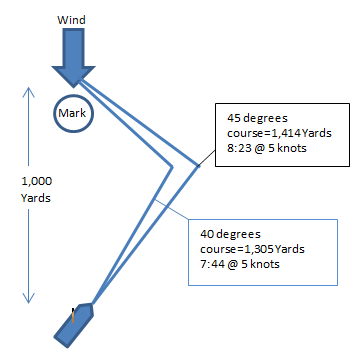
A good sailor knows exactly how high her boat will point into the wind while still maintaining the maximum velocity toward the destination.  This is especially true if you want to get from point A to B as fast as possible and point B is directly upwind.
Achieving maximum velocity toward the destination is a delicate balance between the shortened distance gained by pointing higher and the potential increased speed by falling off.

The chart demonstrates the time you can gain by pointing up 5 degrees, a little over half a minute for a typical leg of a POYC race.  However, if you give up more than 3/10 of a knot, you will have a net loss of time.

Practice, Practice, Practice
The only way to learn how well your boat can pinch the wind is to sail upwind and slowly swing the bow into the wind. When the sails start to luff, fall off until they fill. Work at broad reaching, gybing and running with the wind too.  Take something to measure your speed and see how much speed you give up by pinching the wind.  You should practice in all wind conditions.  During a race is not the time to experiment, so get out and practice sailing to a fixed buoy on the lake.

Knot of the Month for May – The Monkeys Fist

From Wikipedia ~
A monkey’s fist or monkey paw is a type of knot, so named because it looks somewhat like a small bunched fist/paw. It also looks somewhat like a volleyball or an older style football. It is tied at the end of a rope to serve as a weight, making it easier to throw, and also as an ornamental knot. This type of weighted rope can be used as an improvised weapon, called a slungshot by sailors. It was also used in the past as an anchor in rock climbing, by stuffing it into a crack, but this is obsolete and dangerous.

The monkey’s fist knot is most often used as the weight in a heaving line. The line would have the monkey’s fist on one end, an eye splice or bowline on the other, with about 30 feet (~10 meters) of line between. A lightweight feeder line would be tied to the bowline, then the weighted monkey’s fist could be hurled between ship and dock. The other end of the lightweight line would be attached to a heaver-weight line, allowing it to be drawn to the target easily.

The knot is usually tied around a small weight, such as a stone, marble, tight fold of paper, or a piece of wood. A thicker line will require a larger object in the center to hold the shape of the knot. Another variation of the monkey’s fist knot omits the use of an external object as a weight and rather uses the spare end which gets tucked back into the knot. This results in a nicer looking knot of a lesser weight, minimizing the potential danger of hurting someone with the knot when hauling line.
Monkey’s fists were also commonly used as melee weapons by sailors embroiled in street and tavern fights during the 19th century and the use of the monkey’s fist as a slungshot became common in the street gang subcultures of the 19th century. Similarly, when learning or practicing in the use of a Chinese meteor hammer, each end of the practice weapon is often tied off with a monkey’s fist knot.

Monkey’s fist’s are commonly used as a convenient and unobtrusive method of storing and transporting precious gemstones.[citation needed]

A monkey’s fist can be used on two ends of a tow lines of one side a fish net which is then thrown from one trawler to other, allowing the net to be cast and set between two boats so the trawl can be used between the two, in pair trawling[1] where the tow or catch is negotiated between both parties. This makes it easier to catch fish given the greater surface area between both boats to turn around and catch missed fish from the sea much quickly. Once all fish have been hauled up from the sea, tow lines of the fish net is returned by way of thrown both monkey’s fists back to the host trawler. Alternatively, a monkey fist can be used as a weight of a heaving line thrown to over to an opposing ship to bring two ships together.[2]

Click Here Monkey’s Fist Animation

ODE to ROPE

This is for our Commodore Debbie who has declared this the “Year of the Knot”

As I cast off for that very first time,
The “rope” in my hand has now become “line”.
And hauling the sails to the top of the mast,
That “rope”, now a “halyard” holds strong, taught and fast.
Then sailing in brisk winds full force on a beat.
The sails are trimmed in by that “rope” that’s a “sheet”.
And now at my anchorage with sails safely stowed,
I trust in that “rope” that now serves as a “rode”.
Through all my life I will never lose hope,
Of a reason or time to play with a rope.