This months knot is the Bowline, which all sailors should know… Here’s some links :
http://en.wikipedia.org/wiki/Bowline


This months knot is the Bowline, which all sailors should know… Here’s some links :
http://en.wikipedia.org/wiki/Bowline
Call to order and announce that Commodore Champion is in Florida ( The Scribe sez probably captured by Barren River lake pirates or something)
Recognize past Commodores:
Doug Roberts, Ronny Hendricks, Gary Reimer,
Barry Sanders, Herb Siewert and Lee Huddleston
Thanks to Faye Stinnet for cooking (marinated chicken with marinated peppers and onions with pasta) this month and Ronny for the country ham last month. Tim Hayes is signed up for June, We need volunteers for July, August and September. Please contact Alan Cannon or sign up on the sheet at the club.
Committee Reports:
Purser: Barry Sanders – the usual, bills are paid with money in the bank. Barry also mentioned that we have swapped Burgees with Boat US and one of our Burgees is hanging in their headquarters.
Race Committee: Doug Roberts – discussion of keeping the existing race schedule met with some resistance with the high water, but there were no changes except the Huddleston will be one day this year.
Yardmaster: Gary Reimer is looking at modifying swing arms for the ability to use dock and avoid moving it during high water, may schedule a work party during high water to paint the head, Please stay off of the dock until water is below the swing arms.
Scribe: Gary Guss: SLACKER – no report – some fishy excuse about daughters graduate school graduation.
Our big project for the year will be to replace the pavilion structure this winter, plans and drawings to come later. Met with significant discussion (opposition) some question the need for the replacement and are concerned about losing the rustic nature of the pavilion. Herb mentioned that some of our members have joined simply because of the rustic nature of the pavilion?????????

Artistic rendering of "New" Old Pavilion
A mention that the beer and drinks in the shed are primarily for club functions but are available to the membership at other times if you are in need of a cold drink. We ask that you donate drinks to replace what you drink.
Considering a voluntary “slip fee” for overnight dockage to offset increased operating costs, corps fees, and dock modifications to accommodate high water. Ask for suggestions for an appropriate daily rate. Another unpopular topic. It was mentioned that most of the people that use the dock are the people that show up at work parties and run sailing schools etc. There was mention that we should consider a dues structure that was higher where you could “work off” some of the dues by participating in work parties if we need to raise additional money. I explained that it was more equitable for those that use the dock to help pay for it and keep it maintained and that it was considered as a voluntary action.
 Have a vote for the best “Monkeys Fist” and award the prize. Max won the prize (a bunch of bananas) New knot for the month of June is the bowline, which is the knot I use most other than a cleat hitch. Makes a good secure loop at the end of a line and is easy to untie if it is not under a load.
Upcoming events:
5/21 9:30-11:30 Sailing class and at noon need boats to sail – Racing Rules by Rob Wyatt -Members Refresher
5/28 Huddleston Cup (one Day)
6/10 Next Monthly meeting
6/11 Jolly Roger long distance race
6/18 Summer Sailstice – raft up or movie night
Lee Huddleston mentioned that he had offered his vehicle to the executive board and had offered some suggestions to avoid the liability concerns. If the club does not want to accept his donation, he indicated that he would sell the vehicle and wondered if a consortium of members would like to jointly purchase it.
The Kafers mentioned that they were staying in the Coconut Grove Yacht Club in Key Biscayne and that POYC did not have reciprocal privileges with them. There was discussion as to whether we could accomplish a wider network of reciprocal privileges with other yacht clubs.
Any more business……….motion to adjourn
Alan Cannon – Vice Commodore
 Introduction to Racing Rules Class – Saturday 5/21
Understanding the rules of Sailboat Racing will increase your enjoyment of the sport. The most basic rules of Sailboat Racing are similar to the boating “rules of the road” that govern navigation and how boats interact when meeting each other. Understanding these right of way rules will greatly reduce the risk that you might injure yourself or damage your boat while participating in a race as well as improve your general sailing knowledge.
Four main right of way rules: [Part 2, Section A]
1. Boats on a port tack shall give way to boats on starboard tack (Rule 10).
2. When boats are on the same tack and overlapped, the boat to windward (the boat closest to the wind) shall keep clear of a leeward boat (Rule 11).
3. When boats are on the same tack and not overlapped, the boat that is astern shall keep clear of the boat ahead. (Rule 12).
4. When a boat is tacking (changing tack) it shall keep clear of boats that are not tacking Rule 13
Four rules with general limitations: [Part 2, Section B]
1. Even if you have right-of-way, it is your duty to avoid a collision, once it becomes apparent that the other boat is not giving way (Rule 14).
2. If you acquire right of way, you must initially give the other boat room to keep clear, unless you get right of way because of the other boat’s actions. [Rule 15]
3. A boat that changes course, even if it has the right-of-way, shall do so in a manner that gives the burdened boat a chance to “keep clear” and give way (Rule 16).
4. If you catch up with another boat and you want to pass it to leeward, you may not sail above you proper course i.e. you shall not luff higher than you would have done if that boat wasn’t there [Rule 17]
Rob will again conduct an introduction to racing rules class on Saturday, May 21st. This was a great session last year and really helped many of those new to racing sailboats get a basic understanding of the rules. It is also a good refresher for those of who have raced before, but have a question about the rules. Come on out to the club on Saturday morning (10 AM).
Part 3: Pelée, Paris, and the Pitons
St. Pierre is the original capitol of Martinique but was completely destroyed by the eruption of Mt. Pelée in 1902. It has been rebuilt on a smaller scale and looks like most Caribbean seaport villages with a prominent church in the center of town, a front street of small shops, a dock, and a variety of restaurants along the waterfront. We ate dinner at La Tamaya, a tiny French restaurant at which we were the only customers. As the French say, “Ooh la la!”
Next came Fort du France, known as the “Paris of the Caribbean.” We took a ferry to it from our anchorage at Anse Mitan. It was not as I remembered it. The city had a very worn look to it with too many shops closed, the park overgrown, and the cathedral under renovation. So much for Paris.
The next day we set sail for St. Lucia with the intention of putting in at Rodney Bay on the northwest corner of the island. The wind was so favorable we didn’t want to quit sailing so we skipped Rodney Bay and sailed on to Marigot Bay. What a jewel! It’s a long narrow bay with high mountains protecting it on three sides and it was delightfully prosperous. Moorings Yacht Charters had expanded its facilities to include everything a sailor could want from provisioning to laundry to shops and even a spa with massage. Best of all, there was a Customs and Immigration office in the complex! A fine Mahi Mahi Creole dinner at Juliet’s on the mountain at the end of the bay provided a postcard view of the sunset through the palm trees at Doolittle’s, the end of a perfect day.
Seeing an island from the sea is wonderful, but you don’t know the island until you have experienced it by land. We rented a Honda CRV with its steering wheel on the wrong side and set off to see the Pitons and beyond. The Pitons are the most amazing geological feature of the Caribbean. From the water’s edge they stab at the sky like enormous shark’s teeth, 2400 and 2600 feet high. They are the highest points on the island. After admiring them from multiple view points on the twisting highway and fending off numerous vendors who wanted to tell us about the Pitons, we reached the ultimate observation point, Dasheen restaurant at Ladera Resort, a place we first fell in love with in 1993. Perched on a ridge further back on the island, it looks down at the sea through Petit Piton and Gros Piton. We finished the day by negotiating another two or three hundred hairpin curves around the southern tip of the island, up the Atlantic coast, across the central rain forest with its washed out roads, and back to Marigot Bay.
We thought it couldn’t get any better than that until we sailed from Marigot to Anse des Pitons, the cove between the two Pitons. A local man in a boat named Believe It or Not came out to form a business relationship with us and I told him we wanted him to save us the best mooring at the foot of the Pitons. Since it was late in the afternoon, we were afraid there would be no mooring balls, and it is illegal to anchor there. He did his work by leading a catamaran that was ahead of us to a mooring in Soufriere Bay. Then he came back and directed us to the only available mooring below the Pitons. It was a pleasure doing business with him! Soon after that a Rasta man in a boat named Distant Thunder came by to sell us bananas, mangoes, pineapples, and papayas. After snorkeling at the foot of Petit Piton we concluded that this really was as good as it gets.
Part 4: Sailing the Night Away
After a leisurely breakfast and more snorkeling at the Pitons, we slipped our mooring and set sail at noon. It was a late start but we were counting on sailing 48 hours to Montserrat, so we knew we would be sailing all night, perhaps even two nights. We would be sailing in the lee of St. Lucia, Martinique, Dominica, and Guadeloupe, so we set out about 12 miles offshore in hopes of having good wind. We were blessed with a steady wind of 12-13 knots so we sailed along at 7-8 knots, significantly above the 5 knots we had used to estimate our sailing time.
Richard and Gretchen took the 9 p.m. to midnight watch. Diana and I took the midnight to 3 a.m. watch, and I stayed up with Dan on the third watch until Richard relieved me at 4:30 a.m. Night sailing was a pleasure, even if it interfered with getting a regular night’s sleep. The night sky was beautiful, lights on the distant shores kept us company, and sunburn was no issue at all. A couple of times when the wind died down we had to run the engine to maintain our desired minimum speed of 5 knots. Clipping through the wide open Caribbean at night was a little spooky, but was a thrill. At one point Diana noticed the faint lights of another vessel in the dim distance. At night the chief danger is collision with another ship so we went on constant alert until we ascertained that it was a cargo vessel heading to Dominica, and though it was close to us it would not intersect us.
When morning dawned we had reached Les Saintes and the southern tip of Guadeloupe. The wind was growing fickle so we motorsailed on toward Montserrat. A gray naval warship drew our interest when it sped toward us, but apparently it wasn’t interested in us–it steamed past us and over the horizon toward Puerto Rico or Cuba. Twice we were entertained by schools of dolphins. They raced the boat and did circus tricks all around us. From the bow I could count 8 or 10 adult dolphins weaving back and forth in front of the boat, sometimes coming so close that the boat almost touched them. I think they had power in reserve and just enjoyed having something to play with.
We had planned to sail up the Atlantic side of Montserrat to avoid any ash that might be coming from Mt. Soufrierre, the volcano that destroyed half the island in 1995, but the wind shifted to a rare westerly breeze. That would have put us in the lee of Montserrat and in the path of ash, so we tacked to port and sailed up the Caribbean coast instead. This gave us a close-up view of the enormous lava flows that reached all the way down to the sea and extended the shore in several places. It also covered the city of Plymouth leaving not much more than roof tops exposed to mark the place where the capital once thrived.
We reached Little Bay on the northwest corner of Montserrat at 5 p.m. This gave us 90 minutes of daylight to anchor and relax over dinner. While we were eating in the cockpit, a storm brewed up. Then the most entertaining event of the day occurred–a waterspout develop about a hundred yards from us. As we watched it, it moved toward us, hitting the boat next to us and bouncing it all around. It missed us but hit another boat and rattled it strongly before reaching the shore and sucking the surf into it for a fascinating display of Mother Nature Power. We’ve got photos and video of it to amuse ourselves later.
There was nothing special on Montserrat to keep us, so we set sail at 6:00 a.m. the next morning with St. Barts as our destination. We saw the Kingdom of Redonda up close, Nevis and St. Kitts in the distance, and finally St. Eustatius in the far distance. We made good time and reached Gustavia harbor just before 6 p.m. We had just enough daylight to find an anchorage in the crowded harbor. The sun set as we set a big pot of chili on the table.
Today we will go into Gustavia to do customs and immigration, a little shopping, and wifi before sailing to Anse Columbier, a quiet bay with a lovely beach at the end of St. Barts that is only accessible by sea.
 Don’t be scared ’cause its Friday the 13th… Potluck is 6PM at the lake, Faye Stinnet is cooking and please bring a dish to share. Monkey Fist knot is the knot of the month. The best knot will win an awesome prize or something from the Commodore.
The good ship Vagamonda, a Beneteau 51 like our Mary Jewell, left St. Martin on Monday for a short sail to St. Barts. After spending a day with the beautiful people (no, we didn’t see any glitterati) we motored 30 miles on a windless day to Saba, an island fraught with difficulties due to its extremely deep water, vertical shores with no beaches, and only one small manmade harbor behind a seawall. The people of Saba live in five villages high on the island. At 800 feet altitude we reached a spotless town of white houses and red tile roofs, ironically named Bottom. From there we went up another thousand feet to the village of Windwardside, named for an obvious reason. This incredibly steep island was very scenic and the diving was spectacular.
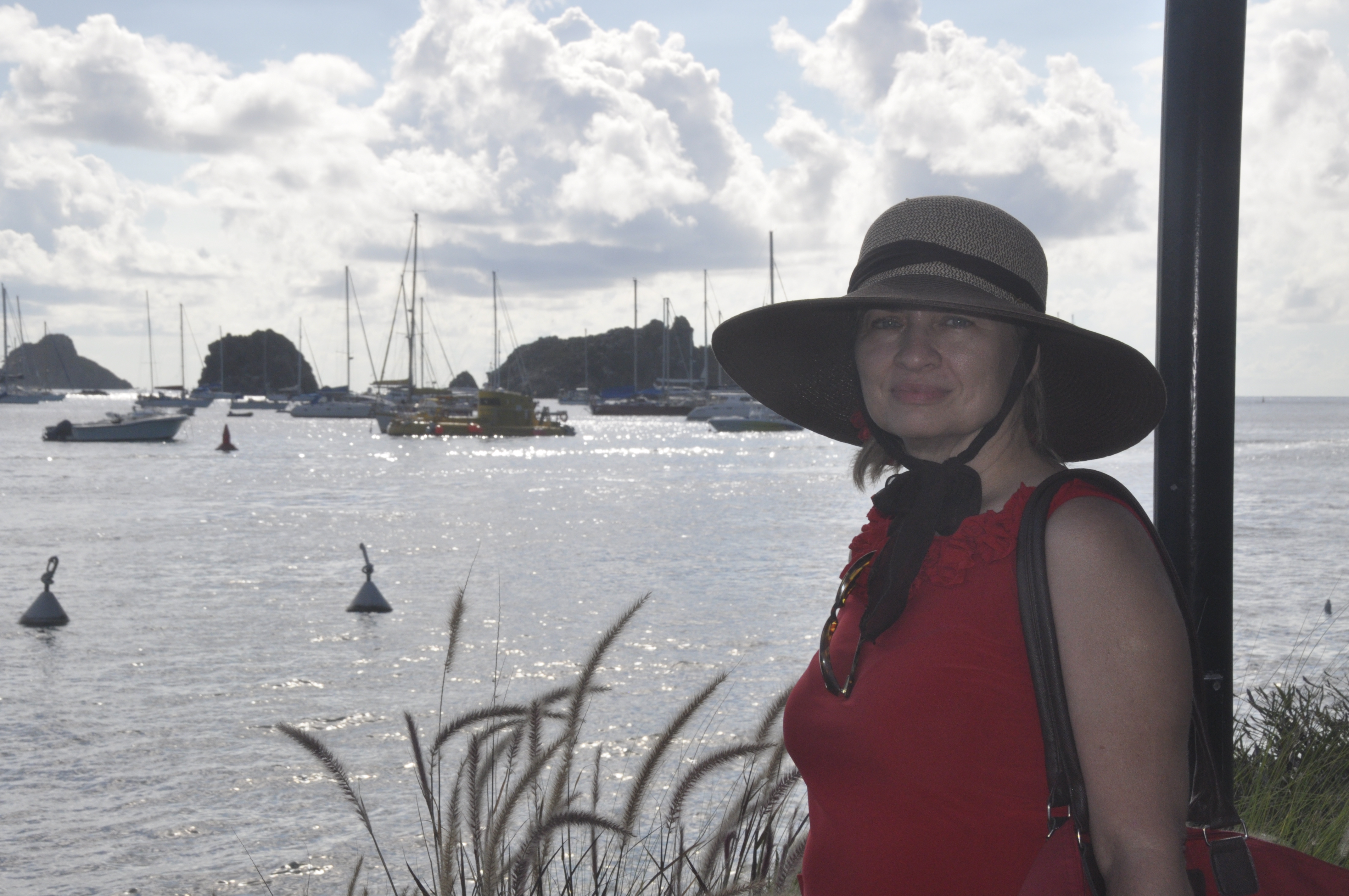
At the Carreenage in St. Barts
Next we went to St. Eustatius where we hiked up an extinct volcano and down into the crater which was covered with rain forest. After stops in St. Kitts and Nevis we arrived in Jolly Harbor, Antigua. Antigua Race Week was going on, so we spent a day watching the races. From Shirley Heights between English Harbor and Falmouth Harbor we could see boats making mistakes that we would never make if we were racing . Down at Nelson’s Dockyard sailors, vendors, and spectators mingled, partied, and swapped stories, lies, excuses, and exaggerations.
Sailing conditions were exhilarating for the long haul from Antigua to Guadeloupe. Winds were 25 knots on the beam with gusts over 30, seas were mostly 8-10 feet with occasional 15 foot rollers, and skies were clear. With two reefs in the mainsail we covered the first 41 miles at 8-9 knots and occasionally touched 10 knots. If that wasn’t enough to write home about, big things began to happen 5 miles out of Deshaies, Guadeloupe. First the genoa halyard snapped. The sail fell down the forestay and was whipping in the wind and water, not unlike some spinnaker problems we had witnessed in the Antigua races. We dropped the main and headed to windward. The genoa on a cruising charter boat is heavy duty and stiff, so getting it down was a struggle, but we managed to stuff it into the forepeak cabin, the first time I ever thought that cabin was worth much except for storing empty luggage. Then the cleat on the mast that the topping lift was secured to popped its rivets and pulled off. Down came the boom on the bimini. That bent the frame and popped another rivet, but we used a small line to tie down the bimini frame until we could reorganize the boat and get some repairs made. Arriving in Deshaies was completely anticlimactic after all this, but we were glad to be in the harbor of this picturesque little French village.
After spending the night anchored in Deshaies harbor we motor sailed to Jacques Cousteau’s marine park at Pigeon Island where I scuba dived with a boatload of French people. The dive boat looked pretty rough, but after the first dive, they cleared off all the scuba gear from a platform on the boat and spread a pretty table cloth over it for lunch. The French take dining very seriously.
Today we set sail at 6:30 a.m. so that we could reach the Sunsail base in Marina bas du Fort, Point-a-Pitre, in time for boat repairs. It proved to be a historic occasion as we were this base’s very last customer–they are closing the base tomorrow. Sunsail’s British technician, who was holding the fort until the end, gamely climbed to the top of the mast in a bosun’s chair and installed a new halyard. While he was making this and other repairs, we were unloading garbage and upgrading our electronic capabilities, a local woman was cleaning the boat, and another woman was delivering provisions for the next two weeks. Such a beehive of activity! We will set sail tomorrow for Marie Galante or Ille des Saintes.
Larry
Without wind there is no sailing.
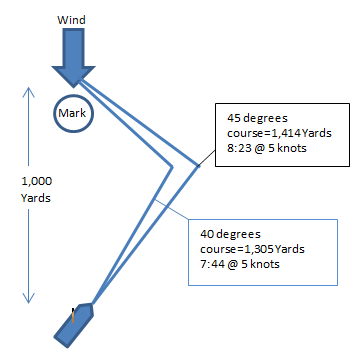
A good sailor knows exactly how high her boat will point into the wind while still maintaining the maximum velocity toward the destination. This is especially true if you want to get from point A to B as fast as possible and point B is directly upwind.
Achieving maximum velocity toward the destination is a delicate balance between the shortened distance gained by pointing higher and the potential increased speed by falling off.
The chart demonstrates the time you can gain by pointing up 5 degrees, a little over half a minute for a typical leg of a POYC race. However, if you give up more than 3/10 of a knot, you will have a net loss of time.
 Practice, Practice, Practice
The only way to learn how well your boat can pinch the wind is to sail upwind and slowly swing the bow into the wind. When the sails start to luff, fall off until they fill. Work at broad reaching, gybing and running with the wind too. Take something to measure your speed and see how much speed you give up by pinching the wind. You should practice in all wind conditions. During a race is not the time to experiment, so get out and practice sailing to a fixed buoy on the lake.
The first is the story of our member Nat Love who we lost earlier this year.
The second is our long time member Lee Ann Austin. Who just won the Jefferson Award for her tree planting efforts.
 Port Oliver Yacht Club - The Telltale